


Drone attacks have intensified in the city of El Obeid and its surroundings in central Sudan as the country's devastating war draws closer to the city, which is under army control, resulting in the deaths of large numbers of civilians in at least two incidents, according to residents.
The city is one of Sudan's most important cities and the capital of North Kordofan state, within the wider Kordofan region that lies between the Rapid Support Forces' stronghold in Darfur and the eastern half of the country under army control.
At around the same time, the militia's ground forces began taking control of cities and villages across Kordofan, imposing a siege on towns in South Kordofan state, according to residents.
The forces have not yet reached El Obeid, where daily life has continued despite the imminent threat and the departure of residents in late last year as the war escalated. The army and allied forces have deployed on the outskirts of the city.
Injuries among mourners
The war in Sudan broke out in April 2023 after the army and the Rapid Support Forces clashed over their roles in a planned political transition. The war has pushed half of the population toward hunger and famine and destroyed the country's economy. Drones have played an increasingly important role, with the Rapid Support Forces using them in particular to exploit the army's early air superiority.
It is difficult to estimate the total number of deaths caused by the conflict, although researchers point to at least tens of thousands killed. According to the United Nations Office of the High Commissioner for Human Rights, more than 100 civilians were killed in the first half of December across Kordofan.
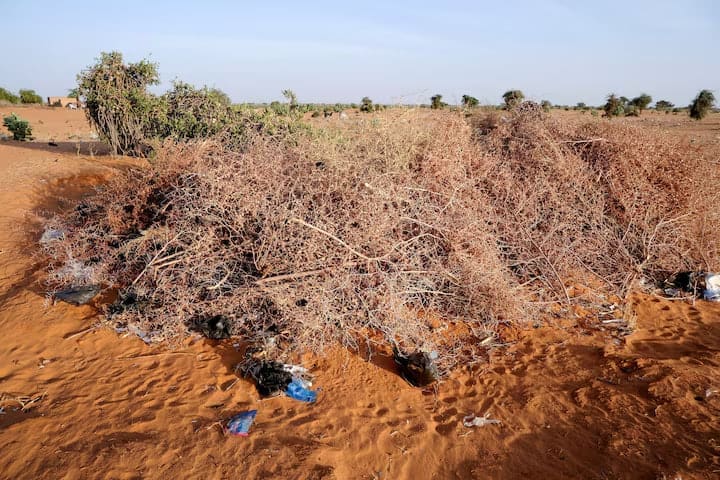
A cemetery for victims of a drone attack in El Obeid, North Kordofan state, Sudan, 14 January 2026.
In the El Obeid area, residents said the worst incident occurred on 5 November in the village of Al-Luwayb. Dozens had gathered from distant areas to attend a funeral when an ambulance belonging to a joint force allied with the army passed by, and a drone followed shortly afterwards.
This incident reflects the repeated attacks documented by Reuters in El Fasher, Darfur, near or on ambulances and clinics, which the Rapid Support Forces claimed were sheltering hostile forces.
Eyewitness Safaa Hassan, who had burn marks on her arms and a shrapnel wound in her leg, said: "We were sitting and suddenly the drone hit us. I went out and felt something hit me and I did not know what it was. They told me it was a drone. The courtyard was full of women."
Residents added that the bodies of the victims, some torn apart by the explosion, were later buried in a mass grave.
Reuters was unable to independently verify the accounts, and the Rapid Support Forces did not respond to a request for comment.
"Children under the rubble"
More recently, in early January, a drone strike killed the wife of Abdullah Mohamed Ahmed, seven of his grandchildren, and two of his female relatives, when it hit the house in El Obeid that he had rented after fleeing their village following a Rapid Support Forces attack.
These are among some 43,000 people who fled their homes in North Kordofan, and some 65,000 people who fled the whole region between late October and 31 December, according to the International Organization for Migration of the United Nations.
Musa Adam, a neighbour who was present at the time of the attack, said: "We found the children under the rubble, under the iron, and under the beds. Only God knows the condition of the children."
Ahmed said of the Rapid Support Forces: "They could not achieve their objectives that they were seeking, so they began killing and terrorising citizens."
Satellite images obtained by researchers at Yale University have confirmed that the house was indeed targeted.
Source: Reuters.


