

As the "Rijal al-Fajr" initiative from Algeria spread widely, reaching the mosques of many Arab and Islamic countries, media outlets circulated an account stating that the initiative began in the Ain Kebira area of Sétif Province with the participation of six children, before moving to Bordj Bou Arréridj.
However, local testimonies and media statements from those running the initiative call this account into question, and shed light on the role played by Quran teacher Sheikh Omar Aissaoui and the Quranic school affiliated with the Abu Bakr al-Siddiq Mosque in Bordj Bou Arréridj Province.
Out of fairness to the originator of the idea, and in care to attribute efforts to those who made them, Wasl has followed a number of testimonies and sources concerning the initiative's origins, and has corrected the reference to its starting point in our previous coverage.
A testimony from the people of Bordj Bou Arréridj
A local source familiar with the activities of the Abu Bakr al-Siddiq Mosque told Wasl that Sheikh Omar Aissaoui comes from Bordj Bou Arréridj Province, works at the Quranic school affiliated with the mosque, and is one of the students of its imam, Sheikh Walid Mehssas.
The source confirmed that the children participating in the initiative, and the Quranic school that hosts them, belong to the same province, expressing surprise at the spread of the account that attributes the initiative's launch to Sétif.
This testimony is supported by an interview published by the website Dzair Tube with Aissaoui as the initiative's originator, as well as coverage by the Awras website that documented the participation of children from Bordj Bou Arréridj in the activity.
Who is Sheikh Omar Aissaoui?
According to the local testimony, Sheikh Omar Aissaoui is a teacher of the Holy Quran at the Quranic school affiliated with the Abu Bakr al-Siddiq Mosque, and is among those responsible for raising young people and connecting them to the mosque.
In his interview with Dzair Tube, he spoke of an educational experience whose idea dates back about four years, based on encouraging young students to pray the Fajr prayer in congregation, providing them with breakfast and honouring them, alongside the sporting and recreational activities organised by the Quranic school.
These statements show that the experience predates its media fame by several years, and that it is part of an educational effort that goes beyond merely organising gatherings for the Fajr prayer.
Interview with Sheikh Omar Aissaoui on Dzair Tube
The mosque that drew the world's attention with a scene of mercy
Abu Bakr al-Siddiq Mosque in Bordj Bou Arréridj Province
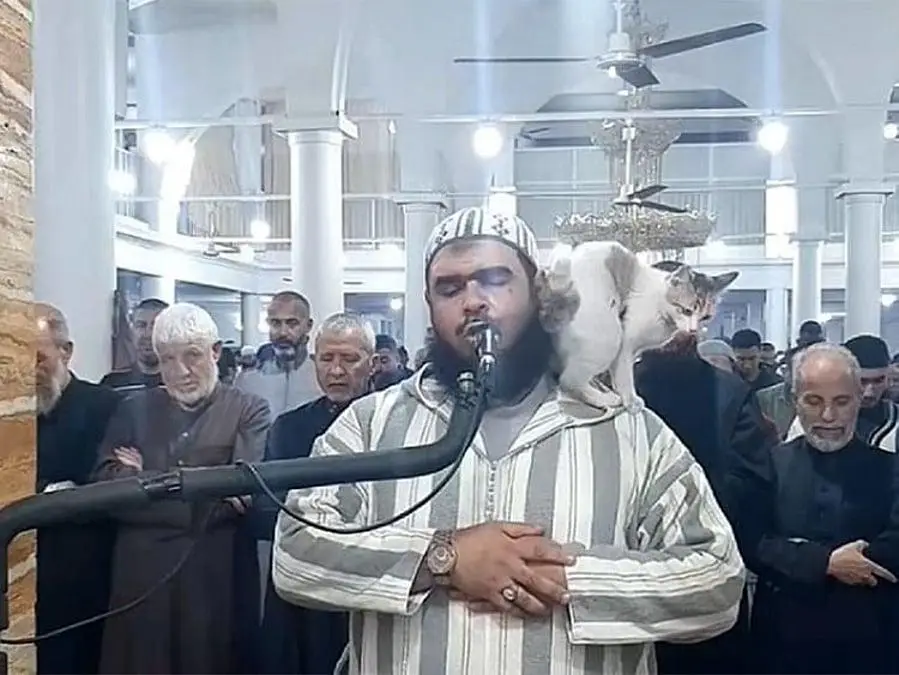
It is a notable coincidence that the Abu Bakr al-Siddiq Mosque in Bordj Bou Arréridj Province is the same mosque that caught the world's attention in Ramadan 1444 AH / 2023 CE, when a video clip of its imam, Sheikh Walid Mehssas, spread, in which a cat climbed onto his shoulder while he was leading worshippers in the Tarawih prayer, and he handled it gently and continued his recitation.
The Algerian Ministry of Religious Affairs and Endowments documented in a statement dated 8 April 2023 the name of the sheikh, the mosque and its location in Bordj Bou Arréridj, while the Algerian newspaper Echorouk covered the clip's worldwide spread.
Today the mosque returns to the spotlight through the "Rijal al-Fajr" initiative, which, according to the local testimony, is overseen by one of Sheikh Walid Mehssas's students, Quran teacher Sheikh Omar Aissaoui.
The mosque that the world knew yesterday for a scene of mercy and gentleness is known today for a scene of upbringing and of instilling love of prayer in the hearts of young people. Between these two scenes appear aspects of the mosque's message in Islam: a message of faith, mercy, teaching and the building of the human being.
Reviewing the circulated account
The existence of similar activities in Sétif or other Algerian provinces does not contradict documenting the role of the Quran teacher Omar Aissaoui in Bordj Bou Arréridj. However, repeating a media account does not replace returning to those who lived the experience themselves.
The evidence we have received at Wasl confirms the connection of Aissaoui's experience to Bordj Bou Arréridj, and this episode reveals one of the ills of media work in an age of speed and wide circulation: relying on the fame of a source instead of verifying the accuracy of the information. The spread of a report is not evidence of its truth, and its circulation through major media platforms is no guarantee of its accuracy.
An error may start from a single source, and then dozens of platforms repeat it without verification, so that the multitude of those relaying it gives the impression of many sources, and major platforms follow, and the error spreads like wildfire, even though all the accounts trace back to a single origin whose truthfulness was never checked. Hence the importance of verification, of returning to primary sources and to those concerned, and of not placing media scoops above the integrity of reporting. Speed of circulation, for all the opportunities it offers to spread knowledge and good, can become an ill that entrenches false information, obscures the efforts of its true owners, and makes correcting an error harder than preventing it in the first place.
It is not media integrity to merely repeat what has spread; it is to check its accuracy, and to move quickly to correct it once an error becomes clear. Returning to the truth is a virtue, and persisting in an error once it has come to light is a breach of trust.
Years of upbringing before the moment of fame
The most important thing revealed by Sheikh Omar Aissaoui's testimony is that behind the moving scenes that circulate lie years of educational work.
What appears in clips lasting only a few minutes may be the fruit of years of teaching, patience, follow-up and encouragement, and of building a bond between the child, the mosque and the Quran teacher.
It was not the initiative's fame that created this work; rather, the work that preceded the fame is what gave it its content and its impact.
Sheikh Walid himself speaks about the origins of the "Rijal al-Fajr" initiative
Recognising those who made the effort
The purpose of correcting the circulated account is not to enter into a competition between Algeria's provinces, nor to diminish the efforts of those behind similar initiatives, but to fulfil the duty of media integrity and to credit merit to its rightful owners.
Sétif, Bordj Bou Arréridj and all of Algeria's cities host efforts in teaching the Quran and raising young people, and the spread of these experiences across the Islamic world is a cause for pride in all of them.
Nevertheless, Sheikh Omar Aissaoui, the Quranic school and the Abu Bakr al-Siddiq Mosque have a right to have their role made known, and not to have the details of their efforts lost among the circulating accounts.
Just as good work deserves to be published and celebrated, its people deserve to be treated fairly, and their story told as it happened, not as the circulating accounts have left it.
Perhaps the finest gift to these educators, alongside prayers for them, is for the fruits of their efforts to multiply in the mosques of Muslims, and for every Quran teacher to find in their experience an inspiration for creativity, patience and the good upbringing of generations.
Sources
- Interview with Sheikh Omar Aissaoui on Dzair Tube.
- Awras coverage of the "Rijal al-Fajr" initiative.
- Statement of the Algerian Ministry of Religious Affairs and Endowments regarding Sheikh Walid Mehssas.
- Local testimony and video clips received by Wasl.


