

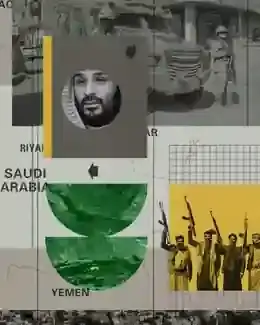
A report published by The Atlantic on Saturday, 21 November 2026, revealed growing Saudi concern over the expanding military capabilities of the Iran-backed Houthi group, amid rapid battlefield developments in Yemen and warnings that the confrontation could move onto Saudi territory.
The report's author, journalist Robert F. Worth, described the group's transformation as approaching a model resembling "North Korea in the Arab world," a reference to a highly isolated and heavily armed entity that relies on ideological mobilisation and missile capabilities and poses a threat extending beyond Yemen's borders.
The report is based on interviews the author conducted in the Saudi capital, Riyadh, during October of this year with Saudi and Yemeni officials, military officers and analysts, including sources whose identities the magazine did not disclose.
A Rising Threat to Saudi Arabia
The author opened his report by describing a meeting with a Yemeni military officer in one of Riyadh's luxury shopping centres, while the officer explained the course of fighting with the Houthis in southern Yemen.
During the meeting, warnings of a missile attack were sounded, followed by explosions after missiles were intercepted, a scene the author considered an indication that the war's repercussions had reached daily life in the Saudi capital.
The report noted that the repeated missile attacks demonstrated the Houthis' ability to threaten vital Saudi installations and economic facilities, at a time when the kingdom was focusing on economic and technological transformation projects and reducing its dependence on oil.
According to Saudi and Yemeni officials, Riyadh now treats the Houthi threat with greater seriousness than before and is working to strengthen its border defences.
The report stated that Saudi Arabia has concluded agreements to bring in thousands of military personnel from Pakistan and Syria to help protect its border with Yemen. The author attributed this information to his sources and did not provide independent documents to substantiate its details.
Worth argues that the nature of the Houthi threat places Saudi Arabia before a military challenge it cannot meet by relying on foreign forces alone, particularly if the war spreads into its territory.
External Support and Advances in Arms Production
The report devoted considerable space to the development of Houthi military capabilities, noting that the group is no longer limited to the conventional weapons it used in earlier phases of the war, and has expanded its production of missiles and drones and developed guidance and communications systems.
The author said the Houthis have benefited from studying the Russia-Ukraine war, and from modern technologies including fibre-optic guidance and artificial intelligence tools.
He noted information suggesting the group used the artificial intelligence tool "Claude" to improve guided missile technologies, but the report did not provide sufficient technical detail to allow independent verification of the nature of this use.
On the subject of external support, Worth cited a senior Saudi official as saying that Iran coordinated with the Houthis on a military escalation in the Red Sea, and that a plane belonging to Mahan Air transported military equipment and experts to areas under group control, including Iranian, Lebanese and North Korean personnel.
The official also claimed that Russia sent a large shipment of weapons and technology to the Houthis, concealed within a shipment of wheat.
However, the author cautioned that some details of the Saudi account may be exaggerated, noting that Saudi officials seek greater American military support.
Accordingly, these claims, particularly those concerning military shipments and the participation of North Korea and Russia, remain allegations attributed to the report's sources and are not facts independently verified by the magazine.
Bab al-Mandab, Taiz and Aden: The Battle for the South
The report links the growing Houthi capabilities to the military developments in southern Yemen since last September.
According to the author's account, the Houthis launched a broad offensive during which they took control of the Bab al-Mandab strait area, one of the most important maritime passages for international trade, before the Saudi-backed Yemeni government forces organised a counteroffensive to retake the areas they had lost.
He noted that the forces backed by Riyadh announced on 15 November their withdrawal from the vicinity of Bab al-Mandab, after limited gains achieved during October.
In Taiz, the report addressed the siege imposed by the Houthi group on the city, warning of the possible military repercussions of its fall for the governorate of Aden, which the internationally recognised Yemeni government has adopted as its seat.
The author quoted Henry Thompson, an expert on Yemeni affairs who has previously worked with the United Nations, as questioning whether defensive preparations to protect Aden are adequate, while noting that some defensive movements had appeared in recent days.
He also quoted a member of the Yemeni government whom he met in Riyadh offering a pessimistic assessment of the possibility of a Houthi advance towards Aden. This assessment reflects its source's concerns and does not establish that the city's fall is imminent.
Hodeidah Tunnels: Underground Fortifications
Among the most prominent details in the report was its discussion of a network of tunnels and fortifications that the Houthis are believed to be building in areas under their control, particularly the coastal city of Hodeidah.
It noted that some seizures of shipments bound for Houthi-held ports uncovered equipment used for digging tunnels, including drilling tools and ventilation systems.
The report quoted Yemeni analyst Mohammed al-Basha, founder of Basha Report, a company specialising in geopolitical risk, as saying that the Houthis have built in Hodeidah "a city beneath the city."
Al-Basha considered that any attempt to take Hodeidah militarily could face major difficulties because of the underground fortifications.
However, the report did not provide independent maps or images showing the scale of the alleged tunnel network, so details regarding its extent and nature remain attributed to the sources who described them.
Divisions Hinder Efforts to Confront the Houthis
The Atlantic report did not limit itself to the Houthis' strength but also addressed weaknesses in the camp opposed to them.
The author quoted a Yemeni officer as saying that government forces and their allies suffer from deep political and regional divisions, including rivalry between factions linked to the Islah party and other forces, as well as the tendency of some southern forces toward a secessionist project rather than prioritising confrontation with the Houthis.
The officer said the Houthis are aware of the extent of these divisions and exploit them to their advantage.
The report also criticised the Saudi management of the Yemeni file, citing problems including delayed salaries, weak coordination and military support mechanisms, and comparing this with the United Arab Emirates' experience in training and arming the Yemeni forces allied with it.
The author considered that the UAE's withdrawal from the military confrontation with the Houthis, against the background of disputes with Saudi Arabia, has weakened the camp opposed to the group.
By contrast, a Saudi official was quoted as saying that the kingdom seeks, in the long term, to build a larger and more unified Yemeni army capable of recovering territory and reducing Houthi military capabilities.
However, the report questioned how easily this goal could be achieved while disputes among Yemeni forces continue.
Will the Houthis Open a Front Against Saudi Arabia?
The report addressed a scenario that a number of officials and analysts the author spoke with considered a potential danger in the coming phase: the shift of Houthi operations from the southern front inside Yemen to a northern front targeting Saudi territory.
Worth said the people he met expressed their belief that the Houthis could open a new front towards Saudi Arabia, which would place the kingdom in a direct confrontation that is difficult to treat as merely an internal Yemeni conflict.
This scenario, however, remains an assessment of future risks, not an announcement of a confirmed Houthi military plan or a specific timetable for its implementation.
The author argues that the Houthis' continued ability to target Saudi airports and oil facilities gives the group important leverage, even if the Saudi-backed Yemeni government forces manage to recover some territory.
The report also cited Nadwa al-Dawsari, of the Middle East Institute, as believing that anti-Houthi forces may find it difficult to shift the balance of power without direct American air support.
The Houthis and Expanding Influence into the Horn of Africa
The report also raised the question of Houthi activity outside Yemen, describing the group's relations and contacts with armed actors and local groups in several Horn of Africa countries.
According to the author, the Houthis seek to build networks of support, training and cooperation in Somalia, Djibouti, Eritrea, Ethiopia, Kenya and Sudan, in a manner resembling some of Iran's methods of establishing ties with regional armed groups.
The report did not provide independently documented details of the scale of these relations or the nature of the cooperation. They should therefore be treated as information and assessments offered by the author that require further verification.
A War Extending Beyond Yemen's Borders
The Atlantic report concludes that the Houthis have become a regional challenge extending beyond the scope of the Yemeni war, having acquired missile and drone capabilities that allow them to threaten international navigation and vital installations in neighbouring countries.
The author believes Saudi Arabia faces a dilemma: it needs to curb this threat, while the Yemeni camp opposed to the Houthis suffers from weak coordination, and the United States hesitates to engage in broader direct military involvement.
However, the most serious scenario the report discusses, a Houthi invasion of Saudi territory, remains a projection put forward by its sources rather than a confirmed military development.
While the author warns of the Houthi-controlled areas turning into a highly isolated military entity resembling North Korea, the alleged scale of external support for the group, the nature of its fortifications and its future military plans remain matters many of which require independent evidence.
Overall, the report reveals growing concern over the Houthis' ability to prolong and widen the war, amid continuing Yemeni divisions and regional competition over the country's future.


