


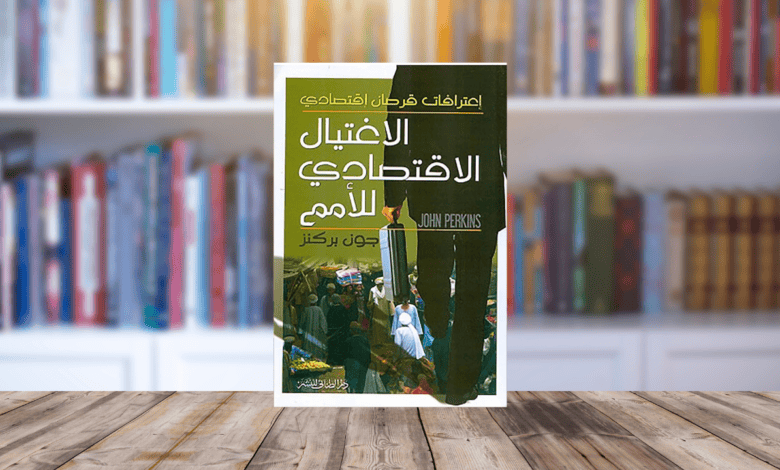
The book by John Perkins that revealed how countries are driven toward economic dependency
In 2004, the American author and economist John Perkins published "Confessions of an Economic Hit Man", which was translated into more than 30 languages and within a few years became one of the most controversial books on the relationship between economics, politics and international power. The book is not a traditional academic study in political economy, nor an intelligence document in the strict sense, but a blend of memoir, political confession and critical reading of the international economic system, in which Perkins recounts what he says was his personal experience within a system that aimed to use loans and large development projects to expand American influence and that of multinational corporations in developing countries.
Key points addressed in the book
- "Economic hit men" and domination through debt: Perkins describes how developing countries are drowned in huge debts through loans for excessive infrastructure projects, leading to their economic and political dependency on dominant powers.
- Hidden tools of control: According to the book, these "hit men" rely on falsifying financial reports, bribery and blackmail, and in extreme cases, threats and assassinations to tighten their grip.
- The goal: influence without direct military violence: This strategy aims to serve the interests of large corporations and dominant states without the need for military intervention, using debt as an effective weapon.
John Perkins was born on 28 January 1945 in Hanover, New Hampshire, USA. He attended Tilton School and then studied for a time at Middlebury College before receiving a bachelor's degree in business administration from Boston University in 1968. After graduating he joined the US Peace Corps and served as a volunteer in Ecuador between 1968 and 1970, an experience that placed him for the first time in an international environment outside the United States.
He then began working during the 1970s at Chas. T. Main, a consulting firm in Boston, where he later held the position of chief economist. Available professional biographies indicate that he worked at the company between 1971 and 1980, before moving in the 1980s into the field of independent energy, and later devoting himself to writing and public activity.
Why did Perkins expose these facts?
Perkins indicates that his motives for writing the book were deep and personal. He felt the need to reveal these facts, especially after the events of 11 September 2001, when he saw how those events were exploited to justify new wars and growing economic domination. Perkins said he faced threats to his life and the lives of his family while writing the book, which underlines the sensitivity of the information he disclosed and the importance of his message.
What is meant by the "economic hit man"?
The term that gave the book its title is Economic Hit Man. According to Perkins's account, it does not refer to a person who carries a weapon or carries out assassinations, but to an economic expert or consultant who uses gentler tools: figures, economic forecasts, loans, giant projects, and relations between corporations and governments.
The basic idea Perkins puts forward is that modern control no longer always requires direct military occupation. A powerful state can achieve a large part of its aims by creating economic dependence.
A developing country goes to an international financial institution or obtains financing for a huge project, and is persuaded that the project will achieve high growth rates, create jobs and double the gross domestic product, making it more prosperous. But if the size of the debt exceeds the state's ability to repay, the project turns from a tool of development into a long-term obligation.
This is the structure the book seeks to draw attention to. The idea is not that international loans are bad in themselves; states need to borrow to finance infrastructure and investment. The question Perkins raises is: who determines the size of the loan? Who chooses the project? Who benefits from the money? And who bears the cost of failure?
Tools and tactics used
Perkins explains that the work of the "economic hit man" goes beyond merely providing loans. It includes a wide range of unethical tactics, such as:
- Falsifying financial reports: Economic forecasts for infrastructure projects are inflated to make loans appear attractive and sustainable on paper.
- Bribery and blackmail: Bribes are used to persuade local leaders to accept these deals, and if they resist, blackmail or threats are resorted to.
- "Jackals": In cases where leaders refuse to cooperate or try to escape this dependency, the "jackals" step in. These are agents specialised in toppling governments or assassinating their leaders to secure the continuation of dominant interests.
Second: when the economy becomes an extension of politics
The most important aspect of the book is that it attempts to transfer the concept of empire from the military field to the economic field. Traditional empires relied on armies, military bases and direct occupation. The economic empire, in the picture Perkins presents, can operate with less visible and more complex tools.
Thus, in its first form, the matter does not appear as a process of control, but as a development project. This point is the most important in the book, because Perkins does not say that control always comes through forcing the state to do something it does not want, but through limiting the options available to it.
A state that has become indebted to the tune of billions of dollars does not deal with the world from the position of a fully independent state; it must take into account its creditors, financing institutions, markets and the companies linked to the project, and thus debt turns from a mere figure in the budget into a political factor.
Third: developing countries at the heart of the narrative
Perkins places a number of countries at the heart of his story, most notably Indonesia, Panama, Ecuador, Saudi Arabia, Iran and Colombia, and presents each case as a model of a different way of exercising influence.
In Indonesia, he describes his first experience with the world of the "economic hit man", where the task was, according to his account, to build economic models that justified pumping huge investments and loans into infrastructure projects.
In Panama, Perkins links economics, politics and sovereignty, and dwells on the figure of Panamanian President Omar Torrijos, who was among the most prominent political figures to appear in the book.
In Ecuador, the book turns to the oil file and the relationship between natural resources and the interests of large corporations. It then addresses the death of Ecuadorian President Jaime Roldós in a plane crash in 1981, as well as the death of Torrijos in the same year.
Fourth: Saudi Arabia and the "petrodollar deal"
One of the most intriguing chapters of the book concerns Saudi Arabia, where Perkins recounts what he describes as an economic-political "deal" aimed at recycling Saudi oil revenues within the American economic system, so that the money would be invested in the United States and return in the form of investments, contracts and projects, in exchange for political and security guarantees.
Regardless of how accurate all the details Perkins narrates are, the chapter opens an important door to understanding the relationship between oil, the dollar, security and American foreign policy during the decades that followed the oil shock of the 1970s.
Oil was not merely a commodity, the dollar was not merely a currency, and investment was not merely an economic decision. All these elements intertwined with security, energy, trade and foreign policy.
Hence emerges one of the most important ideas of the book: that separating economics from politics in international relations may at times be an artificial exercise, because money, energy, trade and debt can perform political functions as much as economic ones.
International financial institutions as tools for reshaping decisions
Perkins goes on to dismantle the relationship between economics and politics, placing international financial institutions at the heart of the system he describes. A loan, in his view, is not merely a financial transaction between creditor and debtor; it can become a means of reshaping the priorities of the borrowing state, especially when the state is in urgent need of external financing.
According to the narrative he presents, the process begins with studying the state's needs, then identifying projects that can be financed, and preparing economic estimates that appear capable of justifying the size of the borrowing. The larger the project, the higher the value of the contracts obtained by large corporations, while the state that owns the project remains responsible for repaying the loan and its interest over many years.
Here financing becomes part of political decision-making, because a state that relies increasingly on external loans finds itself compelled to take into account the interests of those providing the financing, whether the matter concerns economic conditions, political orientations or international positions.
Giant projects and the making of dependency
Perkins pays great attention to the idea of giant projects, such as power plants, dams, roads, airports and oil and infrastructure projects.
A project does not end once it is built, as it entails operating and maintenance costs and loan repayments, in addition to obligations tied to the implementing companies and suppliers.
The state is thus faced with a complex equation: the larger the project, the greater the need for financing; the more financing, the greater the volume of obligations; and the more obligations, the more the economic decision becomes tied to the outside.
This view reveals a shift in the concept of development from merely increasing production to a broader question concerning who holds the instruments of development financing and who sets its priorities.
Oil: the wealth that becomes a source of conflict
Oil occupies a central position in the book, not only as an economic resource but as one of the most important sources of geopolitical power in the world. States that possess vast oil reserves hold a resource that can reshape the balance of power, and so their natural wealth becomes a focus of attention for major powers and global corporations.
Through the cases he reviews, Perkins links oil with foreign investment, major contracts and foreign policy, explaining that control over resources does not necessarily mean owning them directly, but may be achieved by influencing how they are extracted, marketed and financed, and how their revenues are directed.
Thus oil appears in the book as a link between economics, security and international politics.
When political leadership stands against the system
Among the figures to whom Perkins gives extensive space is Panamanian President Omar Torrijos, whom he presents as a model of a leader who tried to preserve a degree of independence in the face of foreign interests.
The book does not stop at Torrijos as an isolated political case, but makes him part of a broader question: what happens when a political leadership refuses to accept the conditions imposed by the balance of economic power?
In this context, Perkins links political independence with control over resources, and the state's ability to make its decisions away from external economic pressure.
The narrative shows that the struggle over the Panama Canal was in his view not merely a dispute over a strategic waterway, but part of a broader struggle over sovereignty, wealth and influence, and the state's right to control its resources and strategic passages.
From "economic hit man" to "jackal"
In the structure of his book, Perkins presents a graduated picture of the instruments of control. In the first stage appears the "economic hit man", who relies on reports, economic forecasts, financing and persuading governments to accept projects and loans.
If economic means and covert pressure fail, the military option remains, so the three tools form a single sequence: the economy first, covert operations second, and military force last.
In this way the book presents a system that does not rely on a single instrument, but has multiple levels of pressure, beginning with soft tools and ending with hard ones.
Major corporations at the heart of the equation
Perkins does not separate the interests of major powers from those of multinational corporations; he presents the relationship between them as one of the essential keys to understanding global political economy.
Corporations need markets, resources and contracts, while states need economic and strategic influence, and so interests intersect.
When a major corporation obtains a contract to implement a project in a developing country, it does not achieve only commercial profits; it becomes part of an economic network extending to banks, financing institutions and governments.
The corporation thus turns from a separate economic entity into a party within a broader web of interests. Perkins emphasises that major corporations, through their financial strength and international reach, can become influential in decisions concerning energy, infrastructure, natural resources and markets.
The economy as a new language of power
Through the overall cases he recounts, the book reaches a central idea: that power in the modern age is no longer measured only by the number of soldiers or the size of military arsenals.
A state that possesses vast financial capacity, global corporations, a strong banking system, a currency of influence and the ability to finance projects can exert wide influence over other countries without sending a single soldier. In this way national economies become part of the system of international power.
Perkins thus broadens the concept of power from the military field to an interlocking network of economic, political and strategic tools.
The price paid by states and peoples
The book does not view debts as abstract financial figures, but links them to the lives of societies. Servicing debt means deducting part of the state's resources over many years, and can affect its ability to spend on education, health and public services.
When a state becomes obliged to meet huge financial commitments, its economic choices narrow, and it may be forced to reorder its priorities in line with its capacity to honour its obligations.
The human being behind the figures
Ultimately, Perkins returns the issue to its human dimension. The economy, in his view, should not be measured only by growth rates, output and foreign investment, but by what it means for people's lives.
If gross domestic product rises while poverty persists, if giant projects are built while basic services decline, and if investments multiply while debts grow, then the question of the nature of development becomes more important than celebrating the size of projects.
Towards a new understanding of international relations
At its close, "Confessions of an Economic Hit Man" presents a picture of the world as a network of intertwined interests, in which governments, corporations, banks, financial institutions, natural resources and markets overlap.
In this network, conflict is not always openly declared, nor does it necessarily appear as a direct confrontation between two states. It may begin with an investment contract, an infrastructure project, an oil agreement or a long-term loan, and then develop into an economic relationship that leaves its marks on political decision-making and national sovereignty.
Thus the book moves from recounting personal experiences to raising a broader question about the nature of the global order and the mechanisms by which influence is produced within it.
When the economy becomes one of the arenas of struggle over sovereignty
At its core, Confessions of an Economic Hit Man confronts the reader with a world in which politics is not separated from economics, security is not separated from energy, and debt is not separated from sovereignty.
Through John Perkins's personal experience, the book moves between countries, projects, companies and governments to present a comprehensive picture of how economic instruments can be turned into instruments of political influence.
The path does not always begin with tanks. It may begin with an economic study, then a loan, then a project, then a contract, then a long-term financial obligation. When these links accumulate, the relationship between the borrowing state and the financing parties becomes deeper than a purely financial relationship; it becomes a relationship that reshapes the balances of power, decision-making and sovereignty.
Here lies the central idea the book leaves with the reader: that understanding international politics in the modern era cannot be completed by studying armies and wars alone. It also requires looking at the movement of money, the flow of investment, networks of companies, energy markets, financial institutions and infrastructure projects.


