

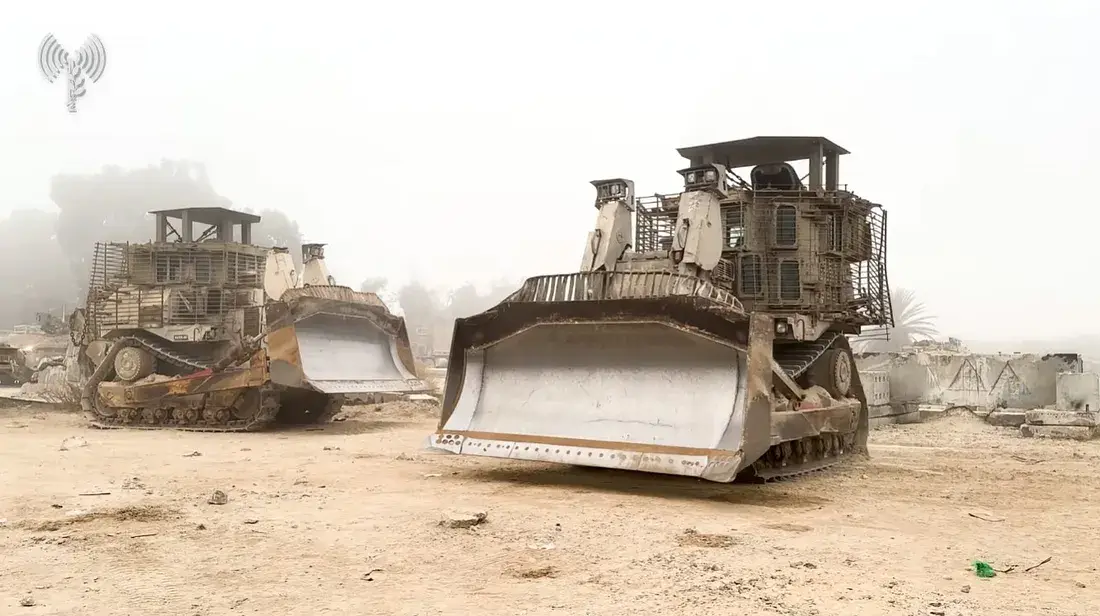
Large-scale Israeli operations to remove, crush and transport the rubble of destroyed neighbourhoods in the Gaza Strip have raised growing human rights concerns that they could erase criminal evidence and cause the loss of the remains of thousands of Palestinians still buried under the debris, at a time when violations committed during the war are subject to international investigations and legal proceedings.
The Palestinian Center for Missing and Forcibly Disappeared Persons warned that Israeli forces are transporting hundreds of tonnes of rubble daily from destroyed neighbourhoods located within closed military zones. It considered that the use of heavy machinery to break up and move the rubble before it is examined could crush human remains or mix them with stones and waste, in addition to obliterating burial sites and destroying DNA and other forensic evidence that could reveal the identities of victims or the fate of the missing.
Estimates of the number of missing persons still under the rubble vary, but the Palestinian authorities and the Civil Defence speak of more than eight thousand people whose bodies are believed to remain inside the destroyed buildings. The United Nations Special Rapporteur on the situation of human rights in the Palestinian territories, Francesca Albanese, affirmed that removing rubble in this manner may destroy evidence linked to grave crimes and prevent the recovery of the victims' remains, stressing the need to collect evidence and identify bodies before comprehensive rubble removal operations are carried out.
The warnings gain greater significance given the enormous scale of destruction in the Strip. The United Nations estimates there are about 61 million tonnes of rubble in Gaza, while other joint estimates by the World Bank, the United Nations and the European Union point to larger quantities, depending on the periods covered by the assessments.
The Euro-Mediterranean Human Rights Monitor said in a report issued in August that at least 10 million tonnes of rubble had already been removed, crushed or transported from their original locations within areas under Israeli military control. The Monitor said it had recorded in the preceding weeks around 100 trucks a day leaving the Gaza Strip loaded with rubble for undisclosed sites inside "Israel" and areas in the south of the occupied West Bank.
According to the report, some 400 heavy machines for excavation, demolition, crushing and transport, operated by Israeli civilian companies under military protection, are taking part in extensive operations in the east and south of the Gaza Strip. It noted that the Israeli authorities have not provided detailed data on the volume of materials transported or their final destinations, and have not allowed independent monitoring of the sorting and transport operations, which makes tracing any remains or potential evidence within the rubble extremely difficult.
The problem does not lie in the rubble as mere building remains. Destroyed sites may contain weapon fragments, traces of blood, personal belongings and human remains, as well as information that could help investigators determine how the attacks were carried out, the type of weapon used, and where the victims were when they were killed. Human rights specialists say that changing the original location of these materials, or mixing and transporting them, can break what is known in criminal investigations as the "chain of custody" of evidence, making their later use considerably more difficult.
The new warning came days after painful scenes in the Al-Zaytoun neighbourhood of Gaza City, where Palestinians on Sunday buried the remains of about 100 people, including around 60 children, recovered after years from under the rubble of buildings destroyed by Israeli strikes. The Civil Defence in Gaza said that a shortage of heavy equipment continues to hinder the recovery of thousands of other bodies.
A Legal Obligation to Preserve Evidence
The file also carries a crucial legal dimension. In January 2024, the International Court of Justice issued provisional measures in the case brought by South Africa against "Israel" under the Genocide Convention, and ordered "Israel" to take effective measures to prevent the destruction and ensure the preservation of evidence related to acts falling within Articles II and III of the Convention.
The Court reaffirmed this obligation in May 2024, calling for guaranteed access to the Gaza Strip, without obstruction, for commissions of inquiry, fact-finding missions and international bodies tasked with investigating allegations of genocide, in order to preserve evidence. To date, the Court has not issued its final judgment on the merits of the genocide case itself.
The Euro-Mediterranean Human Rights Monitor says that removing sites before forensic teams and independent investigators can examine them could lead to the destruction of materials of judicial value, and deprive thousands of Palestinian families of knowing the fate of their relatives, recovering their remains and burying them appropriately.
The Israeli Ministry of Foreign Affairs, the Prime Minister's Office and the Israeli army did not respond to a Reuters request for comment on Albanese's warnings about rubble removal. "Israel" generally rejects accusations of genocide, and says it has targeted the Hamas movement and taken measures to minimise civilian casualties.
As talk of reconstructing Gaza begins, demands are growing that bulldozers should be preceded by search and forensic teams, not the other way around. Among tens of millions of tonnes of concrete there are not only the remains of homes, schools and hospitals, but also the remains of the missing and potential sites of investigation, and evidence that may be lost permanently once it is crushed and moved from its place.
For the thousands of families still waiting to learn the fate of their sons and daughters, the battle over the rubble is not only a matter of reconstruction, but a struggle for the right to know the fate of the missing, to preserve evidence, and to hold those responsible for the crimes committed in Gaza to account.


