


Violence broke out in the Somali capital, Mogadishu, where government forces and militias allied with the opposition exchanged gunfire ahead of a planned demonstration against the government, causing damage to buildings and forcing residents to flee.
The clashes began on Wednesday and continued until Thursday, ahead of planned protests against President Hassan Sheikh Mohamud's decision to extend his mandate despite its expiry last month.
The move has also led to the postponement of elections, angering the opposition, which regards it as Mahmoud's plan to concentrate power. The government has denied these allegations.
The opposition called for a peaceful demonstration on Thursday.
The Associated Press reported large numbers of people on the streets and a heavy security presence with police patrols. The police said the violence resulted from "organised attacks" and linked it to political groups seeking to entrench their power.
This marks a new political upheaval for the Western-backed Somali government, which has been fighting the al-Shabaab movement since 2007. The last election held in Somalia was in 1969, after which a civil war tore the country apart for more than 30 years.
The sound of gunfire and explosions was heard in several neighbourhoods of Mogadishu. A resident, Abdullah Mohamed, told the Associated Press: "We heard heavy gunfire, and people were fleeing their homes."
Former prime minister Hassan Ali Khaire, who said he is being targeted by security forces, sharply criticised the government in a post on X, saying it is using "heavy weapons" designed "for conventional military operations".
He said: "These are weapons entrusted to the Somali state to fight al-Shabaab, and now they are being directed against Somalia's leaders and its citizens in an unprecedented campaign of political repression and targeted assassinations".
He added that "civilian infrastructure has not been spared destruction" and that electricity supplies were "deliberately disrupted".
"Mortar shells and weapons"
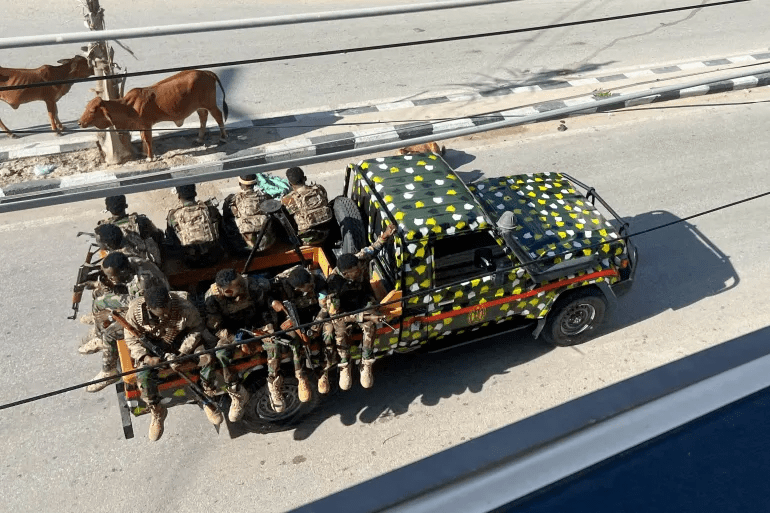
Civilians face the risk of becoming collateral victims in the fallout of the conflict between the two warring political factions.
Ahmed Ismail, a Mogadishu resident, told Reuters: "A mortar shell fell on my neighbour's house, injuring a mother. A large house near us also caught fire. Mortar shells and other weapons fell on it".
Another eyewitness, Mahmoud Farah, told Reuters that two armoured vehicles were set on fire.
No official reports of casualties were issued. Fighting subsided by 9:30 a.m. (06:30 GMT) on Thursday, according to Agence France-Presse, as the government and the opposition began talks between them.
A security analyst, who asked not to be named, told Agence France-Presse there had been "civilian casualties in some areas".
The African Union called for restraint, expressing deep concern over the clashes in residential areas. The European Union supported this position, as did the US Embassy in Mogadishu.
Mahmoud is not the first Somali president to try to remain in office after his term ended.
Former president Mohamed Abdullah Farmajo remained in office for more than a year after his term officially ended in 2021, which led to violence and condemnation from the international community.
News agencies


