


On the banks of the Yamuna River in northern India stands Agra, one of the cities most closely tied to the memory of Islamic civilisation in the Indian subcontinent. Its name has been linked to the Mughal state since its beginnings, and under the Mughals it became a political capital and a centre of administration, trade, the arts and architecture.
While the Taj Mahal has made the name of Agra present in the world's memory, the city's history is older and broader than this famous monument. It was the capital of an empire whose territory extended over large parts of the Indian subcontinent, and it witnessed, during the reigns of Akbar, Jahangir and Shah Jahan, one of the most flourishing phases of Mughal architecture.
From the Founding by Sikandar Lodi to the Arrival of Babur
The rise of Agra in Islamic history is associated with Sultan Sikandar Lodi, one of the sultans of the Lodi dynasty, who made the city an important centre of his rule at the beginning of the tenth century AH / sixteenth century CE.
Official sources in the Agra district state that Sikandar Lodi founded the city in approximately 910 AH / 1504 CE, after which it became the seat of rule of his son Ibrahim Lodi.
The greater transformation, however, came after the First Battle of Panipat in 932 AH / 1526 CE, when Zahir ud-Din Muhammad Babur defeated Sultan Ibrahim Lodi, and Agra entered a new phase with the establishment of the Mughal state in India.
Babur: The Beginning of Mughal Change
Babur was not merely a military conqueror; he brought with him architectural and cultural traditions from the Islamic world of Central Asia.
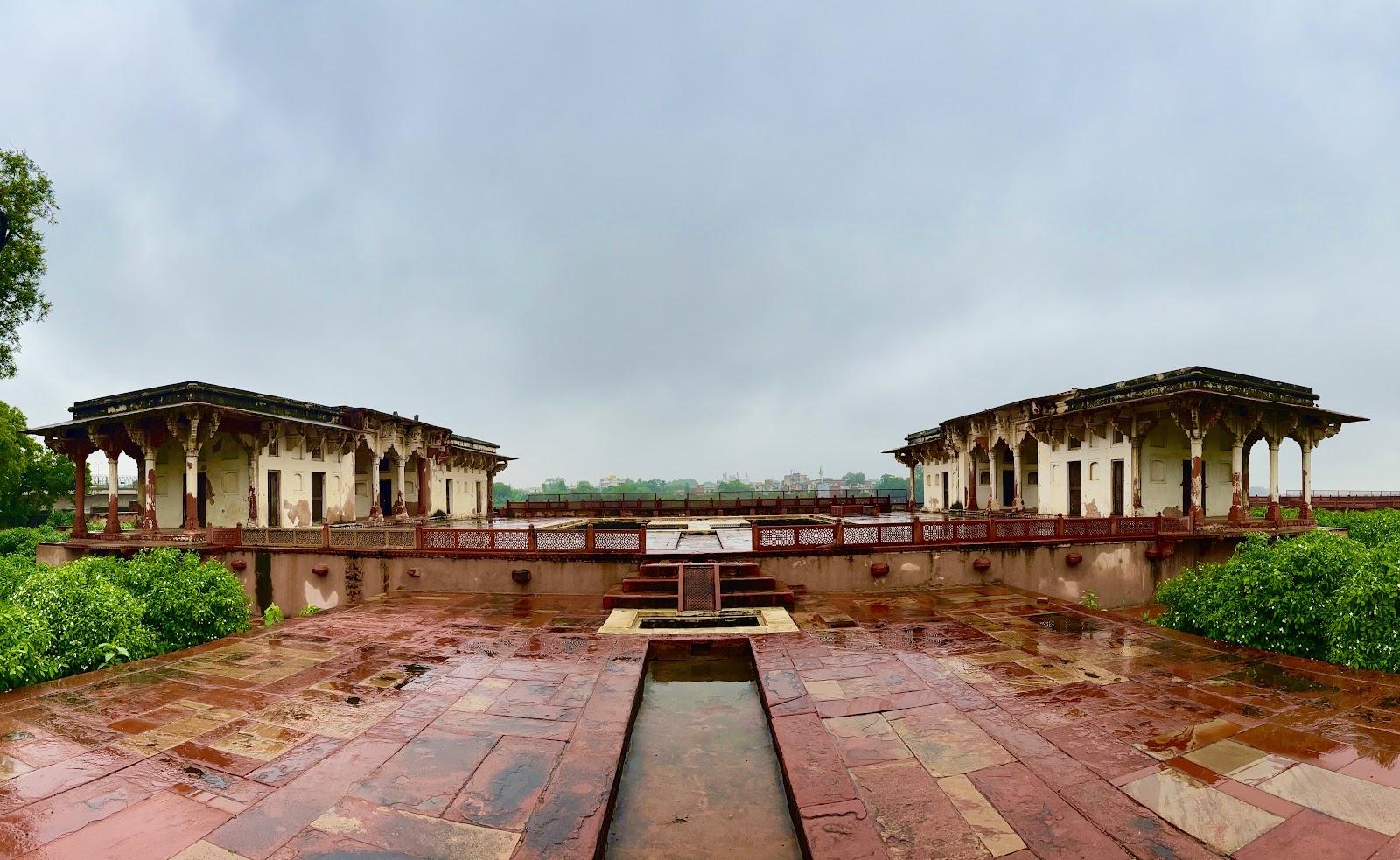
Among the first things he took interest in at Agra was the creation of gardens, the most famous of which is Ram Bagh, which was connected to Persian traditions of garden design, where water, geometric axes and green spaces formed a single composition.
Babur's project, however, was not completed during his reign, as not long afterwards the empire moved into a more consolidated phase under his grandson Jalal ud-Din Akbar, and it was then that Agra began to enter its golden age.
Akbar: When Agra Became the Capital of an Empire
With Akbar's accession in 963 AH / 1556 CE, the Mughal state entered a phase of immense political and administrative expansion.
Agra became the main centre of the empire. It was no longer merely the seat of the sultan, but was transformed into a city attracting statesmen, scholars, merchants, artists and craftsmen.
The Encyclopaedia Iranica notes that Agra reached the peak of its standing as one of the most important cities of the empire under Akbar and Jahangir, and this standing continued during the first part of Shah Jahan's reign. It also became a major administrative centre within the empire's administrative divisions.
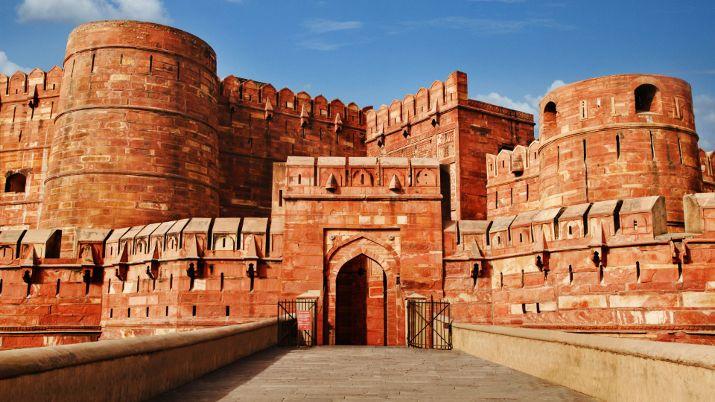
In approximately 972 AH / 1565 CE, Akbar began his massive project to rebuild Agra Fort, using red sandstone, and the fort gradually grew into a complete imperial city.
Agra Fort: The Seat of Rule and the Imperial Courtyard
Agra Fort is one of the most important testaments to the city's political power. It is a vast fort of red sandstone, its walls extending for approximately 2.5 kilometres, and it contains a large number of palaces, halls of audience, mosques and royal structures.
The fort was not merely a military stronghold; it was the residence of the emperor, his family and state officials, and a centre where major political decisions were taken.
Under Shah Jahan, the character of large parts of the fort changed, as some older buildings were removed and replaced by structures of white marble, in a shift reflecting the great development of Mughal architectural taste.
Among the most famous structures that remain inside the fort are the Diwan-i-Am, the Diwan-i-Khas, Jahangir's Palace, Khas Mahal, the Moti Masjid and the Nagina Masjid, along with other buildings that combine political function and architectural beauty.
Jahangir: Agra as a City of Gardens and Arts
Sultan Jahangir, who reigned from 1014 AH / 1605 CE to 1037 AH / 1627 CE, continued to pay attention to Agra. He was passionate about nature, gardens and the arts, and during his reign the city saw continued building and urban expansion, while the arts associated with the Mughal court flourished, especially painting, decoration and architecture.
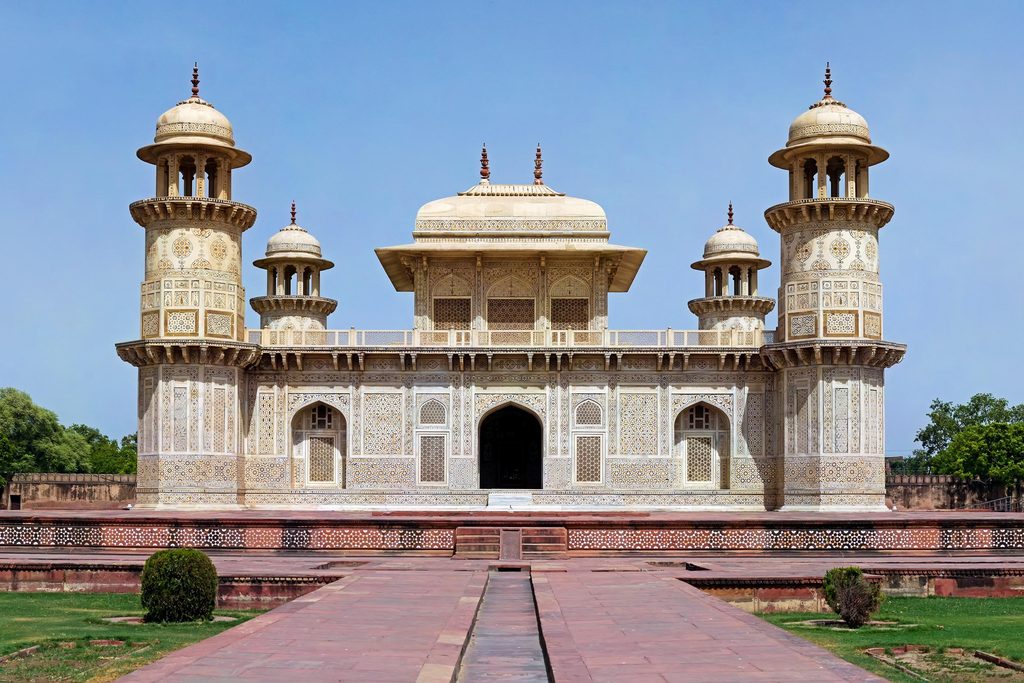
In this period, important structures also appeared that reflect the gradual shift of Mughal architecture from wide reliance on red sandstone to the use of white marble and fine stone decoration.
Among the most prominent examples is the Tomb of I'timad-ud-Daulah, which Nur Jahan ordered built for her father Mirza Ghiyas Beg between approximately 1031 and 1037 AH / 1622 and 1628 CE. It is distinguished by its use of white marble and decoration inlaid with semi-precious stones, and it is considered an important stage in the development of Mughal architecture that preceded the emergence of the Taj Mahal.
Shah Jahan: When Agra Became the City of Marble
Mughal architecture in Agra reached one of its highest stages under Shah Jahan, who reigned from 1037 AH / 1628 CE to 1068 AH / 1658 CE.
Shah Jahan was devoted to architecture. He added to Agra Fort a series of marble palaces and luxurious structures, before immortalising his name in the city's history by building the Taj Mahal.
Construction of the Taj Mahal began in approximately 1041 AH / 1632 CE; the main building was completed in 1058 AH / 1648 CE, while some of the surrounding elements were completed later. The mausoleum was built of white marble, and craftsmen, stonecutters and calligraphers were brought from various regions of the empire, Central Asia and Iran to take part in the project.
The Taj Mahal is therefore not merely a famous mausoleum, but the culmination of an entire phase in the development of Islamic Mughal architecture in India.
The Taj Mahal: Agra's Most Famous Legacy to the World
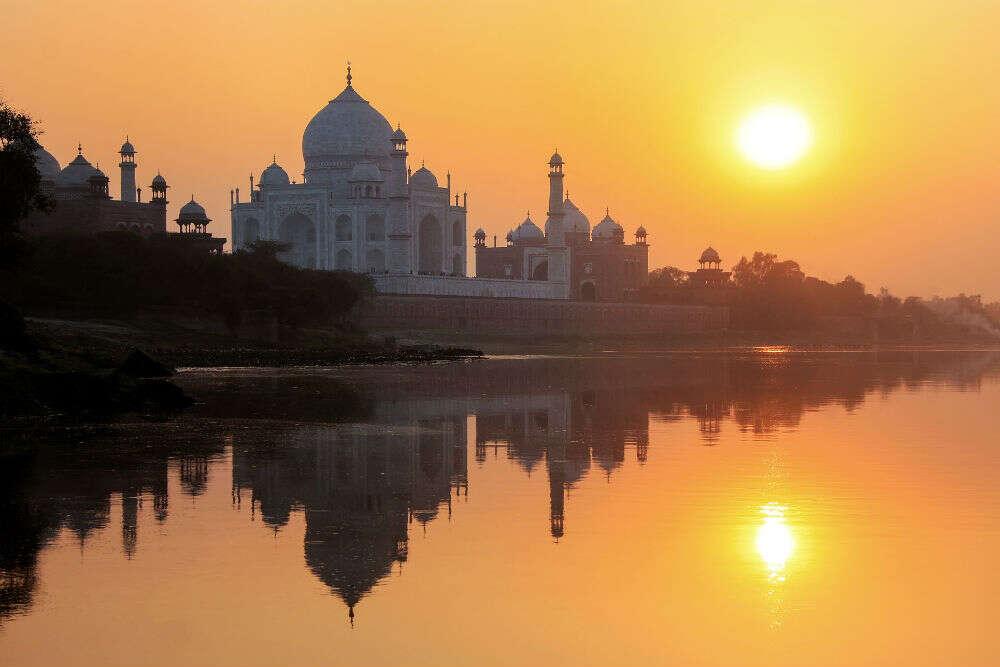
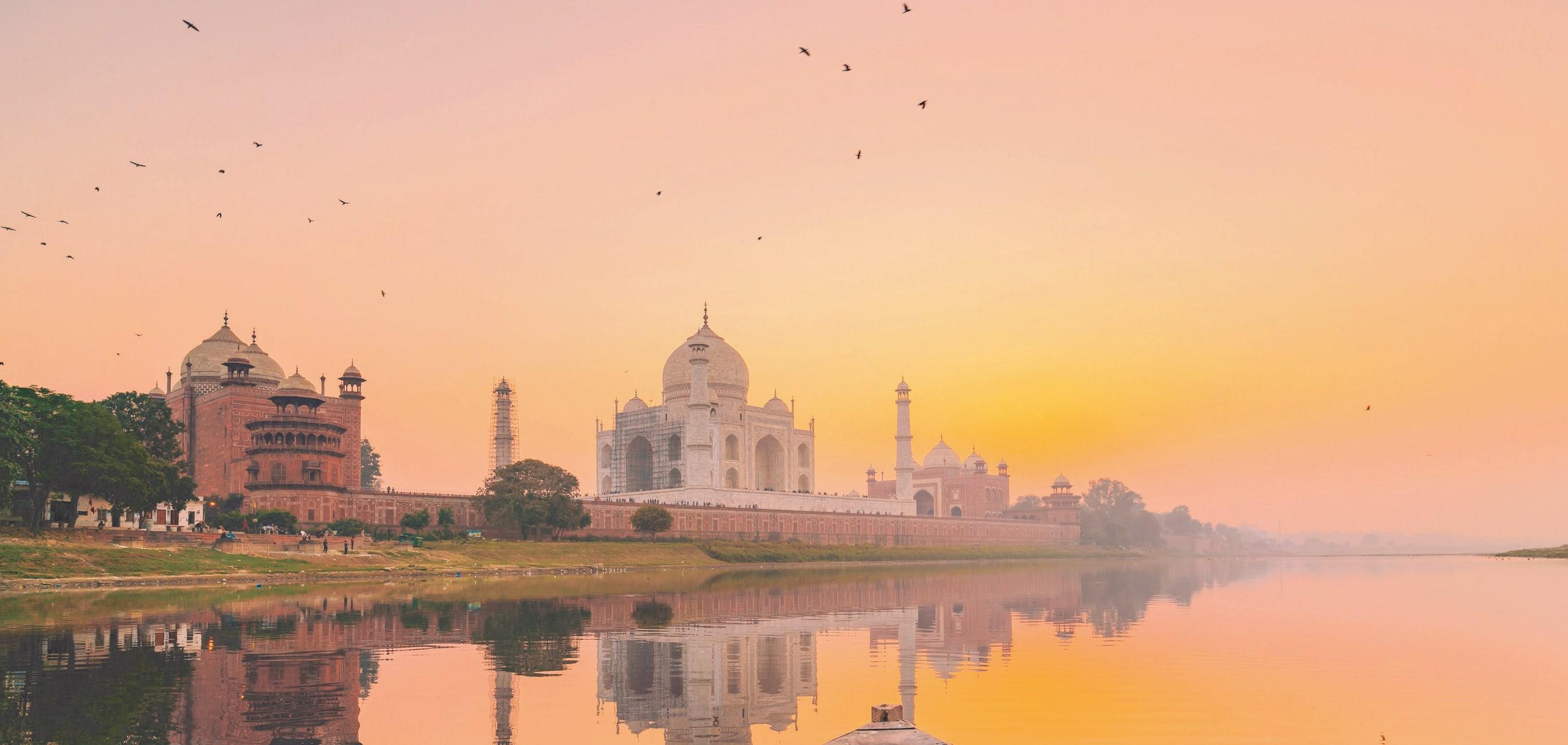
The Taj Mahal stands on the eastern bank of the Yamuna River. Shah Jahan ordered its construction in memory of his wife Mumtaz Mahal after her death in 1040 AH / 1631 CE.
Its architecture combines precise geometric planning, domes, minarets, white marble, inlaid decoration, Arabic calligraphy and gardens arranged around a water axis.
Historical sources indicate that the Arabic and Qur'anic inscriptions in the building also help in determining the sequence of construction stages, while craftsmen from many regions took part in its completion, reflecting the broad cultural scope of the Mughal state.
The Taj Mahal has thus become one of the most famous symbols of Islamic architecture in India.
Agra and Fatehpur Sikri: Two Cities in One Story
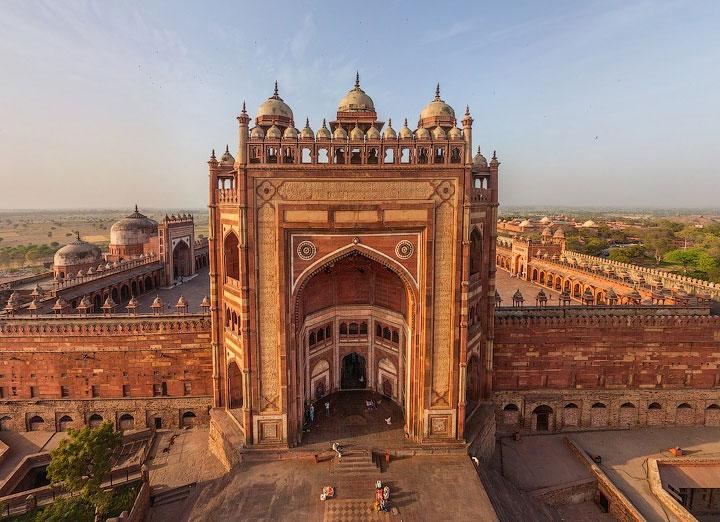
It is important to distinguish between Agra and Fatehpur Sikri. Akbar founded Fatehpur Sikri at a short distance from Agra and made it the capital for a brief period, from approximately 979 AH / 1571 CE to 993 AH / 1585 CE, before the centre of the capital moved to Lahore.
Fatehpur Sikri was designed as a complete imperial city including palaces, administration, mosques and markets, while Agra remained a highly important centre even during that period.
The move of the capital to Fatehpur Sikri was therefore not a cancellation of Agra's standing, but part of Akbar's broader efforts to organise the political and urban space of his empire.
The End of an Era as Capital
Under Shah Jahan, the imperial capital gradually moved to Shahjahanabad in Delhi in the middle of the eleventh century AH / seventeenth century CE, and Agra declined from its position as the main capital, but it did not lose its importance.
The city remained a major economic, cultural and urban centre, and the traces of the Mughal state remained present in its palaces, gardens, mosques and markets.
When Aurangzeb seized power in 1068 AH / 1658 CE, his father Shah Jahan was confined inside Agra Fort until his death in 1076 AH / 1666 CE, so that the fort, which had been a symbol of imperial power, became a witness to one of the most dramatic moments in the history of the Mughal dynasty.
Agra: A City That Encapsulates an Entire Era
Agra's significance lies in the fact that it was not merely a political capital, but a cultural laboratory in which administration, economy, architecture, the arts and royal life intermingled.
In its fort, Mughal emperors took decisions that shaped the future of the subcontinent; in its gardens and palaces, Mughal architectural traditions developed; and from the banks of the Yamuna emerged the Taj Mahal, which became the most famous work associated with the city.
After its golden age ended, Agra remained a witness to a period in which the Mughal state was one of the largest political powers in the Islamic world, and to a civilisation that managed to blend the heritage of Central Asia, Persian traditions and Indian customs into a new architecture with its own distinctive character.


