


On the banks of the Ebro River, in the heart of its fertile valley, Islamic Zaragoza rose, or "Saraqusta" as Muslim historians and geographers knew it, to become one of the most important cities of al-Andalus in its north-eastern region. The city was not merely a border outpost facing the Christian kingdoms. Over more than four centuries it became a political, military, commercial and scholarly centre, and it reached the peak of its prosperity in the era of the Taifa kings, when the state of the Banu Hud and the Ja'fariya palace stood as witnesses to a remarkable chapter in the history of Islamic civilisation in al-Andalus.
From the Roman City to Islamic Zaragoza
Muslims entered Zaragoza in the early second century AH, specifically around 95 AH / 714 CE, after Islamic rule had extended to the north-east of the Iberian Peninsula. Local and historical sources indicate that the city did not offer prolonged resistance when Muslims entered it, and that the Muslims made use of its existing urban fabric before reshaping it according to the needs of an Islamic city, with a mosque, markets, a citadel and residential quarters.
The city soon acquired exceptional importance because of its location on the Ebro River and its proximity to the routes linking central al-Andalus with its north-east. It became the capital of what was known in the Islamic administrative and military division as the Upper March, a border zone where the military and commercial interests of the Islamic state and the Christian kingdoms of the north intersected.
Zaragoza in the Umayyad Era
During the Umayyad era in al-Andalus, Zaragoza remained a city of considerable political and military weight, though its authority was not always stable. The Upper March witnessed local conflicts and revolts, and its position on the frontier made control of it a strategic concern for the Umayyad rulers.
As Islamic administration developed, Zaragoza became the centre of a wide province known as the Kura of Zaragoza. Islamic geographical sources describe a broad territory under its authority, comprising multiple towns, fortresses and villages. The works of Muslim geographers have preserved important information on the region's rivers, roads, markets and administrative divisions.
The value of Andalusian geographical sources is evident here, foremost among them the works of al-Udhri, who lived in the fifth century AH and paid particular attention to the geography of al-Andalus and its regions, including the Zaragoza area and the Upper March. These writings have become important sources for understanding the administrative, economic and urban structure of Islamic al-Andalus.
From the Collapse of the Caliphate to the Banu Hud State
The greatest transformation in Zaragoza's history was linked to the fall of the Umayyad caliphate in Cordoba in the early fifth century AH, when al-Andalus entered the era of the Taifa kingdoms.
In Zaragoza, the rule of the Banu Tujib was established during the first phase of the Taifa state, before authority passed to the Banu Hud around 431 AH / 1039 CE. With the rise of the Banu Hud, the city entered a new phase of political strength and cultural flourishing.
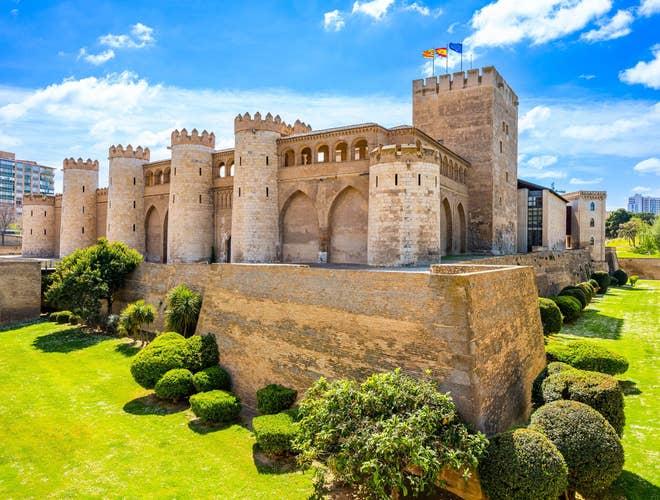
During their rule the Ja'fariya palace was built, named after al-Muqtadir, and it became one of the most prominent surviving examples of Islamic architecture in the Taifa era. Sources specialising in the history of Islamic architecture indicate that the palace dates to the period 437–473 AH / 1046–1081 CE, and that it represents one of the most important surviving models of Taifa palace architecture.
Al-Ja'fariya: A Palace of Learning and Politics
The Ja'fariya was not merely a seat of government. It was an expression of the status the Banu Hud wished to give their capital.
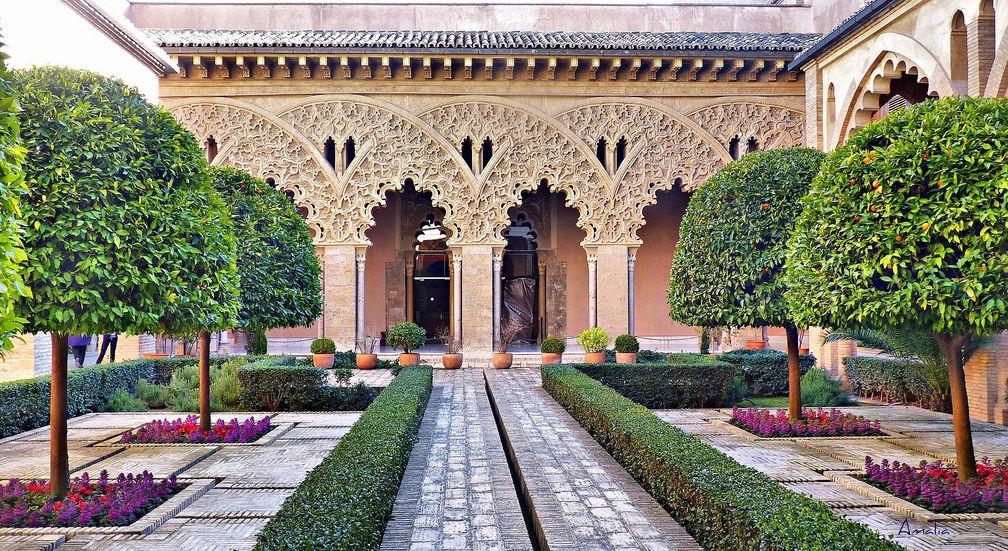
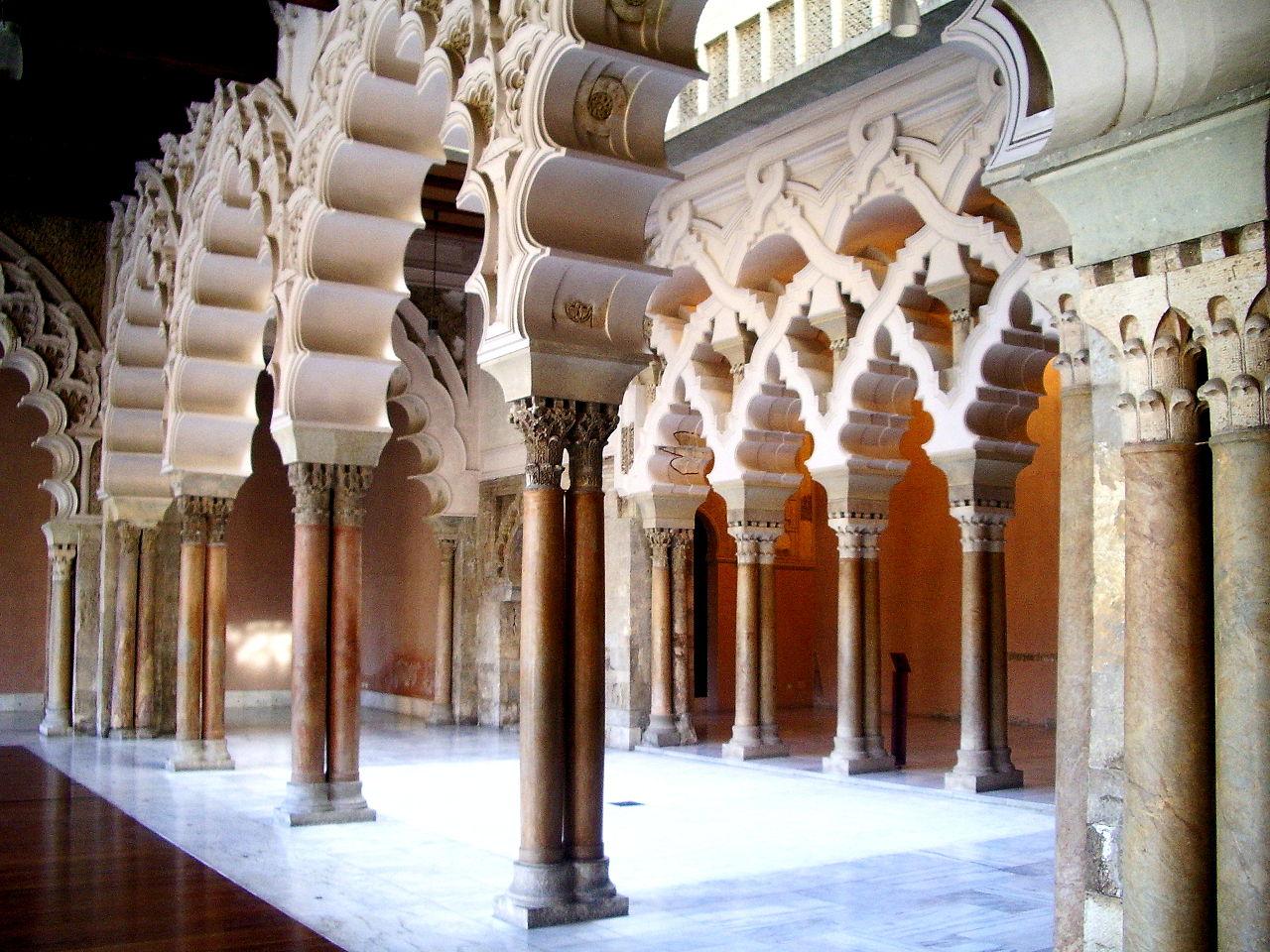
Within it, architecture, art, politics and learning came together. This is evident in the central courtyard, the decorated arcades, the interlacing arches, the plaster ornamentation, the ruler's private oratory and the reception halls.
The architecture reveals the continued influence of the Umayyad school in al-Andalus, alongside a clear development of decorative styles in the Taifa era. Architectural studies show that the Ja'fariya drew on certain elements of Umayyad architecture in Cordoba and Madinat al-Zahra, then reshaped them into a new form suited to the political and artistic tastes of the Taifa period.
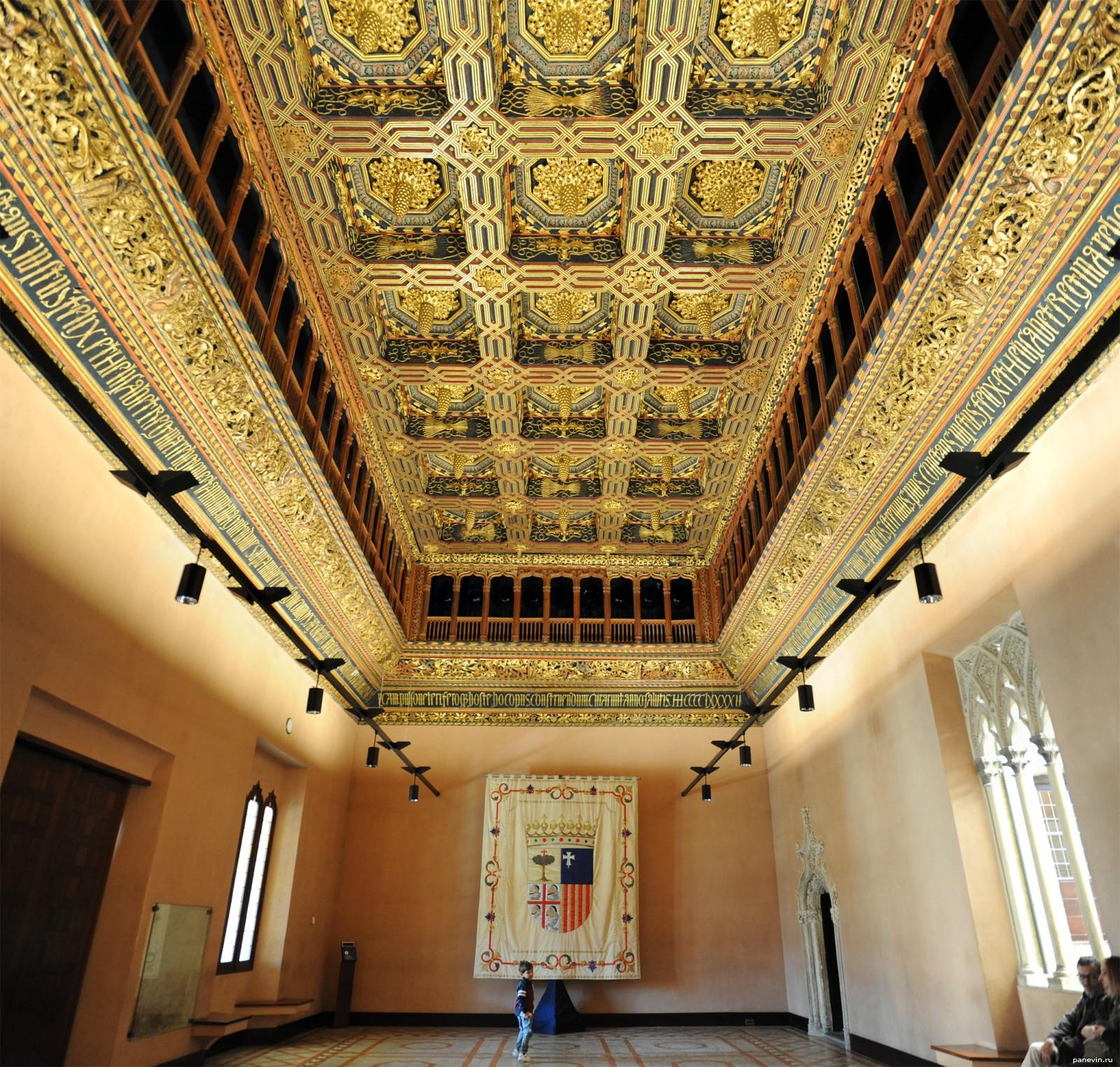
Notably, the Islamic palace did not disappear after the fall of Zaragoza. Later historical phases followed one another there, and the Islamic part of it remains a witness to the level architecture had reached in Zaragoza during the fifth century AH.
Zaragoza: When a Mathematician Sat on the Throne
Among the most intriguing figures in the city's history is Yusuf al-Mu'taman ibn Hud, who ruled Zaragoza between 474 AH / 1081 CE and 478 AH / 1085 CE.
Al-Mu'taman was both a ruler and a scholar. His name is linked to the book al-Istikmal, an important mathematical work dealing with problems in geometry and mathematics, and modern studies reveal its value in the history of Arab-Islamic mathematics.
Zaragoza was thus not only a frontier city. In the fifth century AH it managed to combine political strength with intellectual life, and its court became a meeting place for rulers, scholars, littérateurs and thinkers.
Al-Udhri: The Memory of the Upper March
Another scholarly name associated with Zaragoza's history is the geographer and historian Ahmad ibn Umar al-Udhri, who died in 478 AH / 1085 CE.
Al-Udhri lived during the flourishing of the Taifa kingdoms and offered in his writings rich material on the geography of al-Andalus and its regions, including administrative systems, economy, roads, towns and fortresses. His writings are especially significant because they help historians reconstruct the picture of Islamic al-Andalus beyond the reports of major capitals such as Cordoba and Seville.
Between the Crusader Kingdoms and the Almoravids
Zaragoza's political prosperity was at the same time shaped by growing military pressure from the north.
At the beginning of the sixth century AH the Almoravid state entered a new phase of control over the Taifa kingdoms, and the rule of the Banu Hud in Zaragoza ended after the Almoravids seized it around 503 AH / 1110 CE. The city remained under Islamic rule until Alfonso I of Aragon succeeded in taking it in 512 AH / 1118 CE. Spanish historical sources confirm that the transition to Christian rule took place in 1118 CE, after more than four centuries of continuous Islamic presence in the city.
The fall of Zaragoza was a significant event in the history of the Upper March, as it ended a long period during which the city had been one of the pillars of the Islamic presence in north-eastern al-Andalus.
What Remains of Islamic Zaragoza?
The traces of Islamic Zaragoza did not end with its fall. The Ja'fariya remains the most prominent witness to the Banu Hud era, with its courtyards, arches, ornamentation, oratory and halls that reflect the level of architecture in the fifth century AH. Parts of the fortifications and urban remains also survive, revealing how the Islamic city interlaced with the older urban fabric.
Recent archaeological and architectural studies confirm that Zaragoza experienced significant urban and technical development during the Islamic period, and that the building techniques in brick, plaster and geometric ornamentation found in the city are closely associated with its prosperity in the fifth century AH.
Today modern Zaragoza stands upon many layers of a long history, but the name of Islamic "Saraqusta" remains tied to a period in which the city built a distinctive place within Andalusian civilisation: capital of the Upper March, a centre of commerce, a home for scholars, a stage for long political and military conflict, and one of the leading centres that demonstrated the capacity of Islamic civilisation in al-Andalus to produce learning, art and architecture even in cities on the lines of contact.


