


China Worried About Uyghur Fighters in Syria, but Its Investments Keep Expanding
China's greatest advantage in Syria may lie not in massive spending, but in the absence of genuine Western competition.
By Joyce Karam for Al-Monitor
A new and pioneering report indicates that Uyghur fighters played a significant role in the collapse of Bashar al-Assad's regime in Syria. National Public Radio (NPR) reported that thousands of Uyghur fighters have become among the most organised and combat-experienced foreign forces within the Syrian opposition movement during the civil war.
The fighters rally under the banner of the Turkistan Islamic Party, a Uyghur jihadist organisation that Beijing considers a major security threat.
This new Syrian reality presents China with a dilemma: the new Syrian leadership includes factions that for years hosted Uyghur fighters opposed to Beijing, yet the country is also an economically attractive environment.
As Elizabeth Hagedorn noted, the continued designation of Syria as a state sponsor of terrorism deters American companies from investing there. This is what makes "Syria with no option but to turn to China," according to a former Syrian official.
The Uyghur Factor
The NPR report sheds new light on the role of Uyghur fighters in the fall of Assad. According to journalist Emily Feng, Uyghur fighters in Syria met with Syrian President Ahmed al-Sharaa during the months preceding the attack on Assad's forces.
Feng writes: "During a secret meeting with Ahmed al-Sharaa, then leader of Hayat Tahrir al-Sham and now the current leader of Syria, they agreed to prepare a joint offensive to liberate Aleppo from regime control."
Their role as a disciplined and effective combat force proved to be of great importance in retaking Aleppo and advancing toward Damascus.
Many Uyghurs fled repression in China's Xinjiang region, travelled through Turkey, and eventually joined the Syrian civil war under the banner of the Turkistan Islamic Party.
Why Is China Concerned?
From Beijing's perspective, the new Syrian leadership is closely linked to Hayat Tahrir al-Sham, a radical Islamist movement that hosted Turkistan Islamic Party fighters for years.
The Turkistan Islamic Party seeks to establish an Islamic state in Xinjiang and parts of Central Asia. According to Foreign Policy magazine, Uyghur leaders in Syria say their community numbers around 15,000 people, including some 5,000 fighters, most of whom are stationed in Idlib and Jisr al-Shughur.
Last June, Reuters reported that the new Syrian leadership intends to integrate some 3,500 foreign fighters, most of them Uyghurs, into the 84th Division of the Syrian army, with the knowledge and supervision of the United States, as part of broader efforts to restructure the army.
The Defending Democracies Foundation reported the promotion of the former Turkistan Islamic Party leader, Abdulaziz Dawud Hudaberdi, also known as "Zahid," to the rank of brigadier general in the Syrian military structure.
For China, the concern is not only ideological but also strategic. Beijing fears that Syria could become an environment permissive of armed activity hostile to China, or that it could become a symbolic victory for transnational jihadist movements that include Uyghur fighters.
Despite the Risks, Chinese Investment Is Growing
Despite these security concerns, Chinese companies are steadily establishing their presence in Syria's reconstruction economy.
After more than 13 years of war, Syria's reconstruction needs are enormous. The World Bank estimates reconstruction costs at around $216 billion, while Syrian Minister of Economy Mohammed Nidal al-Shaar stated in May 2025 that rebuilding a "new Syria" could ultimately require more than one trillion dollars.
Syrian-American businessman Samir Sabongi told Al-Monitor: "Companies come every day to meet stakeholders and explore opportunities. When American companies are not present, others fill the void."
Rather than pursuing high-risk, large-scale investments, Beijing appears to be adopting a cautious, state-backed approach focused on securing a long-term strategic foothold while minimising exposure to Syria's unstable political and security environment.
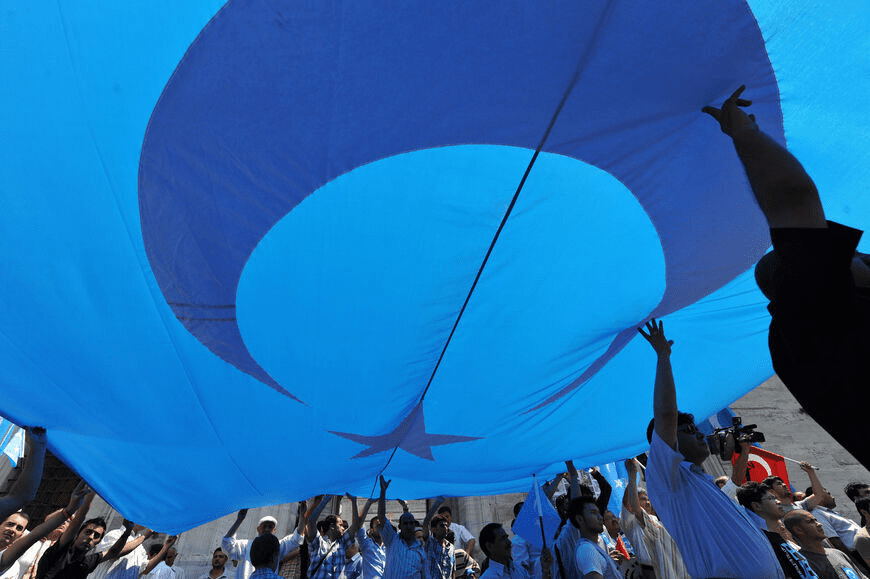
Protesters carried a giant East Turkestan flag during a demonstration held after Friday prayers in Beyazit Square in Istanbul, on 10 July 2009.
Key Sectors Attracting Chinese Investment
Huawei Technologies, the Chinese telecommunications giant, has emerged as one of the most active foreign players in Syria's telecommunications sector, where it is reportedly positioning itself for future infrastructure contracts.
China is also expanding into the following areas:
- Logistics and free zones
- Storage and transport infrastructure
- Mining and energy development
- Steel and industrial projects
Last year, the Syrian General Authority for Land and Sea Ports signed a 20-year memorandum of understanding with Feidi Contracting, which is linked to China, to develop more than one million square metres in two Syrian free zones.
What Comes Next?
China is likely to maintain a highly pragmatic relationship with the new Syrian leadership.
This arrangement appears increasingly transactional:
Beijing offers diplomatic engagement and selective investment.
Damascus seeks to reassure China that Syria will not become a base for armed groups hostile to it.
At present, China's greatest advantage in Syria may lie not in massive spending, but in the absence of genuine Western competition. While American and European companies remain cautious, Chinese companies are gradually filling the void despite Beijing's ongoing security concerns.


