


Frontiers of Geography and Wounds of History: Ceuta.. The African Gateway Besieged by European Fences
Ceuta sits on a volcanic peninsula projecting into the waters of the Mediterranean Sea. Together with Gibraltar on the northern shore, it forms the two pillars of the geographic strait that controls international navigation between the Atlantic Ocean and the Mediterranean. This striking setting and its extraordinary geostrategic importance have over the centuries turned into a historic curse and a bleeding political wound in the flank of the Islamic Maghreb.
Ceuta, together with its sister city Melilla and the Jaafarian Islands, is classified as among the last European colonies on African soil. It is subject to Spanish sovereignty, which describes it as an "autonomous city," while Morocco holds to its usurped identity and rejects the legitimacy of the Spanish presence on it.
This city, which was the launching point of the Islamic conquest of Andalusia, today embodies a stark contradiction: Spain (Al-Andalus), which was for many centuries an Arab Islamic land, now occupies an Arab Islamic frontier town that was the gateway of that conquest.
Roots of the Occupation: From Islamic Al-Andalus to the Spanish Crown
Ceuta was never an ordinary city. In 711 CE (92 AH), the commander Tariq ibn Ziyad set out from it to conquer the Iberian Peninsula, and Spain (Al-Andalus) became part of the Islamic world for more than seven centuries, flourishing culturally, scientifically and economically under the Umayyads, Almoravids, Almohads and others.
With the decline of Islamic civilisation in Andalusia and the beginning of what came to be called the "Reconquista," the northern frontier of the Maghreb became a direct target for the Christian kingdoms of Europe, which saw the militarisation of the southern Mediterranean as a guarantee against any repetition of the Islamic crossing towards the European continent.
The city first fell to the Portuguese on 21 August 1415, under King John I (João I) and his sons, including Prince Henry the Navigator, in a surprise campaign that exploited the weakness of the Marinid state at the time. It was transformed from a flourishing Islamic commercial and cultural beacon into the first European military base overseas. The majority of the Muslim population was expelled, and the Great Mosque was converted into a church.
With the formation of the Iberian Union between the crowns of Portugal and Spain in 1580, the administration of the city automatically passed to Madrid. When Portugal separated again in 1640, the city's rulers and settlers chose to remain under the Spanish Crown, a situation formally consecrated by the Treaty of Lisbon in 1668.
Throughout history, the Islamic Maghreb did not accept this reality. The sultans fought fierce battles to recover the city, most notably the "Great Siege" imposed by Sultan Moulay Ismail, which lasted nearly three decades (1694–1727) without breaching the strongly fortified military walls.
The Legal Track: Treaties Imposed by Force
- Treaty of Lisbon (1668), during the Alawite dynasty (the Alawite Sharifs): officially transferred sovereignty from Portugal to Spain without recognition from the Muslims.
- Treaty of Marrakesh (1767), during the Alawite dynasty: concluded between Sultan Mohammed ben Abdallah and King Charles III, it regulated trade and borders, and affirmed that Spanish sovereignty was confined within the fortifications while the surrounding lands remained Arab Islamic Moroccan territory.
- Treaty of Wad Ras (1860), during the Alawite dynasty: after the Tetouan War and Morocco's defeat, it imposed by force the expansion of Ceuta's borders to its current area (approximately 18.5–19 square kilometres).
- Protectorate agreements (1912) (Treaty of Fez), during the Alawite dynasty: imposed the French protectorate over Morocco, after which a Franco-Spanish agreement defined the protectorate zones, placing parts of northern and southern Morocco under Spanish protection, while Ceuta and Melilla remained outside the protectorate system as being under Spanish sovereignty.
- Moroccan independence (1956), during the Alawite dynasty: ended the French and Spanish protectorate system, but Spain did not withdraw from Ceuta and Melilla, considering that they had not been part of the Spanish protectorate zone and were subject to Spanish sovereignty and administration.
Morocco holds that these treaties were concluded under historical constraints and colonial pressures that do not cancel the Islamic character of the land, while Spain clings to them as documents establishing its sovereignty. Ceuta was not separated from the Islamic Maghreb by the will of its inhabitants or through a referendum; it was seized by military force at a moment of Marinid weakness.
Geostrategic Importance and Demographic Composition
Ceuta's value lies in its small geography (about 18.5 square kilometres), which overlooks the Strait of Gibraltar directly, giving the controlling power the ability to monitor the movement of commercial and military vessels.
About 83,000 to 85,000 people live there, in a demographically and culturally complex community: residents of Christian Spanish origin who hold the reins of administration, the army and public posts, and Moroccan Arab Muslims (the original inhabitants of the land), many of whom hold Spanish citizenship but suffer gaps in development, employment and representation, and are concentrated in marginal neighbourhoods.
The city witnesses a cautious coexistence marked by ethnic tensions, particularly with the rise of Spanish far-right rhetoric that sees the demographic shift in favour of the Muslim side as a "threat to Spanish identity."
The Dividing Wall: Militarising Geography and Migration Crises
Spain encircles Ceuta with a double iron fence stretching about 8 kilometres, reinforced with barbed wire, thermal cameras and sensors, as part of the "fortress Europe" system to prevent irregular migration. This wall separates Ceuta from its natural Arab Islamic Moroccan hinterland (the town of Fnideq) and turns it into a flashpoint in diplomatic crises between Rabat and Madrid.
In late July 2026, some 50,000 to 60,000 Moroccans flowed into the city by land and sea within a few hours, following rumours that the border had been opened, turning the city's streets into open confrontation zones and forcing Madrid to deploy units of the Spanish army.
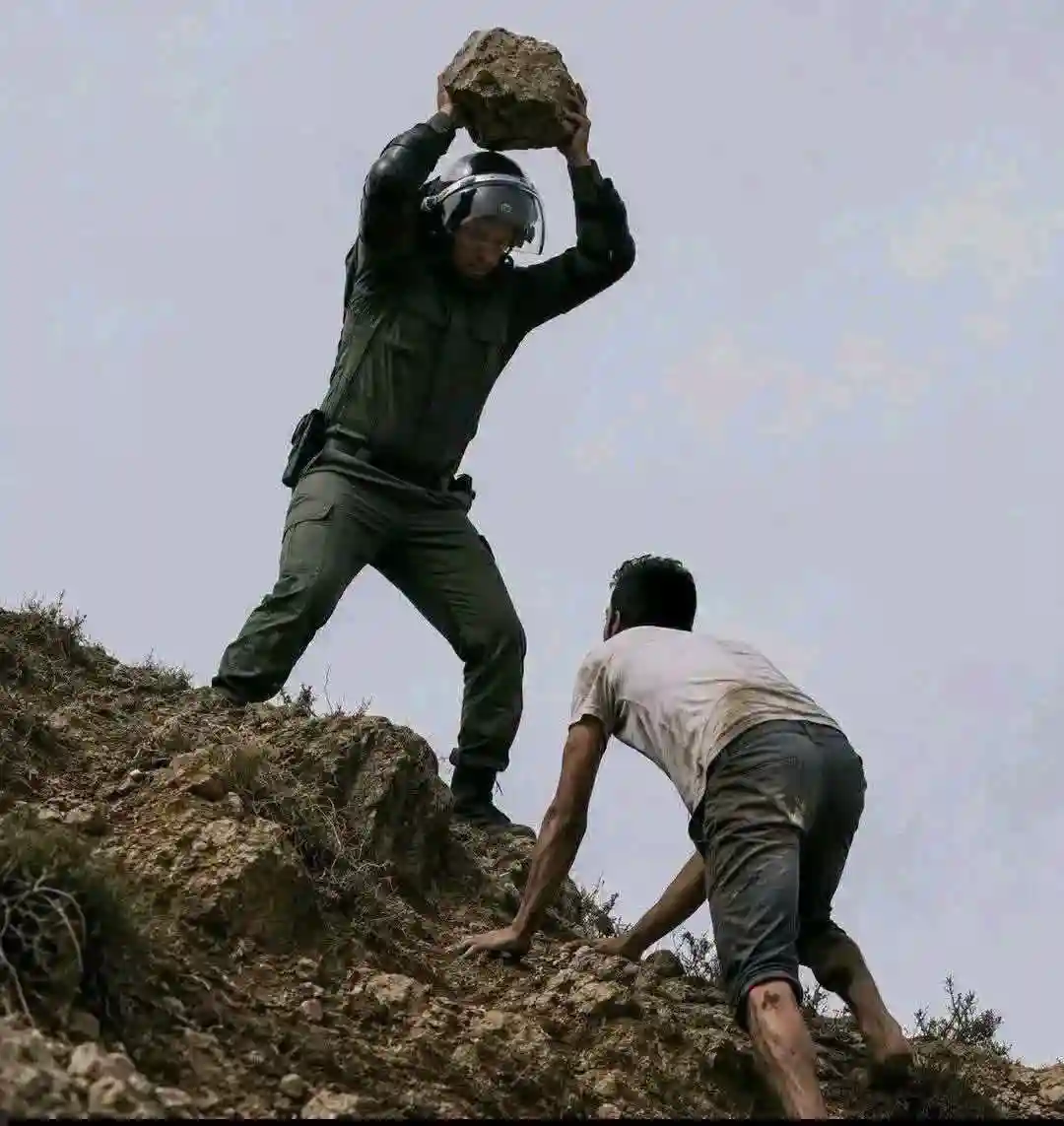
The Spanish newspaper El País confirmed the recovery of 88 bodies of Moroccans who crossed from the sea off Ceuta, while search operations under the water continue.
Economic Squeeze and the Policy of "Fait Accompli"
Ceuta lived for a long time on "subsistence smuggling," as thousands of Moroccans (especially women) entered daily to carry Spanish goods and sell them in neighbouring Moroccan markets.
At the end of 2019, Morocco permanently closed the Tarajal crossing (the Gate of Ceuta) to commercial activity and subsistence smuggling, and built an economic zone in Fnideq as an alternative. Ceuta's economy suffered a sharp recession.
Morocco had previously refused to open official commercial customs because that would mean implicit recognition of Ceuta's international borders and legitimisation of the occupation. However, in 2022, as part of the resumption of relations between the two countries, it agreed with Spain to operate commercial customs on the borders with the occupied cities of Ceuta and Melilla.
The Future of the Dispute: A Deferred File on a Hot Plate
Morocco pursues a policy of continuing to claim Ceuta and Melilla through diplomatic means, considering them part of the issues of completing its territorial unity, and has included their file within the context of decolonisation in international forums.
At the same time, Rabat avoids any direct confrontation, relying on its diplomatic and economic tools and on security cooperation with Spain and the European Union. For its part, Spain seeks to entrench the fait accompli by integrating Ceuta further into the European system.
Occupied Ceuta, with its ancient walls and modern barbed wire, remains a living witness to the contradictions of geopolitics: a city pulsing with Arab Islamic identity and history, administered under the laws of the Spanish Crown, and eyed by migrants as a gateway to Europe.
A deferred sovereignty dispute, but with every border crisis it proves to be a dormant volcano that may erupt and redraw the balance of relations between the two shores of the Mediterranean.
Spain, which rose after centuries of Arab Islamic rule in Andalusia, today occupies the frontier town that was the gateway of that rule.
Main sources: documented historical records of the conquest by Tariq ibn Ziyad (711), the Portuguese conquest (1415), the Treaties of Lisbon 1668 and Wad Ras 1860, Spanish National Statistics Institute data on the population, and international media reports on the migration crisis of July 2026.
Some sources used:
https://ar.wikipedia.org/wiki/%D8%AD%D8%B5%D8%A7%D8%B1_%D8%B3%D8%A8%D8%AA%D8%A9_(1694%E2%80%931727)
https://en.wikipedia.org/wiki/Treaty_of_Wad_Ras
https://www.elpueblodeceuta.es/sec/politica/90-habitantes-gana-ceuta-ano_1_1146272.html


