


An analytical study based on seven decades of census data in India has found that concerns raised by the Bharatiya Janata Party (BJP) about Muslim population growth do not match actual demographic trends. The study indicates that the real demographic challenge facing India is not an increase in the number of Muslims, but an ageing population and declining fertility rates.
Economist Dev Kar, Chief Economist Emeritus at Global Financial Integrity and a Fellow at Yale University, says official data show that the gap in growth rates between Hindus and Muslims is gradually narrowing, and that claims that India's religious composition could change due to population growth or irregular migration are not supported by the figures.
A recurring electoral theme about Muslim population
The issue of Muslim population growth has long featured in Indian political discourse, particularly during election campaigns of the BJP.
In 2002, before the Gujarat state elections, Narendra Modi, who is India's current Prime Minister and was then Chief Minister of the state, used a controversial phrase about the size of Muslim families, implying that Muslims have larger numbers of children.
In the years that followed, this rhetoric was repeated. Some party officials called on Hindus to increase their birth rates, and government officials in previous election campaigns linked the rise in the Muslim share of the population to "leniency towards migration", particularly in the state of West Bengal, where the party accused illegal migrants from Bangladesh of affecting the demographic makeup.
But the question the data raises is whether these factors actually lead to a broad demographic change capable of overturning the religious majority in India.
What does the census say?
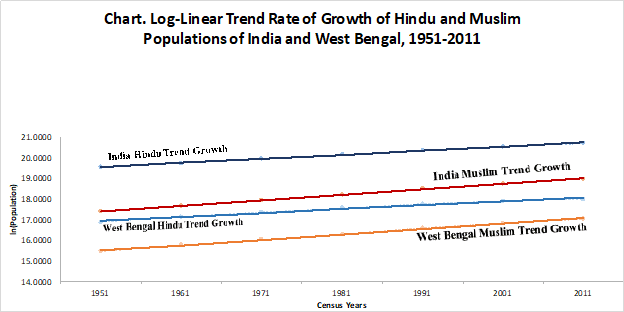
The analysis notes that the Indian census counts not only citizens but all usual residents of the country, whether citizens or not, meaning that any large wave of migration would appear in the population data.
According to census data from 1951 to 2011, the number of Hindus rose from about 303.7 million to 966.3 million, while the number of Muslims rose from 35.4 million to 172.3 million.
During this period, the Hindu share of the population fell from about 84.1% to 79.8%, while the Muslim share rose from 9.8% to 14.2%.
Despite this relative increase, the analysis stresses that the numerical gap between the two communities did not narrow but widened, due to the large difference in the size of the original population base.
In 1951, the number of Hindus exceeded that of Muslims by about 268 million people, while by 2011 the gap had reached nearly 794 million.
The analysis argues that a minority growing at a faster rate but starting from a much smaller base cannot overtake the majority within any realistic time frame.
No evidence of a mass migration effect from Bangladesh
A large part of political rhetoric has focused on West Bengal, which borders Bangladesh, as the region most affected by what is called "illegal infiltration".
However, census data do not show a significant difference between the growth rate of Muslims in West Bengal and in the rest of India.
Between 1951 and 2011, West Bengal's share of India's total Muslim population remained almost constant, at about 14.4% in 1951 and 14.3% in 2011.
The analysis indicates that a massive collective migration would have produced a clear rise in the proportion of Muslims in the state compared with the rest of the country, which the data do not show.
This does not rule out cases of illegal cross-border migration, but it indicates that the figures do not support the idea of flows of millions of people large enough to change India's religious composition, or even that of a large state such as West Bengal.
The fertility gap is narrowing
The report notes that the main reason for the rise in the Muslim share over past decades was differences in fertility rates, not migration.
According to data from India's National Family Health Surveys, the fertility rate among Muslim women fell from about 4.4 children per woman in 1992–1993 to 2.36 in 2019–2021.
Among Hindus, the rate fell from about 3.3 to 1.94 over the same period.
As a result, the difference between the two groups narrowed from more than one child per woman to about 0.4 children.
The researcher sees this convergence as meaning that the change in religious composition is moving towards stability, not towards the demographic reversal portrayed in some political discourse.
The real challenge: an ageing India
Rather than fearing growth in the Muslim population, the analysis argues that India faces a very different challenge: declining fertility and a growing number of older people.
India's national fertility rate has fallen below replacement level, reaching about 2.0 children per woman between 2019 and 2021, while more recent estimates point to about 1.9.
In West Bengal itself, which is the centre of the political debate over population, the fertility rate has reached very low levels of about 1.3 children per woman.
United Nations projections indicate that the share of the population aged over 60 will exceed 20% by 2050, with growing need for health and social care systems and pensions for older people.
India also faces the risk of losing what is known as the "demographic dividend", the period in which countries benefit from a high proportion of people of working age, if it fails to provide sufficient jobs, education and healthcare.
Conclusion
Indian census data over six decades show that the change in the country's religious composition has been limited, and that the rise in the Muslim share was linked mainly to an earlier gap in fertility rates, a gap that is now narrowing rapidly.
The data also provide no evidence that illegal migration from Bangladesh has caused a broad demographic change in India.
The analysis concludes that the issue of a "Muslim demographic threat" has become an effective political tool in elections, but does not reflect actual population trends.
The challenge that will shape India's future is not a shift in religious balance, but how to manage a society moving towards lower fertility and an ageing population, and how to seize the economic opportunity before the window of the demographic dividend closes.


