


Canary Islands: More than 300 migrants arrive at the Spanish archipelago in the Atlantic Ocean.
Late on Sunday night (10 May), a small wooden boat carrying 125 people was seen afloat off the small island of El Hierro, on the western edge of the Spanish archipelago in the Atlantic Ocean, according to a post on the X account of the Spanish rescue service Salvamento Marítimo.
The boat reportedly carried 116 men, three women and six minors. The sea rescue vessel Salvamar Divda was deployed and towed the vessel Kayuko, which was experiencing engine problems, to port. All passengers disembarked safely at La Restinga and are reported to be in good condition.
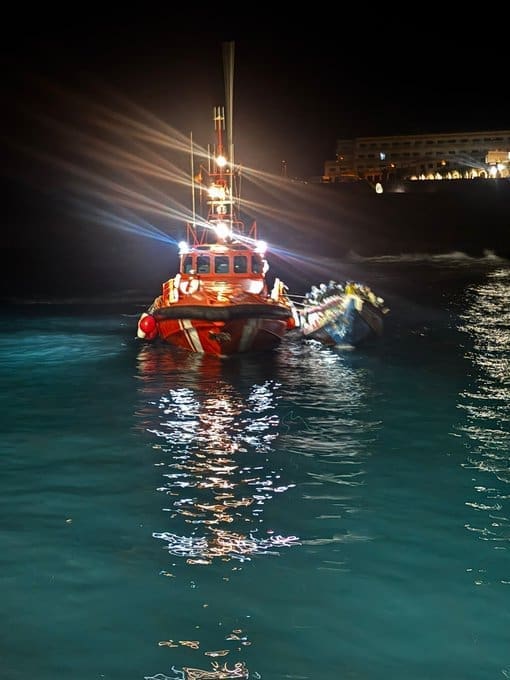
Earlier that day, a "fragile and overcrowded" boat known locally as Kayuko was brought into port on the Spanish island of Tenerife by Spanish rescue authorities Salvamento Marítimo.
The vessel was spotted by a sailing boat about 3.7 kilometres from Las Galletas beach, Tenerife, the Spanish news agency EFE reported.
Two Salvamento Marítimo vessels went to assist the boat and directed it to the port of Los Cristianos on the island, in the south of the territory. The migrants aboard the vessel reportedly left Gambia at least a week earlier. When spotted, its engine still appeared to be running, and it was moving at a good speed.
Surveillance aircraft spots partially sunken vessel
Shortly afterwards, on Sunday, aerial surveillance spotted a partially submerged inflatable craft off Lanzarote carrying 55 migrants. A fast-response boat reached the location early in the afternoon and transported this group to the port of Arrecife in Lanzarote for medical checks.
According to statements from maritime officials, one of the boat's flotation tubes had burst and none of the migrants were wearing life jackets, the Spanish regional news portal Canarias Ahora reported.
A photo published on the Salvamento Marítimo X account showed the migrants seated aboard the half-submerged craft. Some migrants at the front of the boat are raising their hands towards the aircraft that first spotted them and photographed them. The feet of migrants seated on the embossed tube along the left side of the boat are in the water. The sea at the point where the photo was taken appears calm. Rescue services said there was no one in the water at the time of their arrival, and that the boat's passengers remained calm and, despite the low freeboard, the boat remained "stable".
Arrivals in the Canary Islands
On Saturday, Spanish rescue services also confirmed the arrival of a group of 62 migrants on the island of Gran Canaria and 61 on the island of Lanzarote.
In 2025, over the full year, 17,788 migrants arrived via the Atlantic route to the Canary Islands archipelago. The previous year, 46,843 people arrived on the same route.
Over the past two years, Spain and the European Union signed and strengthened a number of bilateral development agreements with departure and origin countries in West Africa, including Senegal, Mauritania and Morocco. This led to funding and training from the European Union for those countries, on the basis of increased patrols and coastal controls.
Despite a significant decline in the number of migrants attempting the Atlantic route towards Spain, other routes, such as the land route from Morocco towards the Spanish enclaves of Ceuta and Melilla, appear to be seeing an increase this year.
According to Spanish government data recently published in the local newspaper El Faro de Ceuta, 2,101 migrants entered Ceuta between 1 January and 30 April of this year, representing an increase of 300 per cent compared with the same period last year.
However, total arrivals across all routes to Spain this year decreased compared with the same period last year. In the first four months of the year, the number of arrivals to Spain fell by 43.2 per cent compared with the equivalent period in 2025.
Sources: Infomigrants + EFE


