


Israeli settler attacks in the occupied West Bank are no longer limited to burning cars and homes or assaulting Palestinian villages. Walls, schools and mosques themselves have become surfaces for racist and threatening slogans, carrying clear messages intended to intimidate Palestinians and entrench a reality of exclusion and displacement.
In the village of Jalud, south of Nablus and home to around one thousand Palestinians, Hebrew phrases such as "revenge," "burn in hell," and "get out of the village" appear on the facade of a school. According to local residents and officials, these inscriptions recur alongside violent attacks carried out by settlers against residents and their property.
Since the beginning of last year, Jalud has been subjected to five major attacks, the most recent on 4 August 2026, when settlers set vehicles on fire and sprayed racist slogans on a residential building.
The school as a target of intimidation
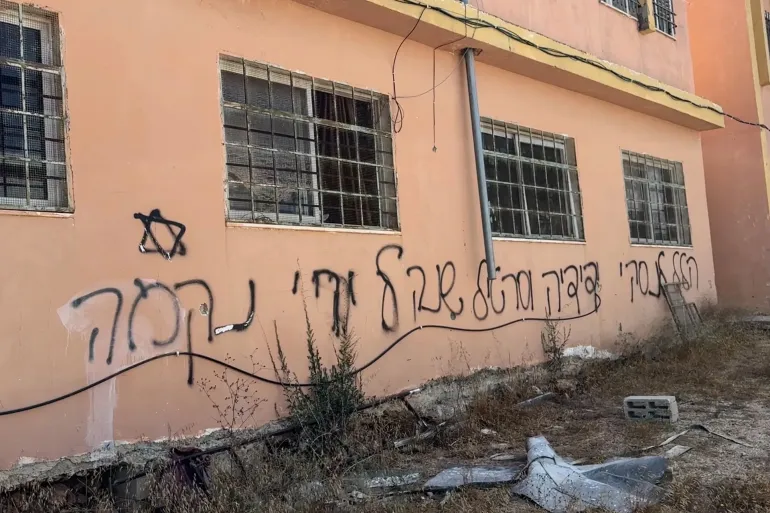
Residents of the village say that targeting schools with hostile inscriptions is not random. The messages target children directly, with the aim of instilling fear in them about going to school.
As for the phrases demanding that Palestinians leave the village, residents view them as a message that goes beyond an immediate threat, suggesting that killing and displacement may be coming.
The head of the village council, Raed al-Haj Mohammed, says these slogans are "racist and exclusionary," and links them to members of "Hilltop Youth," a decentralised network made up mostly of young Jewish men that is associated with violent settlement activity in the West Bank.
The group's strategy is to establish outposts on hilltops outside existing settlements, then seek to impose a new reality on the ground that later paves the way for their legitimisation.
According to the account of Jalud residents, some of the slogans carry the names of settlers killed in previous clashes, in reference to what the attackers present as "revenge" for their deaths.
From "revenge" to displacement
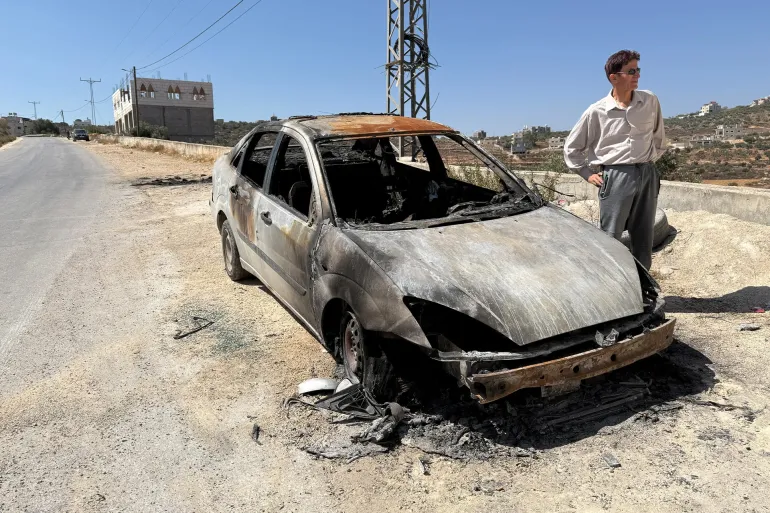
Residents say the attacks cannot be separated from the broader environment of settler violence in the West Bank.
When bloody events occur in Gaza, Palestinians in some West Bank villages find themselves, according to local testimony, targets of revenge operations carried out by settlers, despite no direct connection between the residents of those villages and the events said to have prompted them.
In this way, the concept of "revenge" becomes a tool for punishing an entire community.
Israeli affairs researcher Azzam Abu al-Ads notes that the choice of slogans reflects, in his view, deeper ideological ideas, citing slogans such as "Death to the Arabs," which he describes as an explicit call for annihilation within a settlement vision that seeks an area free of Arabs.
The researcher argues that the war on Gaza since October 2023 has helped strengthen currents within Israeli society that hold that the Palestinian question can only be dealt with by expelling Palestinians or eliminating their presence, according to his analysis.
Targeting the means of survival
Violence is not limited to people.
The burning of homes, crops and mosques, according to researcher Walid Habbas, targets the elements of Palestinian survival and the residents' connection to their land, not merely the punishment of specific individuals.
Hebrew inscriptions on walls take on particular significance in this context. Some of those who carry them out know that Palestinians may not be able to read Hebrew, which means the message is not addressed to them alone.
Rather, according to Habbas, they can serve as a "sign of ownership" directed at other settlers and at Israeli state and society, announcing that the land has, symbolically, come under the control of the attackers.
In this sense, the walls of Palestinian homes become a space for declaring control, while the burning of property and mosques becomes a means of severing Palestinians' attachment to the place.
The mosque as a target of identity
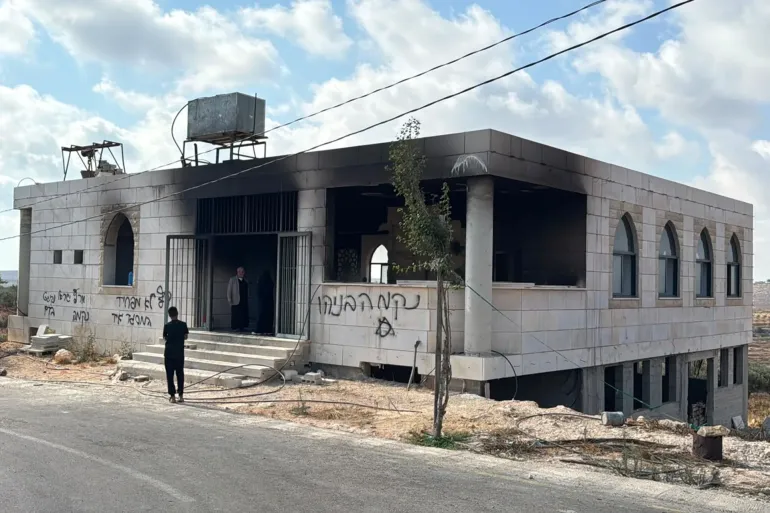
This meaning becomes even clearer in attacks on mosques.
In the town of Qusra, south of Nablus, settlers set fire to a mosque, then wrote slogans on its walls and drew a Star of David, according to local residents.
Habbas sees the targeting of the mosque as not merely an attack on a religious building, but a blow to one of the symbols that generate collective identity and tie residents to the place.
As for drawing the Star of David on walls, the researcher reads it as a symbolic declaration of sovereignty and control: "This place is ours."
In this way, violence goes beyond its immediate target to reach the symbols that give Palestinian society its sense of belonging and continuity.
Why are slogans written in full view?
Perhaps one of the most dangerous aspects of this phenomenon is that these attacks do not always occur in secret.
The inscriptions are sometimes placed on facades overlooking public roads, clearly visible and open to being seen and photographed, while some are carried out quickly and openly.
Habbas believes this does not necessarily reflect recklessness, but may express the confidence of perpetrators that they will not be held accountable.
When an attacker can burn a home or a mosque and write racist threats on its facade without fear of punishment, committing the crime publicly becomes a message in itself.
It is a message about the balance of power: Palestinians see the attack, the settlers know they are being seen, and everyone understands that the incident can be repeated.
Violence as a tool for redrawing the land
The attacks in Jalud and Qusra offer an example of what settler violence can become when it moves beyond individual revenge to a project of controlling the land.
Burning property, targeting mosques and schools, and writing slogans demanding that residents leave are all acts that appear to have different aims, yet converge on one outcome: creating an environment in which Palestinians feel their very existence is under threat.
The accounts of residents and researchers reported by Al Jazeera indicate that the messages written on walls are not merely angry words, but part of a broader system of intimidation that uses words, arson and assault to send a political and social message: that the land is a site of contest over existence, and that Palestinian presence in it is itself a target of violence.
From here, the phrase "get out of the village" does not appear to be a passing threat, but a concentrated summary of a more dangerous trajectory: turning violence from a means of revenge into a tool for pushing residents to leave, and altering the demographic reality on the ground through force and fear.
In the West Bank, where settlements and outposts are expanding and settler attacks are recurring, the most important question becomes not only who wrote the slogans on the walls, but who has the capacity to stop the attacks, hold their perpetrators accountable, and prevent written threats from turning into the actual displacement of Palestinians from their land?
Agencies


