


By Ben Gjerstein
A Russia-backed Bosnian Serb separatist leader, who was removed from office in Bosnia last year for defying the international overseer of the country, has continued his hostile campaign against Bosnia's Muslim community, increasingly allying himself with far-right figures in Europe and the United States.
His escalating rhetoric has alarmed leaders of the Islamic Community in Bosnia and Herzegovina, prompting them to issue a statement last month condemning the spread of hate speech and incendiary rhetoric against Bosnia's Muslim community, also known as the Bosniaks.
The Islamic Community's statement was a response to the hostile and sharply anti-Muslim language used by Milorad Dodik, former president of Republika Srpska, the Serb-majority entity in Bosnia and Herzegovina, and a number of Bosnian Serb leaders, in remarks delivered before audiences in Israel and the United States.
The Islamic Community compared this escalating rhetoric to the hate speech and ethnically charged propaganda that inflamed tensions before the wars that erupted following the breakup of the former Yugoslavia in the 1990s.
Dodik and his fellow Bosnian Serb leaders appear once again to be turning to anti-Islamic rhetoric, this time to win support for their ethnonationalist project of independence for Republika Srpska. Amid cooperation among international far-right actors, these arguments are finding an echo at senior levels of governments and among broad sections of Western public opinion.
Dodik is known for his denial of the genocide in Srebrenica, his anti-Muslim and separatist positions, his racist statements towards officials in other governments, and his repeated undermining of Bosnia and Herzegovina's fragile post-war legal and constitutional framework.
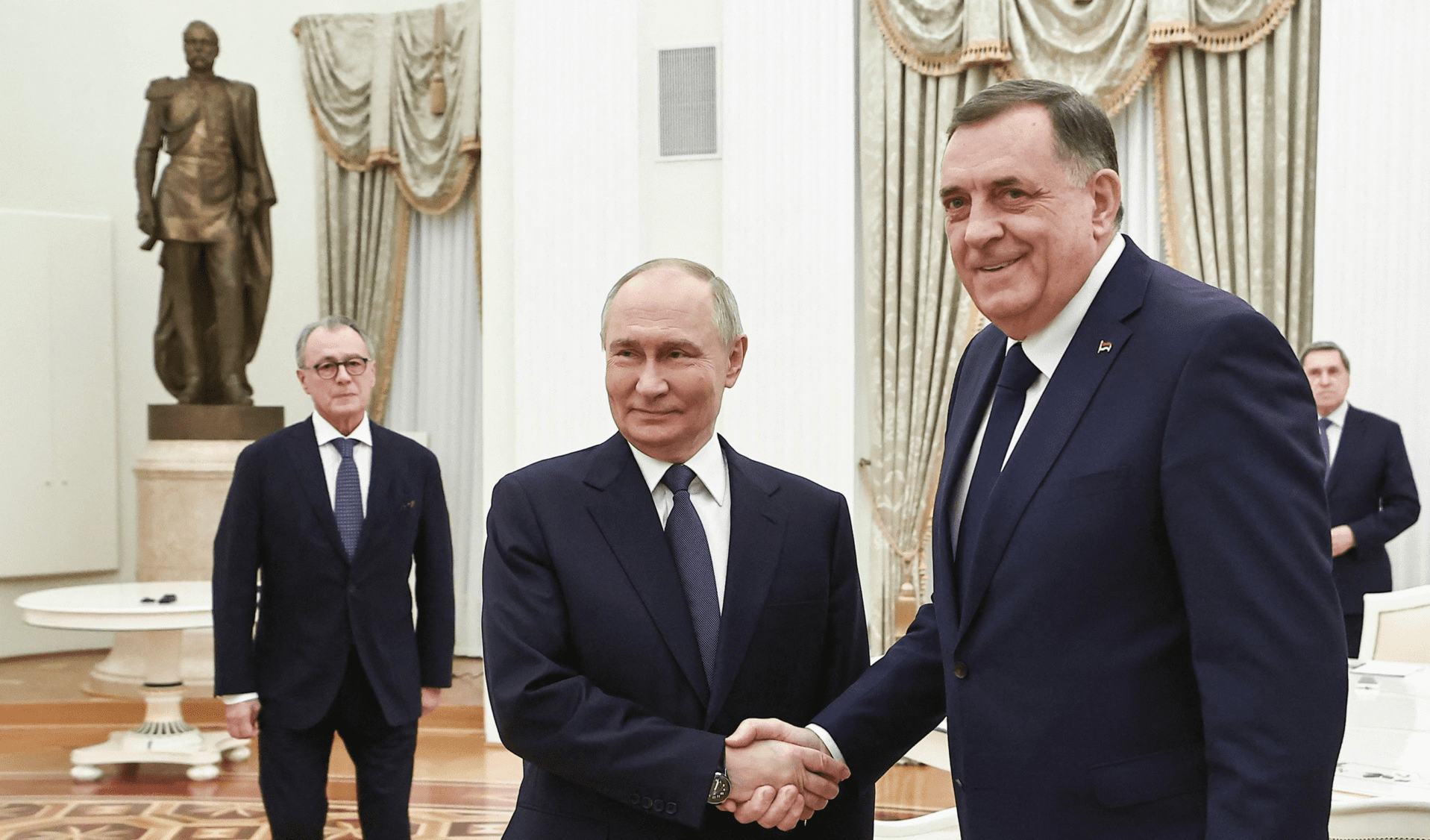
As an ally of Russian President Vladimir Putin, Dodik has travelled repeatedly to Moscow since Russia's full-scale invasion of Ukraine in 2022. He has also cooperated with Russia to undermine commemoration of the victims of the Bosnian war (1992-1995) and the pursuit of genuine justice for them.
His conduct led for a long time to sanctions being imposed on him by the European Union and the United States, until the Trump administration lifted these sanctions in October, after an intensive lobbying campaign, ostensibly as part of a deal to persuade him to accept a court ruling removing him from office, which he had initially rejected.
He remains subject to European sanctions, but still holds the position of leader of his political party in Republika Srpska, and effectively continues to exercise power through proxies.
The Borrowed Language of a Civilisational Clash
During his visits to Jerusalem and then Washington, D.C. in February, accompanied by the Serb member of Bosnia's tripartite Presidency, Zeljka Cvijanović, and the acting president of Republika Srpska, Ana Trišić Babić, Dodik warned of a civilisational clash between the "Judeo-Christian" world and Islam, and portrayed Republika Srpska as standing in direct confrontation with Islamic influence.
In remarks made after Dodik's visit to the United States, Serbian President Aleksandar Vučić, an ally of Dodik, attributed the new rapprochement between Dodik and the United States to a shared interest in "protecting Christianity and preserving its values."
Furthermore, in Jerusalem Dodik claimed that "liberal elites" are encouraging the immigration of "Muslims who carry with them a deep-rooted anti-Semitism." This echoes some principles of the far-right "Great Replacement" theory, specifically its suggestion that mass migration of Muslims from the Arab world will undermine the system and promote the application of Islamic law in Europe and the United States.
During his visit to Washington, accompanied by Trump ally and former National Security Adviser Michael Flynn, who helped lobby for the lifting of US sanctions on him, Dodik met with Republican members of Congress, including House Speaker Mike Johnson, and officials in the Trump administration, including Defence Secretary Pete Hegseth. Dodik said he discussed with Hegseth "defending Christian values."
What is concerning is that the meetings in Israel and the United States may well have achieved their intended effect on right-wing public opinion in both countries. An opinion article in the Washington Times echoed much of Dodik's rhetoric and called on the United States to recognise an independent Republika Srpska. Other actors in Washington, including some affiliated with the Heritage Foundation, which hosted Project 2025, have paved the way for such calls, specifically for anti-Bosniak rhetoric in the United States, over the past year. In addition, the Jewish News Agency recently published an article in the Jewish News Agency.
A local news agency warned that Bosnia had "slipped" towards extremism despite being considered a "model of a moderate Islamic state." In this context, the solidarity of Bosniaks with the Palestinians has been used as evidence of the alleged radicalisation of Bosnian society.
At this critical moment, Serbian journalist Jovana Đurović, based in Washington, D.C., noted that the relationship between Bosnian Serbs and the West is increasingly being shaped by "a growing and increasingly visible Islamophobia." Dodik's statements against Bosnia's Muslims do not differ from those of many far-right agitators and violent extremists around the world.
In the last month alone, Dodik used the highly offensive term "Balija" to describe Bosnian Muslims and claimed that "Muslims… are our enemy." He once described the call to prayer as "wailing" and urged Bosnian Muslims to adopt the Serbian Orthodox faith to preserve national harmony. In late 2025, Dodik accused Bosniaks of being an "amoeba that multiplies and spreads without restraint," and years earlier described them as "congenital liars."
Dominant National Narratives
Furthermore, as Amra Sabić Rees, a professor at Columbia University's Teachers College and a survivor of the Bosnian war, accurately predicted in 2020, "American white supremacist proponents are flocking to Serbian and Croatian national narratives built on an inherent fear of Muslims." Alarmingly, researchers have linked anti-Bosniak (Bosnian Muslim) rhetoric, past and present, to attacks on Muslim communities around the world, including the 2019 shooting at the Christchurch mosques in New Zealand and the 2011 neo-Nazi attacks in Norway.
The roots of this Islamophobia-based orientation towards the West can be traced to the bloody breakup of Yugoslavia in the 1990s. Siniša Tatalović, dean of the Faculty of Political Science at the University of Sarajevo, observes that Dodik's racist and dehumanising attitude towards Bosnian Muslims draws on the ideological foundations that inspired the 1995 Srebrenica massacre during the Bosnian war. Slobodan Milošević, then Serbia's nationalist president, exploited the apparent need to protect European Christianity from Islam to justify aggressive military action and genocide in neighbouring Bosnia. The memory of Ottoman rule was also used as a means of defaming Muslims, treating them as an extension of Turkish rule and holding them responsible for historical atrocities that are considered central to Serbian heritage.
Consequently, the distortion of history is another element of this anti-Muslim discourse. Alongside explicit Islamophobia, Dodik and others have misused the memory of the Nazi Holocaust to serve this nationalist campaign. During his visits to Jerusalem and Washington, D.C., Dodik accused Bosniaks of collaborating with the Nazis and running concentration camps during the Second World War.
While some individuals from all ethnic groups in former Yugoslavia allied with the Nazis, the claim that Bosnian Muslims widely participated in the extermination of Jews and Slavs during the Second World War has been widely refuted. The Bosnian Islamic leadership has also made numerous public apologies for any collusion in the fascist attacks on the Jewish community in the state during the Holocaust. Unfortunately, this distortion of history is not new to Dodik. He has repeatedly used the Holocaust as a means of denying the genocide in Bosnia, and has enlisted Holocaust researchers to do so.
Dodik has long sought to win over those who wish to support similar movements across Europe. Under these circumstances, it is necessary to strongly and collectively condemn Dodik's appeal for what it essentially is: an attempt to rally far-right forces to support the secession of Bosnian Serbs by exploiting anti-Muslim and anti-migrant prejudices. If this appeal succeeds, it could destabilise Bosnia and Herzegovina, increase the denial of the genocide in Bosnia and anti-Muslim hate speech, and raise the likelihood of a return to armed conflict in the Balkans.
justsecurity.


