


The increase that took effect in Syria on Sunday, 13 September 2026 (1 Rabi al-Akhir 1448 AH), was not a limited adjustment to fuel prices but a major jump affecting one of the commodities with the greatest impact on Syrians' lives. In just nine days, the price of a litre of 95-octane petrol rose from 152 to 195 new Syrian pounds, and 90-octane petrol from 147 to 185 pounds, while diesel jumped from 125 to 175 pounds, an increase of about 40%. The price of a domestic gas cylinder also rose, from 1,470 to 1,600 pounds.
This increase is all the more significant when compared with what happened less than three months earlier. On 27 June, 95-octane petrol was reduced to 130 pounds, 90-octane petrol to 125 pounds, and diesel to 107 pounds. Since that reduction, diesel has therefore risen by about 64%, 95-octane petrol by about 50%, and 90-octane petrol by about 48%, a rapid reversal that has led many Syrians to ask:
The Official Account: Syria Is Forced to Buy from a Turbulent Global Market
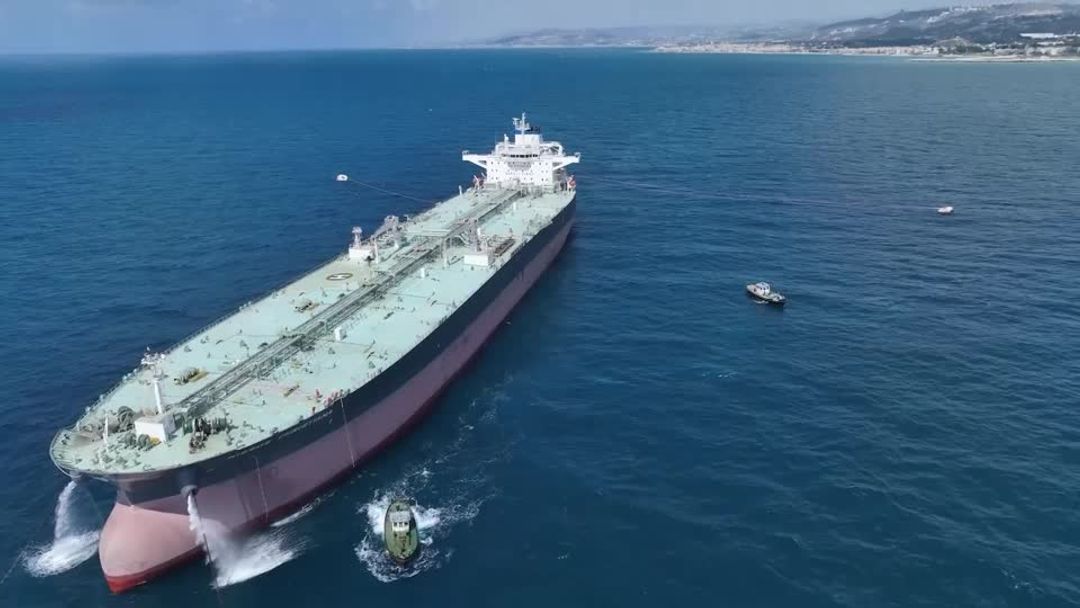
The Ministry of Energy offered a clear explanation for the latest increase, describing it as "temporary" and linked to two main factors: the exceptional rise in global oil product prices, and the partial shutdown of the Baniyas refinery, which has entered a comprehensive overhaul lasting nearly two months.
According to the ministry, the price of an imported tonne of diesel is approaching $1,400, and of petrol $1,350, while Brent crude hovers around $100 a barrel. The problem, according to the government's account, is that the price of crude alone does not determine the cost of fuel; refining, transport, shipping and insurance costs have also risen because of disruptions in the Strait of Hormuz, the Red Sea and Bab al-Mandab, as well as damage to refining capacity in Russia and the Middle East.
This part of the explanation cannot be ignored: global energy markets are indeed experiencing acute disruption. The International Energy Agency has warned of a widening supply gap during 2026, Brent has exceeded $100, and pressure has been especially intense on diesel and refined products because of refinery and transport-route disruptions.
Global price rises, then, are not a wholly fabricated pretext. But the existence of a genuine external cause does not necessarily mean that everything happening in the Syrian market can be explained by it alone.
Syria Produces Oil. So Why Does It Import Fuel?
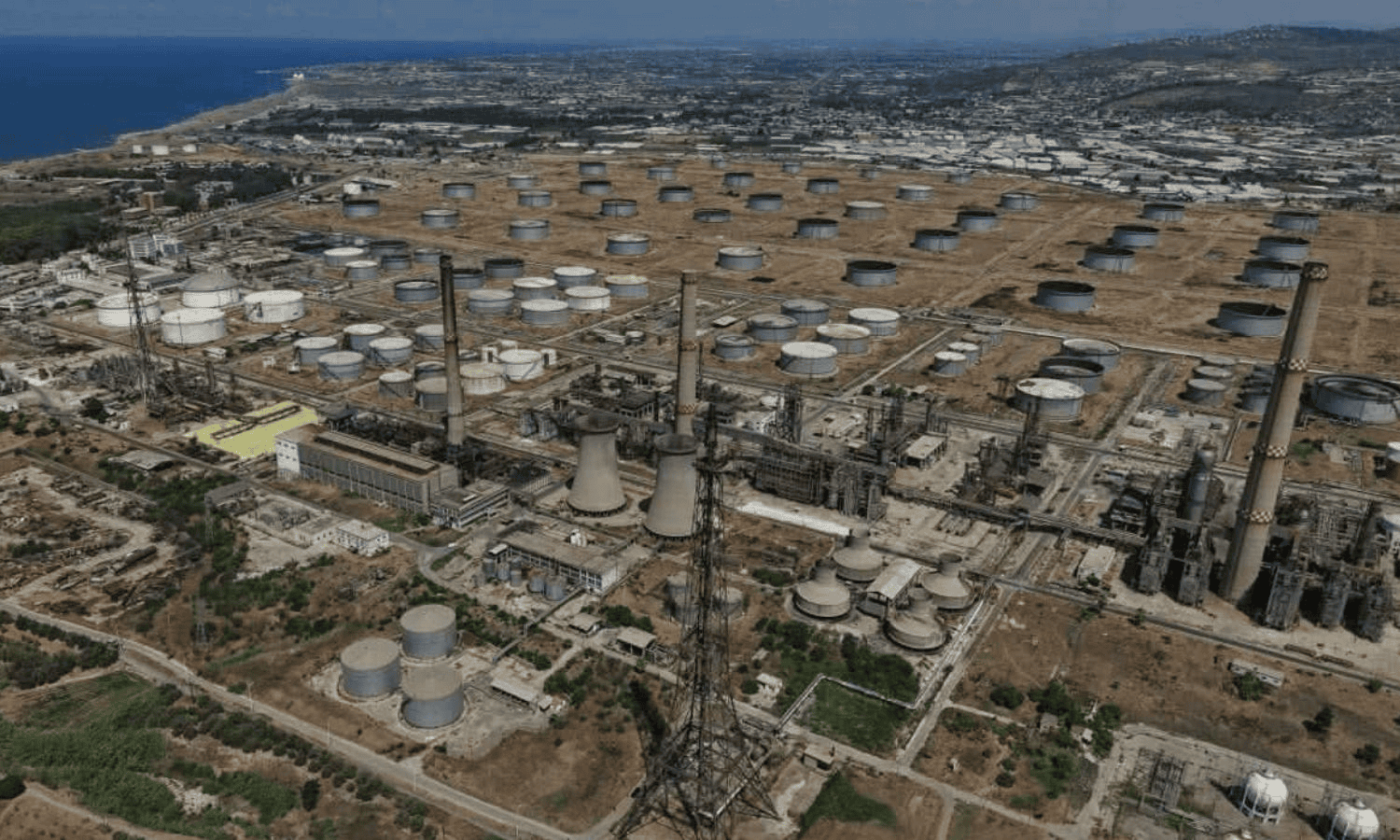
This is the question repeatedly raised on the street, particularly in Deir ez-Zor, Hasakah and Raqqa, where most of Syria's oil wealth is located and where tankers pass residents every day.
According to the latest figures from the Ministry of Energy, Syria currently produces about 100,000 barrels of crude oil per day, while the ministry estimates its need for oil and its derivatives at the equivalent of about 300,000 barrels per day. In other words, even by official figures, domestic production covers only part of the need. The ministry also says that about 60% of the diesel available on the market currently comes from imports: the daily requirement is about 7.72 million litres, of which 3.09 million litres are domestic and 4.63 million imported. As for petrol, the daily supply is about 2.32 million litres, of which 1.54 million are produced domestically and about 775,000 litres imported.
There is another technical reason: crude oil is not ready-to-use petrol or diesel. It must be refined, and some types of Syrian crude are heavy and not fully suited to the specifications and capacities of existing refineries. The ministry therefore says the country sometimes has to export limited quantities of crude that do not suit its refineries, and import ready products the market needs.
The picture also reveals the scale of the sector's historic decline. Before the war, Syria produced about 387,000 barrels per day in 2010, according to the US Energy Information Administration, compared with the roughly 100,000 barrels the government now cites. In other words, although the country has recovered a significant part of its output, it remains far from pre-war levels.
The government's own figures show that production in the first half of 2026 reached 14.8 million barrels, an average of about 82,000 barrels per day, before the ministry said production had recently reached nearly 100,000 barrels per day. This is an important increase, but still insufficient to meet demand.
Baniyas: A Necessary Overhaul, but at a Costly Time
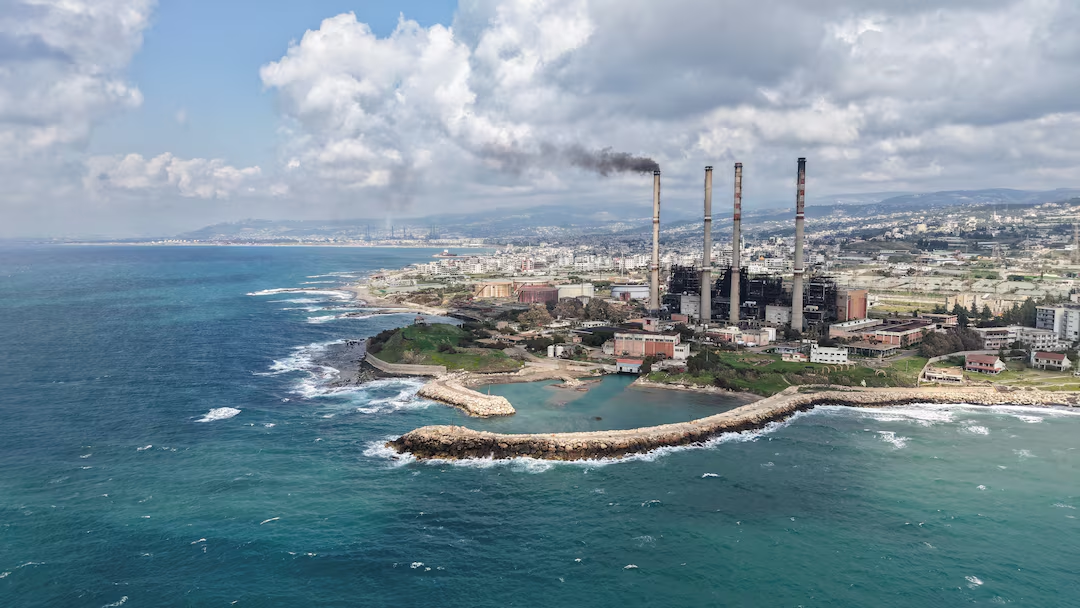
One of the most important causes of the current crisis is the Baniyas refinery. The refinery has begun what is nearly the largest comprehensive maintenance operation in its history, involving the shutdown, inspection and repair of a number of units after years of operation and partial maintenance. The plan aims to raise its capacity from about 80,000 barrels per day to 130,000 after the work is completed.
Technically, the overhaul appears necessary: the Syrian Petroleum Company says the refinery has reached a condition that does not allow repairs to be postponed further. But economically another question arises: why does one of the country's most important refining facilities enter a lengthy maintenance programme at a time when the region is already experiencing an unprecedented crisis in fuel and shipping prices?
The timing may have been technically imposed, but the crisis exposes the fragility of Syria's energy system: the shutdown of a single refinery for a large part of its capacity immediately forces the country to buy larger quantities of petrol and diesel from abroad, at the worst possible moment for global markets.
Here the debate moves beyond "the rise in global prices" to a question of strategic planning: where are the sufficient reserves? Where is the alternative refining capacity? And why has a sector of such vital importance remained vulnerable to the point that maintenance work, or a pump fault, can turn into a national crisis in supply and prices?
Earlier Statements Return to the Spotlight
The current anger concerns not only the price, but the gap between the government's earlier rhetoric and the new reality.
In November 2025 (Jumada al-Ula 1447 AH), when fuel prices were reduced, Energy Minister Mohammed al-Bashir said the step would have a positive effect on the economy and "ease the living burden on citizens, especially as winter approaches." In June (Dhu al-Hijjah 1447 AH), after a further price reduction, he affirmed that the ministry was working according to an approach based on "transparency and periodic review" and on balancing market stability, supply sustainability and the interests of citizens.
Today, the new increase comes again before winter, and by very large percentages, while diesel in particular has become about 64% more expensive than its price after the June reduction.
Even during earlier queue crises, the government insisted they were not the result of a real shortage of products. At the end of June, the Ministry of Energy said what stations were experiencing was merely a "temporary bottleneck" and that the strategic reserve was available, while the minister later explained that part of the crisis resulted from the exclusion of a petrol shipment that did not meet specifications, in addition to some stations reducing their purchases in anticipation of a price cut.
The succession of these different explanations within a short period — a non-compliant shipment, transport bottlenecks, global changes, a refinery overhaul, then a large price increase — has contributed to eroding the trust of a section of citizens, even though each of these causes has a real basis.
From Anger to Blocking Oil Roads
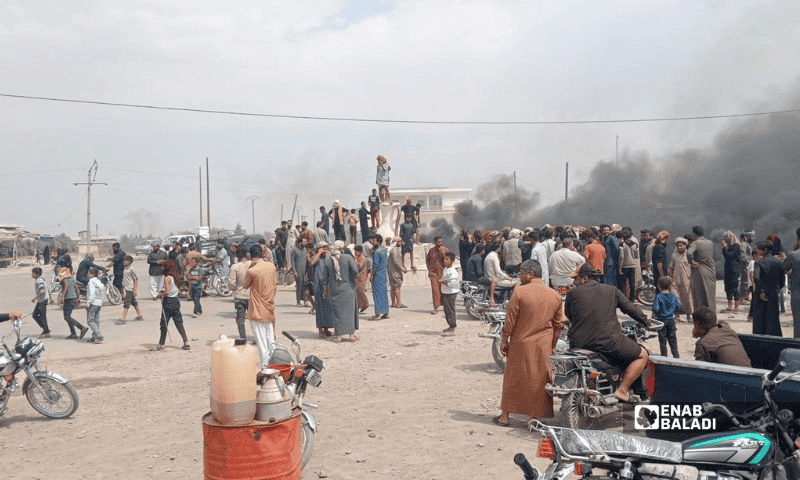
This time, the objection did not remain on social media.
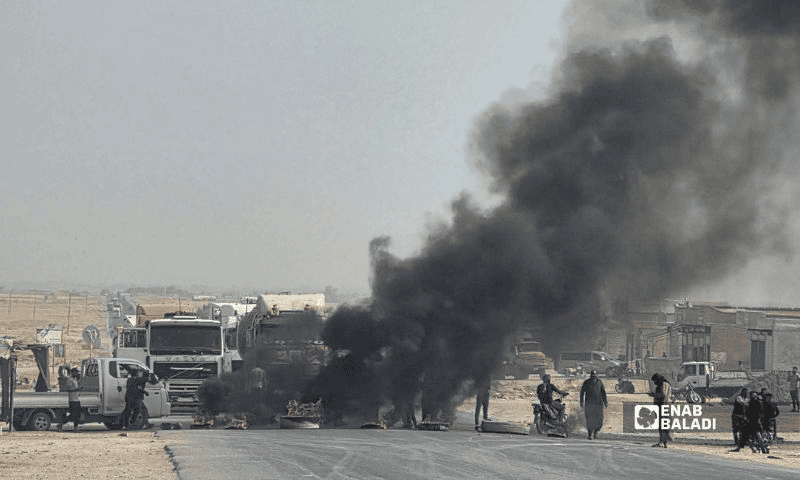
On the day the new prices took effect, towns in Hasakah, Deir ez-Zor and Raqqa witnessed protests and road blockades using burning tyres, and in some locations this extended to preventing crude oil tankers heading into the interior of Syria from passing. Movements were recorded in Markada, Huwaijat Shanan, al-Tayyana, al-Huraiyjiya, al-Karama and areas near al-Shaddadi.
Protest in eastern Syria carries a particular significance: residents watch oil being extracted from their region's land and carried away by tankers before their eyes, and are then asked to pay high prices to obtain its derivatives. Economically, there may be explanations related to refining, cost and imports, but socially it is hard to persuade residents of this equation unless the details of the sector are announced with very high transparency.
The impact has already begun to spread beyond the fuel station. Residents in Hasakah spoke of transport fares between some towns rising from 300 to 500 new Syrian pounds, along with higher costs for water transport and services, while residents fear heating will become a greater burden as winter arrives.
Here lies the particular danger of the diesel price: diesel is not only car fuel, but enters transport, agriculture, heating, generators, the carriage of goods and the operation of many productive activities. Every increase in it gradually becomes an increase in the prices of dozens of goods and services.
And What About the Talk of Corruption?
There is so far no published evidence proving that the decision to raise prices on 13 September resulted directly from corruption, or that any party profited from the latest increase. It would be unprofessional to turn popular suspicion into a proven accusation without evidence.
At the same time, the talk of corruption in Syria's oil sector cannot be dismissed as mere rumour, because government oversight bodies themselves announced only weeks ago that they had uncovered serious violations within the sector.
In August, the Central Commission for Control and Inspection announced, after a three-month investigation, that it had discovered violations in oil production, transport, metering and maintenance, and in contracting in the Deir ez-Zor fields. The commission estimated preliminary damage to public funds exceeding $8 million as a result of contracting, maintenance and mismanagement, in addition to other damage estimated at about $20 million linked to price differences in crude oil transport contracts. It also decided to suspend nine officials and refer them to the judiciary, and to cancel contracts with some companies and contractors.
Earlier, the Ministry of Energy announced the seizure of 153 violations at fuel stations and the closure of eight stations; the violations included selling at inflated prices, disposing of strategic reserves, and selling outside official meters.
These facts do not prove that "corruption raised the price of petrol", but they do prove another important point: the oil sector already suffers from problems of oversight, contracting, transport and distribution, and citizens' demands to see the accounts and costs are not baseless suspicion.
If the Citizen Pays the True Cost, He Has the Right to Know the True Calculation
The government affirms that fuel prices are set according to a range of factors, including oil and product prices on global markets, the exchange rate, and the costs of importing, shipping, insuring, transporting, operating and maintaining. Over recent months it has also moved to review prices more closely in line with market changes.
But moving towards pricing closer to the "true cost" requires, in return, a higher level of transparency. If the citizen is required to bear price rises whenever import costs rise, he has the right to know clearly, and in a verifiable way, how the price he pays was calculated.
What is the actual cost of importing a tonne of diesel or petrol? How much is added for shipping, insurance, transport and refining? What is the proportion of domestically produced product compared with imported product? What is the cost of domestic production itself? What is the amount of taxes, margins or fees included in the final price?
The matter does not stop at how the price is calculated, but extends to the question of the outcome of this policy: how much will the state gain from selling products at the new prices? Where will these revenues go? Will they be allocated to developing fields and refineries, increasing reserves and improving supply, or will they enter the general budget without the citizen being able to know their direct effect on the energy sector?
These questions become more important in light of financial and administrative violations that the government's own oversight bodies have previously exposed in oil production, transport and related contracting. Accordingly, publishing periodic data on production, imports, costs, contracts, revenues and spending should not be seen as an additional demand, but as an essential part of any pricing policy that wants to win people's trust.
Transparency does not mean the government telling the citizen that the price rose because global markets rose; it means enabling him to understand how the cost of a barrel or a tonne moved from the global market to the figure displayed at the fuel pump.
And if the citizen is now asked to pay a price closer to the market price, he has the right, in return, to receive something approaching market standards too: clear accounts, stable supply, guaranteed quality, competition and oversight, and real accountability when waste or corruption occurs.
Without this, the citizen will remain faced with a final figure he is required to pay, while the equation that produced that figure stays closed to him. It is precisely here that the crisis of trust begins, and talk of corruption and mismanagement becomes more widespread, even when some of the reasons for rising prices are objective and real.
From Iranian Oil to Costly Imports: The Source Changed, but Dependence Remained
To understand the current fuel crisis, it is necessary to look back to before the fall of the former regime. After the collapse of much of domestic production during the years of war, Syria's energy sector relied heavily on Iranian crude, which reached the Baniyas and Homs refineries under political and financial arrangements specific to Damascus and Tehran.
Tanker-tracking data compiled by Reuters indicate that almost all of Syria's crude oil imports in 2024, amounting to about 22.2 million barrels, came from Iran. These supplies stopped after the fall of the former regime in December 2024, placing the new government before a large gap between domestic production and market need.
However, the end of dependence on Iran did not mean the end of dependence on abroad. During 2026, Russia became Syria's largest external oil supplier, with imports from it reaching, according to Reuters estimates, about 60,000 barrels per day. Thus the source changed, but one core aspect of the problem remained: Syria still needs to buy a large part of its requirements from abroad, which makes the local fuel price highly sensitive to the global oil price, shipping and insurance costs, and the political and military disruptions surrounding trade routes.
This places Syria's energy policy before a deeper question than the identity of the supplier: when will the country be able to move from managing shortage and importing to building domestic production and refining capacity that reduces the exposure of Syrian citizens to external market shocks?
Economic Reform, but in What Order?
Even if we accept that keeping fuel prices below their real cost indefinitely cannot be financed, this does not settle the debate over how the reform was carried out.
Economic policies are judged not only by the soundness of their ultimate goal, but also by the order of their steps. A large price increase could have been preceded by a clear announcement of a protection network targeting the poorest families, by improved supply stability, by guarantees for the transport and production sectors, and then by a gradual move towards prices closer to cost.
Loading the increase onto the citizen first, at a time when purchasing power remains very weak and supply is vulnerable to disruption, makes the citizen feel that "reform" began from his pocket before its benefits appeared in services or income.
Between a Global Crisis and an Internal Imbalance
To say that rising fuel prices in Syria are caused by corruption alone is an inaccurate simplification. The country does indeed import a large part of its needs, global oil product prices are high, the Baniyas refinery is out of service for a large part of its capacity, and the oil sector still produces far less than its pre-war level.
But the opposite claim, that everything happening is caused by external factors alone, is not convincing either.
The current crisis has exposed Syria's weak capacity to refine its own crude oil locally, the fragility of its storage and supply system, and years of declining investment and maintenance, alongside violations and financial irregularities that state bodies themselves have documented. At the end of this chain stands the citizen, the fastest party asked to cover the gap through higher prices.
The problem, therefore, is not merely the question "Why did petrol prices rise?" It is a larger question: who bears the cost of the weakness of Syria's energy sector?
If the government wants to calm anger and restore trust, it will not be enough to describe the increase as "temporary." What is needed is a publicly verifiable announcement of the cost of each derivative, the volume and sources of imports, the actual output of the fields, the cost of transport and refining, the results of corruption investigations, the fate of the squandered funds, and a clear statement of when and how the return of the Baniyas refinery and rising domestic production will be reflected in prices.
Only then can Syrians distinguish between a bill imposed by the global energy war and another bill whose cause may be mismanagement, waste and corruption within their own country.
Singing concerts and the question of priorities
Sections of Syrians feel an additional contradiction when sharp jumps in fuel prices and mounting hardship coincide with the expansion of major entertainment events and the booking of famous singers, most prominently the singer Assala Nasri, to hold two concerts in Damascus under the sponsorship of the Ministry of Culture and the Syndicate of Artists, a scene that in turn sparked debate about priorities at this difficult economic stage.
This does not necessarily mean that the state treasury bore the expenses of these concerts. The issue here concerns the public image and the ordering of priorities: when citizens are asked to bear higher prices for diesel and petrol on the grounds of scarce resources and rising costs, while at the same time they see official celebration of large entertainment events and displays of spending and festivity, it becomes natural for them to ask what message the state is sending at a moment of severe economic strain. The problem is that displays of extravagance and celebration, if not accompanied by clear sensitivity to the reality of people's lives, can deepen the sense of a gap between official discourse about austerity and crisis and the scene the citizen sees before him.
In a country where the wages of wide segments of the population remain weak, and the costs of transport, heating and food are rising, public priorities and the political symbolism of spending and celebration become a legitimate part of the economic debate, not merely an objection to cultural activity.
It is difficult to separate the liberalisation of fuel prices in Syria from the broader economic direction the government is pursuing, alongside renewed intensive engagement with the International Monetary Fund. The Fund has for years pushed towards reducing energy subsidies and adopting prices closer to cost, and during 2026 it discussed with the Syrian government public finance reform, "cost recovery" for services, and reducing indirect fiscal burdens. Nevertheless, there is so far no published document proving that the IMF imposed on Damascus the recent petrol price increase or specified its percentage and timing; the decision remains formally a Syrian governmental decision, although it is largely consistent with the economic philosophy the Fund recommends.
The Syrian economy may have emerged from some of the sharp collapse that marked the last years of the ousted Assad rule, with the return of commercial activity and improvement in some economic indicators, but recovery does not mean that Syrians' lives have become affordable: poverty remains widespread, inflation rose again during 2026, and the gap between incomes and living costs remains large.
In reality, raising fuel prices in this manner was not the only economic option available to the government. It could have moved gradually from universal subsidies to targeted support that protects the basic quantities for low-income households, with advance cash compensation, support for public transport, agriculture and production, and tighter control over waste and smuggling, in parallel with repairing the refineries and increasing domestic oil output. Real reform does not mean transferring the deficit of the energy sector directly into the citizen's pocket, but rather addressing the causes of the deficit itself, then distributing the cost of reform fairly among the state, the economy and the consumer.
With winter at the door
The most pressing question today is: how will Syrians spend their coming winter if the prices of diesel, gas and transport remain at these levels, while incomes are still limited and households' capacity to endure is declining? The problem will not stay confined to the cost of filling a fuel tank; it will move directly into heating, food prices, transport fares, and the cost of production and services, meaning the cold months could turn into an exceptionally difficult social and economic test.
For this reason, the government does not have the luxury of waiting long. What is needed is to remedy the crisis with urgent and tangible measures: protecting the most vulnerable households, securing heating fuel at affordable prices, regulating markets and preventing hoarding and manipulation, improving supplies, and explaining the pricing policy to public opinion with full transparency. Citizens can understand a genuine crisis if they see it managed seriously and fairly, but they will not readily accept bearing alone the cost of imbalances, waste and poor planning.
As winter approaches, the government's success will not be measured by its ability to raise prices or justify them, but by its ability to prevent the energy crisis from turning into a wider livelihood crisis. The question awaiting a practical answer, not an official statement, is: will the Syrian family be able to heat its home and secure its basic needs this winter, or will it once again find itself facing a harsh season, paying the price of a crisis over which it had no say in the decision?


