

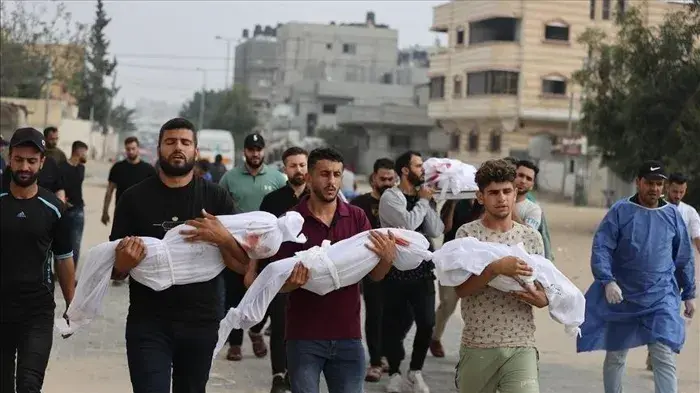
If Islam is the religion of truth, why are Muslims tested? And why are the children of Gaza being killed and what is happening there happening?.. This is a question repeatedly raised these days on the tongues of Islam's enemies, yet it is not always asked in search of an answer. It carries a blatant gloating in their hearts, enjoyment of the victims' blood and making it a subject of mockery of their faith, and an opportunity to settle scores with a religion whose followers grow day after day.
They look at scenes of killing and destruction, then raise a question meant to embarrass the believer: Where is God? Why does He not support His servants? But the paradox is that the question they think is a crushing blow to faith is one the Qur'an addressed centuries ago, answering it clearly: Faith was never a promise of a life without trial, and truth is not measured by the worldly strength of its followers.
Is affliction evidence that Islam is false, or does the objection itself rest on a mistaken understanding of faith, this world, and trial?
God says at the beginning of Surat al-'Ankabut:
﴿أَحَسِبَ النَّاسُ أَنْ يُتْرَكُوا أَنْ يَقُولُوا آمَنَّا وَهُمْ لَا يُفْتَنُونَ وَلَقَدْ فَتَنَّا الَّذِينَ مِنْ قَبْلِهِمْ فَلَيَعْلَمَنَّ اللَّهُ الَّذِينَ صَدَقُوا وَلَيَعْلَمَنَّ الْكَاذِبِينَ﴾ [al-'Ankabut: 2-3].
The verse does not speak of a passing possibility; it establishes a Quranic principle: that merely declaring faith does not mean its bearer will be exempted from testing. Fitna here means trial and examination, through which the sincerity of positions and the steadfastness of their holders become manifest.
Faith is not a word uttered in times of ease, after which life is assumed to remain cushioned by tranquillity and prosperity. It is belief, stance, patience and action, and its adherent may face what tests the sincerity of all of this.
The Qur'an affirms this meaning in His saying:
﴿وَلَنَبْلُوَنَّكُمْ بِشَيْءٍ مِنَ الْخَوْفِ وَالْجُوعِ وَنَقْصٍ مِنَ الْأَمْوَالِ وَالْأَنْفُسِ وَالثَّمَرَاتِ وَبَشِّرِ الصَّابِرِينَ الَّذِينَ إِذَا أَصَابَتْهُمْ مُصِيبَةٌ قَالُوا إِنَّا لِلَّهِ وَإِنَّا إِلَيْهِ رَاجِعُونَ﴾ [al-Baqara: 155-156].
Consider the precision of the Quranic expression: fear, hunger, loss of wealth, of lives, and of fruits. These are not descriptions remote from human reality, but images of the harshest things a person can go through. Yet the Qur'an places them among the forms of trial, then pairs them with good news for the patient.
Here a fundamental point becomes clear: the Qur'an did not say that the believer will not hunger, fear, or lose loved ones. Rather, it informed him that these calamities may befall him, taught him how to face them, and promised those who are patient a reward that will not be lost.
Among the strongest responses to the claim that affliction is evidence against religion is that the most afflicted people were not the furthest from God, but His prophets and messengers.
When the Prophet Muhammad ﷺ was asked, "Who are the most severely tested?" he said: "The prophets, then the best, then the next best. A man is tested according to his religion; if his religion is firm, his trial is intensified, and if his religion is slight, he is tested according to his religion." Narrated by al-Tirmidhi and Ibn Majah, and authenticated by scholars.
And in Sahih al-Bukhari it is related that he ﷺ said: "The people most severely tested are the prophets, then the best, then the next best."
Here the argument that links the severity of a calamity to diminished standing before God collapses. If affliction were evidence of humiliation, the prophets would be the most humiliated, and this is false within the Islamic outlook.
The Prophet Muhammad ﷺ faced harm and denial, was besieged with his companions, lost loved ones, and was injured in Ta'if until blood flowed from his feet; his sons and his wife died during his lifetime, and he tasted grief, fear and hunger. Yet these events were not evidence that his call was false or that God had abandoned him.
Indeed, his biography offers a clear model of the meaning of faith in the face of ordeal: steadfastness without despair, patience without surrender, and a hope that does not cease despite the harshness of reality.
From this we understand that affliction alone cannot serve as a measure for judging the sincerity of a religion or the standing of its adherent before God. It may be a trial, a means of expiating sins, a raising of ranks, or a purification, and we may not assert with certainty the specific wisdom behind any particular person's calamity.
God says:
﴿وَلَا تَهِنُوا وَلَا تَحْزَنُوا وَأَنْتُمُ الْأَعْلَوْنَ إِنْ كُنْتُمْ مُؤْمِنِينَ إِنْ يَمْسَسْكُمْ قَرْحٌ فَقَدْ مَسَّ الْقَوْمَ قَرْحٌ مِثْلُهُ وَتِلْكَ الْأَيَّامُ نُدَاوِلُهَا بَيْنَ النَّاسِ وَلِيَعْلَمَ اللَّهُ الَّذِينَ آمَنُوا وَيَتَّخِذَ مِنْكُمْ شُهَدَاءَ وَاللَّهُ لَا يُحِبُّ الظَّالِمِينَ وَلِيُمَحِّصَ اللَّهُ الَّذِينَ آمَنُوا وَيَمْحَقَ الْكَافِرِينَ﴾ [Al 'Imran: 139-141].
These verses were revealed in the context of what befell the Muslims at Uhud, when a moment of strength turned into wounds and losses, and when the Muslims faced a reality that many had not expected. The Qur'an came to establish that the alternation of strength and defeat among people is one of life's laws, and that adversity may be a field of purification and of the manifestation of the true nature of positions.
This meaning was addressed by Ibn al-Qayyim in his discussion of the wisdom of trial, explaining that what appears outwardly as an ordeal may inwardly be a path to mercy, elevation and chosenness, and that some great ends are attained only after examination and patience.
The Prophet Muhammad ﷺ also said: "No fatigue, nor illness, nor worry, nor grief, nor harm, nor distress befalls a Muslim, not even a thorn that pricks him, but that God expiates some of his sins by it." Agreed upon.
This hadith opens an important door to understanding suffering in Islamic belief: hardship is not necessarily meaningless loss, and the believer's patience through it may bring reward, expiation and elevation that he does not perceive in the moment of pain.
But it is necessary here to avoid the opposite error: one may not judge every calamity as evidence of its bearer's righteousness, nor describe every calamity as punishment for a sin. We do not know the unseen, and we cannot determine God's reckoning of His servants from scenes of pain alone.
Why do non-Muslims sometimes prevail while Muslims lag behind?
This is another question no less important: if Islam is the truth, why do non-Muslim nations possess the means of strength and scientific, economic and military advancement, while Muslim societies suffer weakness and decline?
The answer begins with correcting an imprecise notion: that belonging to Islam automatically grants its adherent material and political superiority, or that disbelief deprives its holder of the means of success in this world.
The Qur'an establishes that life in this world operates by laws and causes, and that the alternation of power among nations is not in itself proof of God's pleasure with one nation or His anger with another. He says: ﴿وَتِلْكَ الْأَيَّامُ نُدَاوِلُهَا بَيْنَ النَّاسِ﴾ [Al 'Imran: 140].
Material progress has its causes: knowledge, work, organisation, planning, production, respect for time, building institutions, and the ability to manage resources. Whoever adopts these causes can achieve their results in this world, regardless of his religious affiliation.
Islam itself does not justify negligence, nor does it turn faith into a substitute for work; rather it calls for striving and taking up causes, and holds the human being responsible for reforming his reality. He says: ﴿إِنَّ اللَّهَ لَا يُغَيِّرُ مَا بِقَوْمٍ حَتَّى يُغَيِّرُوا مَا بِأَنْفُسِهِمْ﴾ [al-Ra'd: 11].
It is not valid to use this verse to accuse the victims of aggression of having caused their own tragedy, for the general context of change does not give anyone the right to hold the wronged responsible for a crime committed by another. But it reminds us that renaissance is not achieved merely by belonging to a nation or raising slogans; it requires work, reform and taking up causes.
It is also mistaken to confuse Islam as a creed and law with the reality of Muslims and the conduct of some who claim to belong to it. The corruption of one Muslim does not make Islam corrupt, and the backwardness of a Muslim society does not prove that Islamic teachings call to backwardness, just as the progress of a non-Muslim state does not prove the correctness of all its beliefs.
When we come to Gaza, the discussion becomes more sensitive, because we are not speaking of a theoretical example, but of human beings who have names, homes and dreams, and of children, women and elderly people paying the price of war, destruction and aggression.
It is wrong to reduce all this pain to a single sentence such as: "It is a trial, so be patient." Patience is a great faith-based virtue, but it does not mean justifying injustice, exempting the aggressor from responsibility, or dropping the duty of support, relief, and striving to halt the aggression.
Nor may we claim to know precisely why each tragedy in Gaza occurred, or assert that what befell its people is punishment or a test of their level of faith. The Qur'an and the Sunnah give us a general framework for understanding trial, but they do not grant us knowledge of the unseen that would allow us to explain every detail of a specific event.
On the other hand, the Qur'an clearly affirms that injustice is not acceptable, and that God does not approve of it or leave it without reckoning. He says: ﴿وَلَا تَحْسَبَنَّ اللَّهَ غَافِلًا عَمَّا يَعْمَلُ الظَّالِمُونَ﴾ [Ibrahim: 42]. And He says: ﴿وَمَا اللَّهُ يُرِيدُ ظُلْمًا لِلْعِبَادِ﴾ [Ghafir: 31].
The existence of injustice in the world does not mean that God loves or approves of it, nor does it mean that the wronged has lost his dignity before Him. There is a difference between God permitting something to occur within the framework of trial and decree, and His being pleased with it or commanding it; the human being remains responsible for his actions and choices, and injustice does not turn into justice merely because it has occurred.
Here we should remember that belief in trial does not cancel the duty to resist injustice, the duty to relieve the distressed, or the responsibility of the community to support the oppressed. Patience is not a call to passivity, reliance on God is not a substitute for action, and belief in destiny and decree does not release a person from his duty toward his fellow human being.
Does the suffering of Muslims prove that Islam is not the truth?
This objection rests on conflating two different matters: the truth of the creed, and the reality lived by its adherents.
If a Muslim believes that Islam is the truth, the evidence for this must be sought in the foundations of Islam: in the oneness of God, in the Qur'an, in the prophethood of Muhammad ﷺ, and in the system of belief, legislation and ethics. To demand that religion guarantee its followers permanent political victory or uninterrupted material comfort is a condition Islam never set.
The logical counter-question is: was the ordeal of the Prophet Muhammad ﷺ and his companions in Mecca evidence that his call was false? Was their siege, their torture, and the killing of some of them evidence that they were in error? Was the Muslims' defeat at Uhud evidence that the message of the Prophet Muhammad ﷺ was not true?
Of course not. We do not judge the truth of a message by the outcome of a single battle, nor the soundness of a creed by the scale of temporary power.
The Qur'an did not promise believers that they would never be defeated or harmed, but it called them to steadfastness, and reminded them that this world is a house of trial, and that the final reckoning is not in this life alone.
The question of Muslims' suffering is legitimate and painful, and one should not silence the one who asks it or accuse him of weak faith merely because he asks. But the answer is not to cut scenes of pain out of the whole context of existence, nor to assume that truth must triumph in every worldly confrontation and at every historical moment.
In the Islamic outlook, this world is not the place of complete recompense, and trial is not an exception to the law of faith; rather it is one of the laws of life that the Qur'an informed us of, and through which the prophets and the righteous passed. Trial may contain purification, elevation of ranks and expiation of sins, but we do not assert with certainty the specific wisdom behind every calamity.
As for Gaza, its tragedy should not be turned into material to justify helplessness, accuse the victims, or minimise their suffering. It is a human tragedy that calls for condemning injustice, supporting the oppressed, providing relief, taking action, holding the aggressor accountable, alongside prayer, patience and seeking God's reward.
Perhaps the most important thing to understand is that faith does not mean not suffering, but knowing how to face suffering without losing one's certainty, one's humanity, or one's responsibility.
If affliction has touched the prophets, and if the Qur'an has informed us of fear, hunger and loss of lives, then it is not valid to make the occurrence of calamities alone evidence that Islam is false. Truth is not measured by the comfort of its followers in this world, and falsehood does not become truth merely because its proponents possess power and wealth.
In the end, God's promise to the oppressed, and His warning to the oppressors, remain an essential part of belief in the Last Day: a day when no tear is lost, no pain is forgotten, and no oppressor escapes reckoning.
﴿وَلَا تَحْسَبَنَّ اللَّهَ غَافِلًا عَمَّا يَعْمَلُ الظَّالِمُونَ إِنَّمَا يُؤَخِّرُهُمْ لِيَوْمٍ تَشْخَصُ فِيهِ الْأَبْصَارُ﴾ [Ibrahim: 42].


