


The Bangsamoro Autonomous Region in Muslim Mindanao, in the southern Philippines, has entered a new political phase after holding its first regular parliamentary election in the region's history. The vote moves the autonomy project from the transitional administration led by former leaders of the Moro Islamic Liberation Front to an elected parliament that will choose the region's chief minister.
Preliminary results of the election, held on 14 September 2026, corresponding to 3 Rabi al-Akhir 1448 AH, show that none of the competing forces won an outright majority in the 80-seat parliament. This opens the door to negotiations to form a coalition capable of electing the first elected chief minister of Bangsamoro.
According to results reported by Reuters, the camp linked to Abdulrauf Macacua, the current head of the transitional government and a former military commander of the Moro Islamic Liberation Front, won around 35.2% of the vote, against 32.4% for the camp linked to the front's chairman, Al Haj Murad Ebrahim. The "Bangsamoro Grand Coalition" won around 20.5%, making it a significant party in the negotiations to form a majority.
A more recent tally reported by the Associated Press indicates that the Bangsamoro Federal Party, led by Macacua, won 31 of the 80 seats, while the United Bangsamoro Justice Party, led by Al Haj Murad, won 30. The elected members of parliament are scheduled to take office on 30 October 2026, after which parliament will choose the chief minister from among its members.
From Armed Struggle to the Ballot Box
The election carries significance beyond party competition. It marks a key milestone in a peace process of more than a decade between the Philippine government and the Moro Islamic Liberation Front, which waged a long armed rebellion demanding rights and self-determination for the Moro people.
In 2014, the Philippine government and the front reached a comprehensive peace agreement under which the front abandoned its demand for an independent state in exchange for a region with autonomy and broader political and economic powers. The process culminated in the enactment of the Bangsamoro Organic Law in 2018, followed by the approval of residents in a 2019 plebiscite to establish the Bangsamoro Autonomous Region in Muslim Mindanao.
Since then, a transitional authority has administered the region, and the process was expected to lead eventually to direct parliamentary elections. The September 2026 election therefore represents an actual transition from transitional institutions to a regional government that derives its legitimacy from the ballot box.
Bangsamoro is the only region in the Philippines that operates under a parliamentary system. Its population is about 4.5 million, most of whom are Muslim, while around 2.4 million people were registered to vote in the election.
Broad Participation Despite Violence
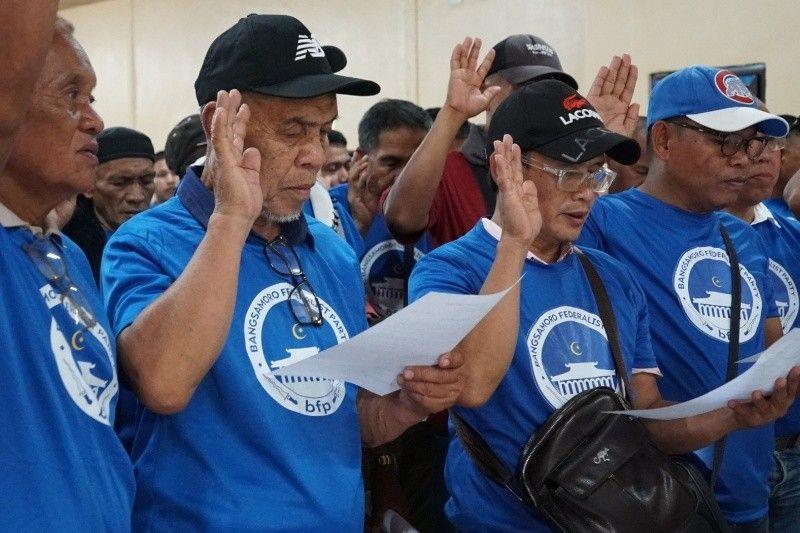
The election saw high turnout; subsequent data showed that about 84% of the nearly 2.4 million registered voters participated.
However, the polling was not free of violence or irregularities. The Associated Press reported that five people were killed in election-related violence in the regional capital and other areas, while problems at some polling stations prompted authorities to extend voting.
In the town of Malusu on Basilan island, authorities discovered ballots that had been filled in advance, prompting the election commission to take exceptional measures and extend voting hours. Authorities also deployed more than 20,000 police and military personnel to secure the election across the region.
Despite the isolated incidents, authorities described the electoral process as a whole as having been conducted peacefully, and did not declare the election failed in any area.
Former Fighters Vote for the First Time
The election also produced symbolic scenes reflecting the transformation Bangsamoro has undergone in recent years.
In a report published by the official media office of the Bangsamoro government on Tuesday, 15 September 2026, corresponding to 4 Rabi al-Akhir 1448 AH, former fighter Mustapha Karim recounted that he cast his vote for the first time in his life. He had spent years in the armed struggle for self-determination before becoming one of the members of the Moro Islamic Liberation Front's armed forces who underwent decommissioning and demobilisation under the peace agreement.
Karim said his participation in the election represents for him the fruit of what he had fought for earlier, and expressed his hope that the new government would help improve education, health and the economy, and achieve the peace that generations of the region's residents have awaited.
In Mamasapano, Islamic teacher Sandatuk Samood, 62, also took part in the election. He said that voting for him goes beyond fulfilling a civic duty, after years of struggle for peace and self-rule. He expressed hope that the elected government would give priority to education, helping the poor, improving healthcare and livelihoods.
The election thus places Bangsamoro before a new test: moving from the stage of peace agreements and transitional administration to exercising self-rule through elected institutions, while negotiations to form a majority in the coming weeks will determine the shape of the first elected parliamentary government in the region.
Will renouncing the military option succeed, and resorting to the ballot box succeed in winning the sovereignty of Muslims in the Philippines?


