


Tarique Rahman, who returned after seventeen years in exile to become the leading candidate for prime minister of Bangladesh's next government, pledged to eradicate rampant corruption and set the country on a "new path" as voting began in the first free and fair election in nearly two decades.
In an interview with The Guardian before polling stations opened on Thursday morning, he promised a new era of clean politics, vowing a strict approach from the top of the hierarchy to the bottom, with no tolerance for corruption, should his party, the Bangladesh Nationalist Party (BNP), come to power.
According to opinion polls, the BNP is likely to win a large majority over its rival, the Islamist party Jamaat-e-Islami, returning the party to government after twenty years.
Despite his modest manner and quiet voice, Tarique, aged sixty, acknowledged that the election is taking place at a pivotal but "difficult" moment for Bangladesh, a country long ranked among the most corrupt in the world, where democracy has come under sustained attack for more than a decade.
"In the previous system, we saw corruption being encouraged. Our economy was left in ruins. It will take time, but if we establish real accountability in every part of government and send a message through the administrative chain, that will eventually bring corruption under control," Tarique said.
This election is the first since the fall of the authoritarian prime minister Sheikh Hasina in August 2024. The student-led uprising that toppled Hasina after fifteen years in power resulted in the deaths of some 1,400 people, according to United Nations estimates, after the state repressed the uprising violently and brutally.
Last year, a court sentenced Hasina, who is currently residing in India, to death in absentia, convicting her of crimes against humanity committed during the final days of her rule.
In the three previous elections, Hasina and her party, the Awami League, were accused of rigging the results and ruthlessly suppressing opponents, including thousands of BNP activists and leaders.
Since August 2024, Bangladesh has been governed by an interim government headed by Nobel laureate Muhammad Yunus, tasked with restoring democracy and preparing the country for free and fair elections. Nevertheless, the country has remained in a state of turmoil, amid a decline in security and public order and growing frustration over the economic slowdown.
Analysts have said that holding a credible, violence-free election would be a vital step forward for the country. There are 127 million registered voters, and to ensure tight security, more than 900,000 police, military and security personnel have been deployed on polling day.
Thomas Kean, senior adviser at the International Crisis Group for Bangladesh, said: "This is the first credible election the country has held in 17 years, so it is of enormous significance. People are excited to have the chance to vote after this long wait."
Tarique returned to Bangladesh to contest the election, ending more than seventeen years spent as a political exile. He took over leadership of the BNP from his mother, former prime minister Khaleda Zia. Many in Bangladesh say they cannot forget the corruption that flourished during the BNP's previous rule between 2001 and 2006, under his mother's leadership. Rahman did not deny that the party committed "mistakes" in the past, saying: "I will not deny that. If we tried to deny them, it would not help us in any way."
However, not everyone in Bangladesh has welcomed Tarique's return. His parents were both prime ministers of the country, and to many he is seen simply as a new generation of dynastic politicians, perpetuating the control that two families have exercised over Bangladesh since independence in 1971, which many had hoped the July uprising would end.
Even if the BNP wins a large majority in the election, analysts stressed that the return of Jamaat-e-Islami and its Islamist alliance, parties that were banned under Hasina, could pose major challenges for the BNP and for secularism in Bangladesh in the future.
Jamaat-e-Islami, together with its allies who espouse what the Guardian described as "more hardline" Islamist policies, believes in the application of Sharia, and is likely to win its largest share of votes in its history and form a strong opposition.
Rahman acknowledged the existence of "some extremist people who are trying to do these things," but said this had nothing to do with "Islam or religion." Instead, he attributed it to "the absence of democracy … people have not been allowed to express themselves for a long time, which has led to frustration building up and, in some cases, to extremism."
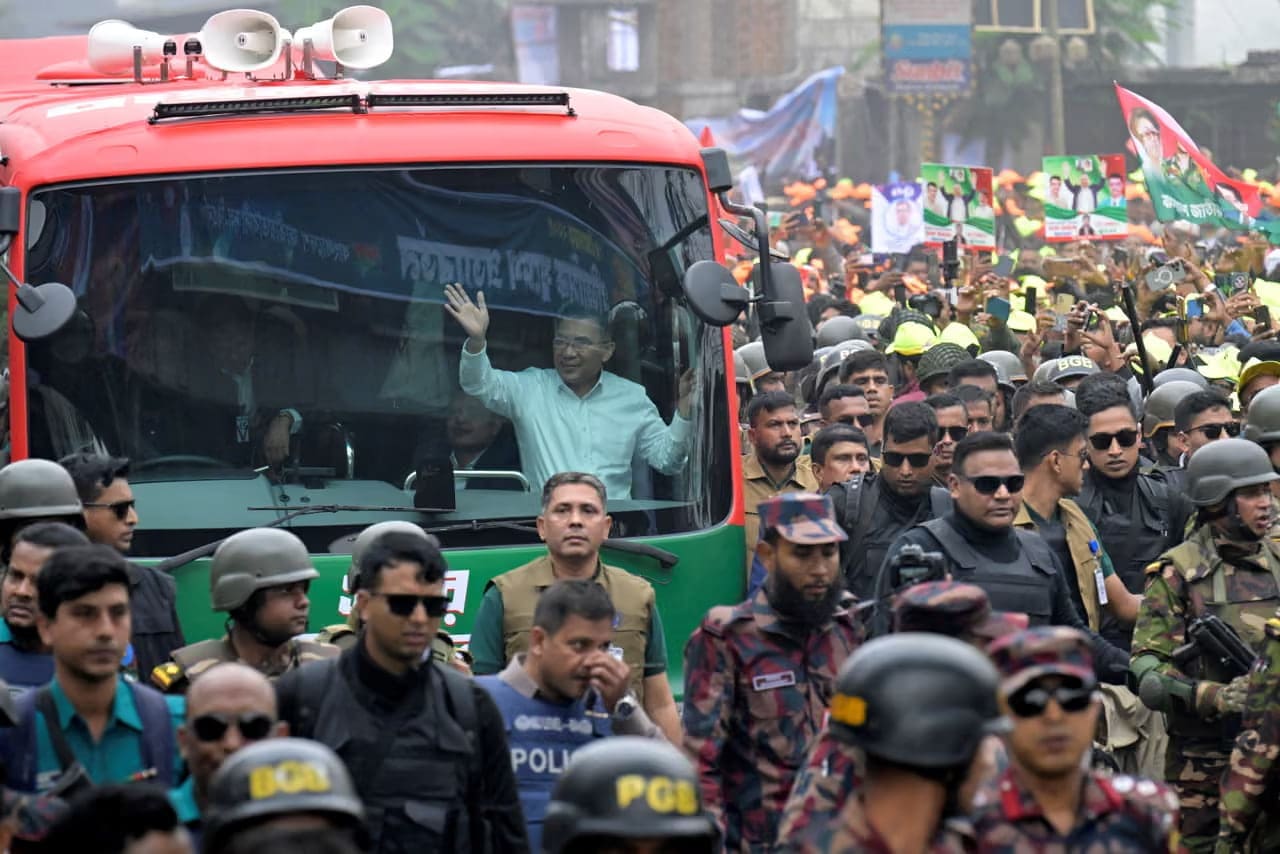
Tarique Rahman waving from a vehicle after arriving in Dhaka from London in December 2025.
Rahman insisted that the rise of hardline Islamist politics does not pose a threat to Bangladesh's pluralism. He said: "If we are able to practise democracy, and if we can provide jobs for young people and a decent life for them, I believe people will abandon this kind of thinking."
One of the biggest geopolitical challenges facing the new government in Bangladesh will be rebuilding relations with its neighbour India. Under Hasina, India was Bangladesh's closest ally, but relations deteriorated sharply after her government fell and have become openly hostile in recent months.
Asked whether India and Bangladesh could rebuild a friendship while Delhi continues to provide a safe haven for Hasina and hundreds of members of her party, Rahman was cautious, saying: "That depends. It must be on their side too."
The Guardian, UK.


