

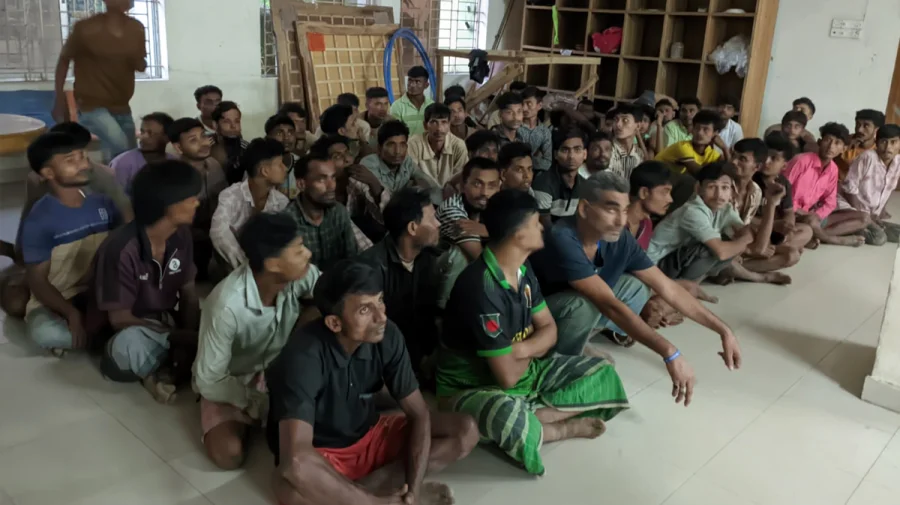
Bangladeshi authorities announced today, Friday, 6 November 2026, the rescue of 56 people held by an armed network suspected of involvement in human trafficking, in the Teknaf area of Cox's Bazar district near the border with Myanmar, during a security operation that resulted in the death of a soldier and the arrest of five suspects.
The Bangladeshi army had earlier announced a preliminary tally of 57 captives rescued. However, the chief of Teknaf police station, Saif ul-Islam, clarified that a review of the identities of those rescued revealed that one of them was an intermediary linked to the smuggling network, bringing the final number of rescued captives to 56.
The operation took place on the afternoon of Thursday, 5 November, in the remote, mountainous Ranggikhali area, after security agencies received information about an armed group of some 15 to 16 people holding nearly 120 people, including Rohingya and Bangladeshi citizens, according to a statement from the Directorate General of Public Relations of the Bangladesh Armed Forces.
Units of the army's 10th Infantry Division, the Bangladesh Border Guard, and local police took part in the operation.
According to the military account, the suspects opened fire as the joint force approached the site, sparking a clash in which soldier Mohammad Titas Sheikh, 27, was hit by a bullet in his left shoulder.
The soldier was taken for treatment, but was later pronounced dead at the military hospital in the city of Ramu from his injuries.
The army added that its forces arrested five people suspected of belonging to the network, and seized a pistol, a locally made weapon, and four rounds of ammunition.
On Friday, the police confirmed that they had received the 56 rescued people and had begun procedures to verify their identities and complete the investigation into the incident.
Authorities have not yet disclosed how many members of the Rohingya minority are among the rescued captives, nor has the fate of the other people whom intelligence information indicated may have been held by the network become clear.
The incident highlights the risks of kidnapping and human trafficking in the border areas surrounding the Rohingya camps in Cox's Bazar, where refugees who fled Myanmar live, and some of whom face the risk of exploitation by smuggling networks.
The circumstances of the captives' detention and their possible trafficking routes remain subject to the outcome of investigations, while local authorities continue to verify the identities of the survivors and the suspects.


