


By Jeremy Scahill. Published on Drop Site.
Iranian Foreign Minister Abbas Araghchi is conducting a strategic tour in preparation for two very different paths that could unfold in the coming days: a return to diplomacy, or a resumption of the war with the United States and "Israel." While President Donald Trump has claimed that the Iranian government is in a state of internal chaos and that his administration is waiting for Iran to surrender, a senior Iranian official told Drop Site that Tehran is working to create the conditions necessary for a new round of direct talks.
The official, who is familiar with Iran's internal diplomatic deliberations and who requested anonymity because he is not authorised to speak publicly about the negotiations, said: "We are currently moving forward according to our own plan, and we see that continuing negotiations is pointless before the US government lifts the naval blockade." He added: "The scope of the conflict has expanded, and naturally the issue is no longer purely nuclear."
The Iranian official confirmed that Tehran still insists on its demand that the US naval blockade in the Strait of Hormuz be lifted as a prerequisite for moving forward. If that happens, a second formal round of high-level direct talks could be held.
Araghchi is Iran's chief diplomat, so even if the chances of a breakthrough are very slim (1%), he will pursue it, according to Hassan Ahmadian, a prominent Iranian analyst and associate professor at the University of Tehran. He told Drop Site that Iran has set out a multi-stage plan to end the war: a genuine ceasefire must be imposed on Israel in the region, specifically in Lebanon, and a settlement must be reached in the Strait of Hormuz "without compromising Iran's national security and regional security." Once these conditions are met, comprehensive negotiations on Iran's nuclear programme and a long-term non-aggression agreement could begin.
Ahmadian added: "Iranians say that time is on our side with regard to three main pillars: munitions, markets and the midterm elections. These three pillars strengthen Iran's position and weaken the US position. Clearly, the United States wants to say: 'We pressured Iran and got this.' But I see that the Iranians are keen to deprive the United States of that, as they will not regard what Trump wants as a victory."
While White House officials claim that Iran presented the United States with a "new" proposal over the weekend, and promoted this narrative through media outlets they prefer, the Iranian official said this description is not accurate. Trump claimed that Iran softened its position over the weekend, but not enough to reach an agreement. Ahmadian said there has been a recent Iranian shift, but it is moving towards setting clearer conditions for resuming negotiations, not towards responding to US demands regarding its nuclear programme. He added: "There are changes, to my knowledge. The main change is Iran's insistence on ending the regional war. This is pivotal in Iran's agreement to discuss other issues."
In practice, Tehran faces an unprecedented challenge in dealing with Trump. Within one year, Israel and the United States have bombed Iran twice in the midst of negotiations. Trump is volatile and contradictory, swinging between expressing optimism about reaching an agreement and claiming that Iran has submitted to comprehensive US demands, before turning back to threatening to destroy Iranian civilisation and intensively bombing its civilian infrastructure. Iran also believes that Israeli Prime Minister Benjamin Netanyahu has unprecedented influence over US intelligence assessments and White House decisions.
A senior Iranian official, referring to previous US-Iran negotiations that lasted months, and sometimes years, of diplomacy and technical talks, said: "Our country has conducted negotiations with the Americans at various levels over the past thirty years, formal and informal, public and secret. It is like them attending a football match with the rules of rugby."
Iran holds total contempt for Trump's special envoy, Steve Witkoff, considering him unaware of diplomatic processes and entirely ignorant of technical issues. Iran views Kushner as Israel's representative in the negotiations. A senior Iranian official said Iran sees no justification for dealing with these two individuals without the presence of a figure such as Vice President JD Vance.
Last week the Iranian government announced that Araghchi would visit Islamabad for bilateral talks with Pakistani leaders. This announcement sparked a wave of media speculation about the possibility of a new round of negotiations. Trump announced that Vance was on his way to Islamabad, and repeated his description of Iran as begging for new negotiations. However, it later became clear that Vance was not aboard a plane, and Iran continued to deny any intention to meet US officials in Pakistan.
Trump then announced that Witkoff and Kushner were being sent, and the media was filled with reports of a meeting with Iran. Some media outlets, citing sources in the White House, claimed that planes were on their way to the meetings, and the White House hinted that Iran was lying about the anticipated talks. White House spokeswoman Karoline Leavitt said on Friday: "The Iranians want dialogue, they want face-to-face dialogue. Steve and Jared will travel to Pakistan tomorrow to hear the Iranian position."
Iran continued to reject any speculation about the possibility of any talks taking place. Iranian Foreign Ministry spokesman Esmaeil Baghaei said shortly after Araghchi arrived in Pakistan: "There are no plans for a meeting between Iran and the United States." He added that Iran had discussed a range of issues, including trade. On Sunday, Islamabad announced an expansion of the transit of goods from third countries through Pakistan bound for Iran. While transit routes had been under discussion since 2008, the timing, given Trump's claim that his naval blockade is "strangling" Iran, could not be ignored.
After Araghchi left Islamabad on Saturday and flew to Oman, Trump hastened to justify his position and control the damage, claiming that he was the one who cancelled the scheduled negotiations. Trump wrote on Truth Social: "A lot of time was wasted travelling, and a lot of work! Besides, there is severe internal conflict and confusion within their 'leadership.' No one knows who is in charge, not even themselves. And we have control, they have nothing! If they want to talk, all they have to do is call!"
Trump then claimed that Iran, as a result of his refusal to send his envoys, softened its position and submitted a new proposal to the United States. He said: "They gave us a proposal that was supposed to be better. Interestingly, as soon as I cancelled it, within ten minutes, we got a new, much better proposal."
Trump continues to claim that he extended the initial two-week ceasefire agreed on 7 April because the Iranian leadership was in a state of chaos and infighting. This narrative has spread widely in Western media. Ahmadian said: "This is part of the cognitive war against Iran. It targets society, the elites and the position of the Supreme Leader. This is not new news, and it is not intelligence they are talking about. It is essentially an agenda to create what they call division. I believe the main goal inside Iran is to increase and reduce mistrust among the elites, which I believe Iranians now understand well."
Ahmadian said Iran sees the American leadership as suffering from profound chaos, as evidenced by Trump's volatility and unimplemented threats, and the recent confusion over the officials who would travel to Islamabad to negotiate with Iran. Ahmadian added that during the first round of direct talks held in Islamabad on 11 April, the Iranian delegation arrived with a clear message from Tehran, representing all sections of the system, and presenting strong arguments to demonstrate unity within the country. He explained that the Iranian side left the talks with the impression that there were fundamental differences between Vance on one side, and Witkoff and Kushner on the other. He said: "Iranians view Witkoff and Kushner as representatives of Israeli interests, not American ones, unlike Mr Vance, who represents American interests in these talks. They differed in their approach to dealing with the Iranians."
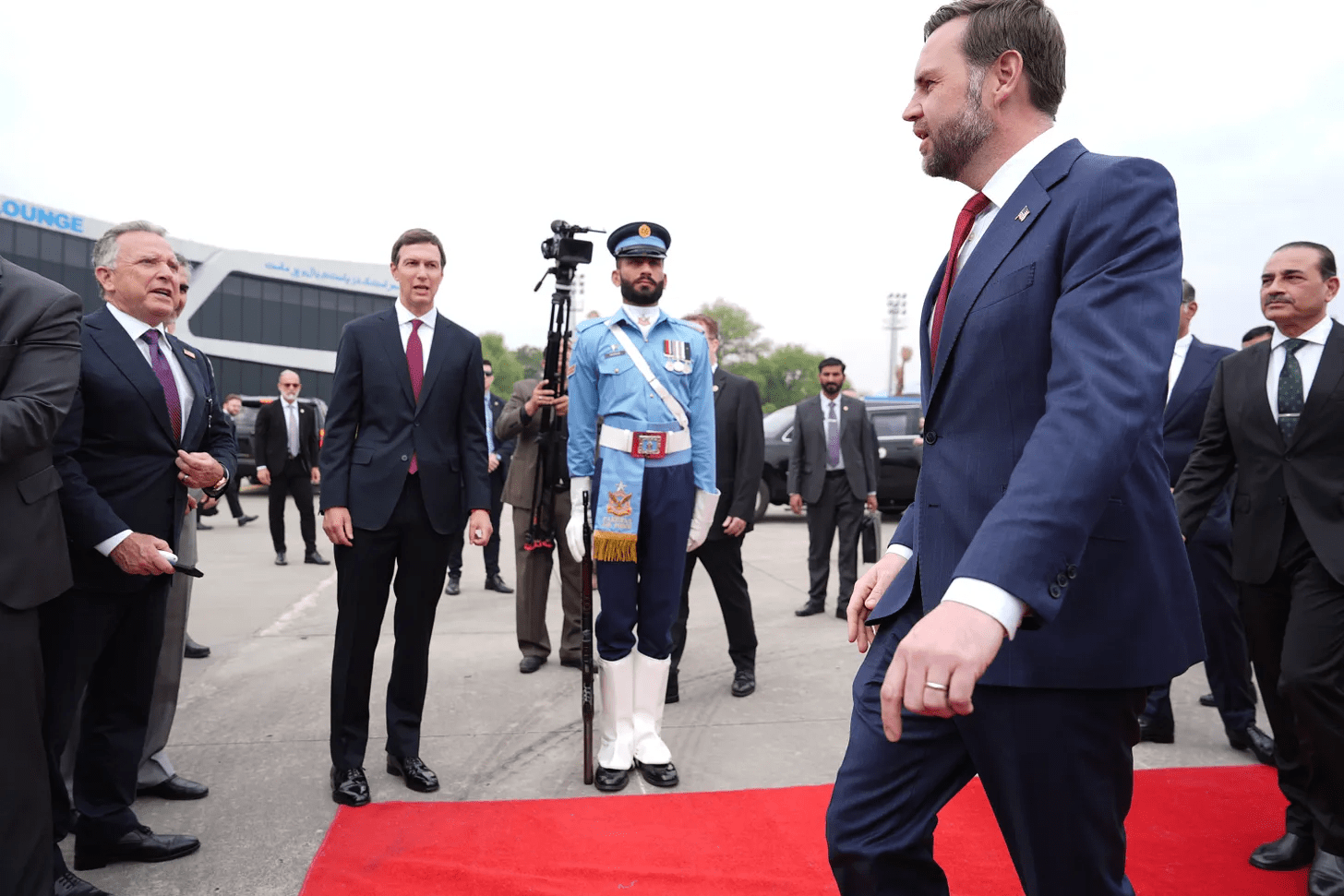
US Vice President JD Vance, Special Envoy Steve Witkoff and Jared Kushner arrived in Islamabad, Pakistan, to hold talks with Iranian officials on 11 April 2026.
"I do not consider that merely a threat"
The senior Iranian official told Drop Site that Abbas Araghchi's three-country tour is partly aimed at clearly explaining Tehran's position to mediators and key strategic actors who may play a role in any future agreement. The Sultanate of Oman has decades of experience mediating between the United States and Iran on nuclear issues, but Muscat was taken by surprise by the sudden attack on Iran one day after its foreign minister's visit to Washington, where it was believed an agreement was imminent. Given Oman's extensive experience and technical knowledge, Iran looks forward to Muscat's return to the diplomatic process. Araghchi also discussed the situation in the Strait of Hormuz, where Oman and Iran are the only two coastal states on this strategic waterway. "Our focus included finding ways to ensure safe transit."
Araghchi wrote on X: "This is in the interest of all our dear neighbours and the whole world."
During his talks with Pakistani officials, Araghchi gave a comprehensive presentation of Iran's position on a range of issues, including uranium enrichment and the crisis in the Strait of Hormuz. The senior Iranian official explained that this does not represent a new proposal, but a reaffirmation and expansion of the conditions Iran has set since February. He said: "We explained our technical positions to the Pakistani side. Regarding the nuclear issue, the solutions we had previously proposed were put forward again, with the aim of reaching a shared understanding with them." He added: "Our remarks were not directed at the Americans, since these are bilateral discussions. We also believe that the mediators themselves should be briefed on the technical aspects of the proposals."
While some Iranian officials have expressed displeasure with Pakistan's role and a sense that it is unable to manage Trump, Ahmadian said Tehran will not publicly criticise Islamabad. He said: "They do not want these talks to weigh down their relations with Pakistan with any negative outcomes."
Before his meeting with Russian President Vladimir Putin on Monday, Araghchi blamed the United States for the stalling of negotiations. He said: "American approaches caused the previous round of talks to fail to achieve its goal, despite the progress made," criticising "the excessive demands they presented and the wrong approach they followed."
Araghchi's meetings in Russia, a strategic and principal military ally, serve two main objectives. If the war resumes or extends into a state of instability without a comprehensive agreement, Iran will need to devise an alternative plan to rebuild the country, achieve economic stability, and prepare for any future American-Israeli military attacks. Moscow's support will be decisive for these efforts, particularly military and intelligence cooperation.
During his meeting with Araghchi on Monday, Russian President Vladimir Putin praised "the courage and heroism of the Iranian people in their struggle for their independence and sovereignty," and pledged that Moscow would provide assistance to Iran in efforts to end the war. He added: "Russia, just like Iran, intends to continue our strategic relationship."
Russia played a pivotal role in the 2015 nuclear agreement and may emerge as an important guarantor of Tehran's interests in any agreement concluded with the United States. Following the 2015 agreement, Iran shipped more than 25,000 pounds — roughly 98% of its stockpile of enriched uranium — to Russia. At that time, Iran was believed to possess only a small quantity of highly enriched uranium, and most of this quantity was sent to Moscow along with the less enriched uranium. After Trump unilaterally cancelled the historic agreement, Iran intensified its uranium enrichment activities, and it is currently believed to possess around 1,000 pounds of highly enriched uranium. Trump recently falsely claimed that Iran had agreed to allow the United States to send troops into Iran to seize the uranium, which Trump described as "nuclear dust."
Ahmadian said: "Russia, and China as I understand it, are the two main parties the Iranians may consider. A partner who enjoys greater trust than the United States, able to play a mediating role, and who could be the destination for highly enriched uranium in the event of an agreement. I believe these matters are an integral part of any negotiations with China and Russia."
Iran has not shown any public sign of changing its position rejecting the transfer of enriched uranium, but at the same time it has confirmed its readiness to resolve this issue within a comprehensive settlement with the United States. An Iranian official said: "For these issues, on the ground, there are clear and practical solutions, and we have always discussed them in serious negotiations." He added: "Any serious negotiations on the American side must include a large team, comprising experts and several government bodies, so that they can understand and address a meaningful agreement covering the various sectoral dimensions on their side."
At present, Iran still believes that the United States and Israel are likely to resume the war. An Iranian official said: "Our assessment is that we do not see [Trump] as capable of formulating an agreement." He added: "We believe they have essentially decided to keep the war going until a change of regime occurs," which the official predicted would continue to fail.
Tehran has indicated that it has prepared new forms of retaliatory strikes and other measures, including in the Strait of Hormuz. On 22 April, Iran's Tasnim news agency published
The Basij-affiliated Islamic Revolutionary Guard Corps' "Vay" organisation published maps of the submarine cable infrastructure in the Arabian Gulf, raising concerns that Iran could cut these cables, causing widespread internet outages and disrupting trade, further harming the global economy. Iranian military commanders said that while the United States strengthened its military presence in the region during the ceasefire period, Tehran also used this period to prepare its weapons systems for further fighting. Iran has not concealed its determination to target US military assets, as well as infrastructure in any Gulf state that provides any support for US attacks.
All of this is taking place amid growing tension in the Strait of Hormuz, marked by near-daily incidents including the seizure, interception and forced redirection of ships. Ahmadian said: "I believe the Iranians will not stand idly by in the face of US harassment and seizure of their ships. Rather, they prefer to fight." He added: "If there is no breakthrough during the coming week, I think escalation will happen. I expect the United States to increase military pressure on Iran, but the Iranians will raise the pressure this time. Iran says that if its infrastructure is targeted, it will target four times what is targeted in Iran. I do not consider this a threat. I believe they will do it, because the more pain there is on the other side, the less likely they are to continue targeting Iranian infrastructure."
Drop Site


