

A citizen in eastern China describes how the voices of the Uyghurs have been "silenced" over the past five years.
Some time ago in a major city in eastern China, a young Uyghur man handed over a letter by hand. The young man addressed the letter to the world beyond China's borders. A non-Chinese national living in eastern China received it and, at its author's request, shared it with me.
At great risk to his personal safety, the author insisted that the letter be translated, edited and published in English. After independently verifying the identity of the letter's author, I agreed. The version of the letter below has been approved by the author. The complete original Chinese version of the letter is available here.
In his letter, the author describes how his life has been shattered by the mass arrest campaign that swept through the Uyghurs across the country, leaving them "in the dark world of Xinjiang." He speaks of how the spirits of Uyghur children are imprisoned from the moment they are born, and how things were not like this before. He, like most Uyghurs in China, is well acquainted with the "re-education" camps and "poverty elimination" programmes used to separate them from one another and from their way of life.
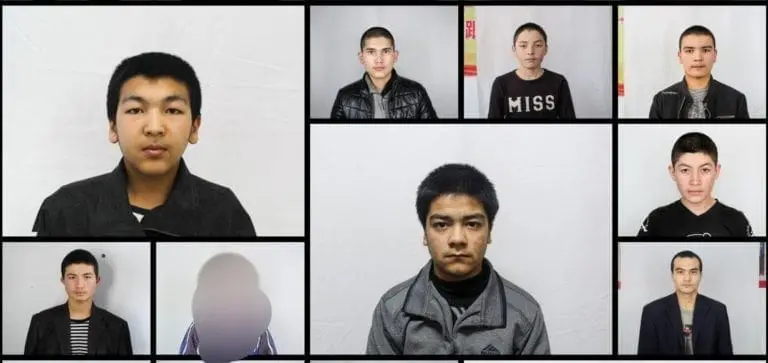
The world he describes emerges in full colour in a vast archive of thousands of photographs taken by police officers of detainees in Kashgar Prefecture, published in 1443 AH (May 2022 CE). The photographs show thousands of Uyghurs, some no older than fifteen, during their detention in camps, prisons and industrial parks in 1438-1439 AH (2017 and 2018 CE). A speech in the leaked data from Zhao Kezhi 赵克志, the national leader of the Chinese Ministry of Public Security, describes up to two million Muslims in need of this kind of "re-education."
Looking at the faces of these detainees, the reality of what the author describes from his vantage point in eastern China becomes clear, even though he draws on the experiences and letters of his family and friends in Xinjiang with precision and considerable clarity. —Darren Byler
The Text of the Letter
"I am a Uyghur living in China, and I take a great risk in writing this letter. I do not dare to reveal my name, for I will not be the only victim: my parents, who are approaching retirement age, may be imprisoned, and my younger sister will never escape the consequences.
Since the days of my grandparents, all members of my family have been members of the Communist Party. I served in the government from a young age, and I have always remained in contact with a large number of state employees.
My parents sent me to a Chinese school when I was a child, since mastering the Chinese language is a necessary condition for securing a good position in China. My family never refused this, and I was eager to be the one who raised the flag at primary school. In the third grade, my wish came true. When I saw the red flag fluttering, I felt pride and a deep love for this land.
It never occurred to me to call for the country's division [by demanding Uyghur independence], and I did not expect my family to be persecuted. But all my ideas began to gradually collapse from 1430 AH (2009 CE) [when widespread protests and unrest broke out among the Uyghurs, followed by mass disappearances and tighter control].
My family members committed no illegal acts, but my uncle unintentionally crossed the line. He was an old member of the Communist Party, so he was sentenced to thirty years in prison, with no right of appeal, under the threat that my grandmother would also be imprisoned for three years. My grandmother's younger brother was also arrested, as he was not a party member because of his religious beliefs.
As for my parents, they go to work day after day, where they are criticised and subjected to struggle sessions in front of their colleagues. They do not dare to request exemption from work. They must be extremely careful, or else they will be taken to detention camps.
These facts must be known, and they must be spoken about. But when such information is disclosed, Chinese diplomats come out to claim that the information is false and cannot be verified. Nevertheless, this will not stop me from writing to bear witness to my experiences and those of my family and friends, to call for change in my country, and to appeal to the international community for help.
Like all the Uyghurs I know, my identity card carries a special electronic security warning. In Xinjiang, where the Uyghur homeland lies, this card must be swiped at checkpoints that have spread throughout the cities, at the entrances of libraries, markets, shopping centres and university campuses. I am fortunate to live away from Xinjiang, on China's eastern coast. Surveillance here is less strict, but when I travel, my identity card suddenly reveals my ethnic origin.
As soon as you swipe your card, an alarm sounds in the background, and the person you are dealing with begins to treat you differently. Once, at a high-speed railway station in Beijing, I was immediately pulled aside into the inspection area, where my bag was searched. In Yunnan, before disembarking from the plane, the flight attendant told me I had to wait. When the plane landed, police officers were waiting for me at the exit. The same thing happened when I went to Guangzhou and Hangzhou.
On another occasion, while I was in Shenzhen, after I checked into a hotel, police officers came to inspect the room and search my belongings, then took me in a police car to a police station. The general procedure involves asking you questions and taking notes, then escorting you to a photography room, where you are forced to stand against a wall beside a height gauge, and three consecutive photographs are taken of you. Some exaggerated police stations ask you to add your WeChat account, and then, at a set time, you are asked to send your location, along with photographs of the activities you are doing.
Many Uyghurs would have felt very lucky to be in my place. Taking advantage of China's household registration policy, a growing number of Uyghurs have tried to move from Xinjiang to other regions of China, to avoid the stricter surveillance and severe harassment by local officials in Xinjiang. But once the authorities realised what was happening, they immediately suspended the acceptance of Uyghur household registrations in most regions. It is as if all the Uyghurs are trapped in the dark world of Xinjiang.
Around 1438 AH (2017 CE), the arrests began. At first, they were limited to people with criminal records and police files. Then they began arresting religious people. One of them was a relative of mine, whom I remember as a highly respected religious figure, a devout and kind-hearted Muslim. After that, they began arresting all Uyghurs who had an international travel record, focusing on those who had visited Turkey and other Islamic countries.
This inspired a group of influential writers in Xinjiang and some relevant senior officials to respond and confront the authorities. All they could do was express their opinions and tell the government that this policy was inhumane. Of course, this provoked even harsher repression by the government. All Uyghur cultural circles and active intellectuals at every level of society were summoned.
The government then began implementing the absurd system called the "Integrated Joint Operations Platform" [IJOP: a computer system that classifies individuals as suspected of committing crimes based on personal data and surveillance]. For example: if you leave your car parked in the garage for a long time, the government will call you to tell you that, because your car is idle, you have been flagged by the system and your case requires investigation. For this reason, some people were summoned as well.
As for the laws and regulations relating to the "Integrated Joint Operations Platform," there are no explanations of how it is implemented or of the nature and limits of the individuals who must be searched or arrested. The person who detains you will not tell you anything. In most cases, they do not know why you were arrested, but your name is indeed on the IJOP list. It has become clear that the automatically generated data was an arbitrary pretext for arresting people.
One of my uncles, whom I knew, worked at one of the camps. His brother had been detained in the camp, but he was not permitted to visit him. Every day, this uncle endures severe inner suffering.
Each of these camps is equipped with countless surveillance devices, and the perimeter of the camps is completely enclosed by barbed wire and huge iron gates. Staff may enter and leave only with a personal work permit, and there are specific times for transit each day. Entry and exit at other times are not permitted, and massive barriers are erected at the gates.
The camps are concrete voids. Every day, their inmates are subjected to intensive indoctrination programmes, criticism sessions and, for some, physical violence.
Since 1440 AH (2019 CE), as international debate over human rights in Xinjiang has intensified, the government has begun to panic. In particular, when internal documents circulate in foreign media, an order is issued to erase all internal documents. Policy books and documents are uniformly destroyed, and some WeChat groups are dismantled to prevent similar information from spreading online.
Since foreign media began covering the camps, many of these camps have been turned into workshops and factories. On the surface, it appears that the prisoners have been placed in an employment framework.
Outside the camps, a so-called "poverty elimination" project is being implemented in many areas. For example, in Shache County, Kashgar Prefecture, in order to meet poverty-elimination targets, impoverished peasants were forced to take out loans, build their own houses, and buy expensive furniture. They appear to have indeed left the cycle of poverty, but the next question is, how will they be able to repay the bank loans on time each month?
Education in the Uyghur language has effectively ended, and Uyghur-language textbooks have been burned on a wide scale.
No one can predict what will happen over the next ten years, but facts are facts, and it is impossible to hide the truth. I would like to remind government officials that when your children see your faces in the future, and after they become aware of the facts, they will undoubtedly condemn you in their hearts. Future generations will not remember your empty lies; all they will remember is your persecution.
We Uyghurs are without protection. Apart from offering our blood, we have no means of resistance! Our mouths are sealed and our hands are cut off. If we do not seek the voice and help of the rest of the world, we will never see daylight. We will be drowned in the spittle of the Communist Party! The spirits of our children are imprisoned from the moment they are born.
I implore the peoples of the world, especially the Islamic countries: please wake up! Profit should not come before your obedience to God. Do not abandon your friends who love God; do not leave them in this hell in exchange for money.
China, please wake up at the last moment! It is not too late to turn back. Otherwise, your pleasure in brutality will summon a violent end!"
The China Project.


