

The primary problem facing modern armies is no longer obtaining information about their adversaries, but knowing how to turn the vast quantity of information, images and data into accurate assessments that help commanders make their decisions. A state may possess satellites, eavesdropping devices and advanced surveillance systems, yet still fail to predict the course of a war or estimate its adversary's capacity to resist.
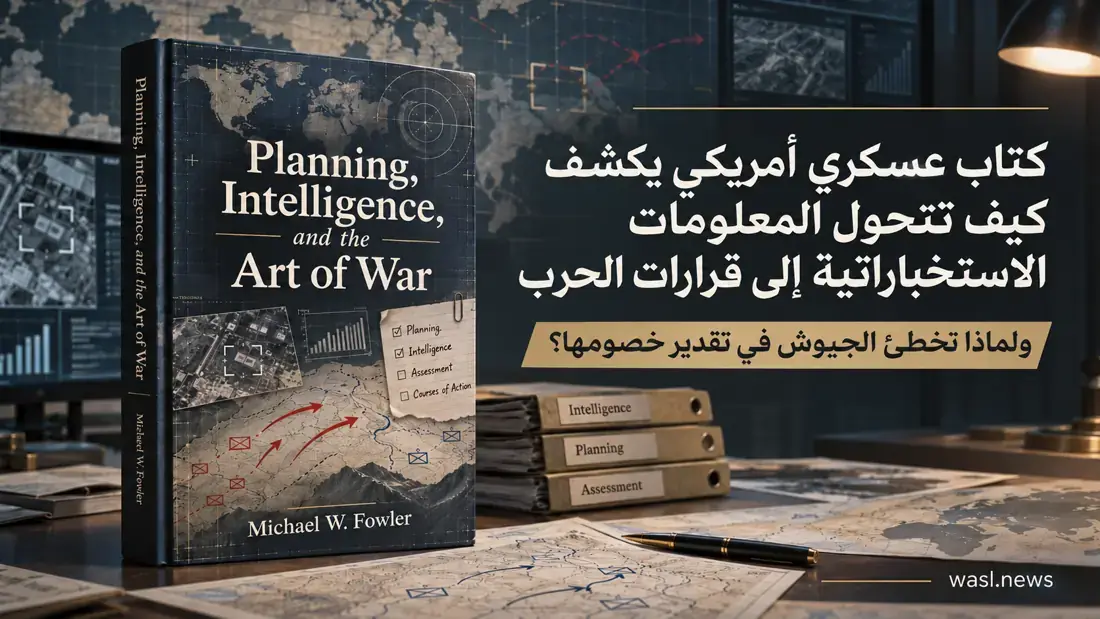
This problem is addressed in the book "Planning, Intelligence, and the Art of War: Research Methods to Support Military Operations" (Planning, Intelligence, and the Art of War: Research Methods to Support Military Operations), published by the American house Wiley in 2026. Its author is Michael W. Fowler, Associate Professor of Military and Strategic Studies at the United States Air Force Academy.
The book runs to 368 pages and contains 17 chapters divided into four parts, through which it presents a method for analysing military information, predicting adversary behaviour, assessing their capabilities, and linking intelligence findings to operational command decisions.
Notably, the author does not treat intelligence merely as a body for collecting secrets, but as an intellectual process whose aim is to reduce uncertainty and enable the commander to make a considered decision even when information is incomplete.
First: What does the military command want to know?
Fowler begins by distinguishing three levels of military intelligence: strategic, operational and tactical.
Strategic intelligence concerns major threats, the likelihood of wars breaking out and their repercussions for national security, while tactical intelligence focuses on identifying the locations of enemy units, tracking their movements and providing the information needed by forces carrying out missions.
Operational intelligence, which is the focus of the book, addresses the most complex question: how can an adversary use its forces to achieve its objectives, and what options might it resort to during war?
The author points out that knowing how many aircraft a state possesses or where its military bases are located is not sufficient to predict its behaviour. It is necessary to understand its political objectives, how its forces are organised, its capacity for supply, its points of weakness, and the circumstances that might lead its leadership to choose one course over another.
Here the difference emerges between possessing data and possessing an intelligence assessment: the former describes what exists, while the latter attempts to explain what may happen.
Second: Why did military assessments fail regarding Ukraine and Taiwan?
Among the most prominent points Fowler raises in the first chapter is his criticism of certain shortcomings in American military analysis.
He considers that expectations about how Russia's invasion of Ukraine in 2022 would develop were far from reality, and that some assumptions regarding a possible Chinese invasion of Taiwan remain general or vague to a degree that reduces their usefulness in operational planning.
As an example, he cites an American war game concerning the defence of Taiwan, which excluded a number of complex elements, such as information warfare, sabotage, cyberattacks and space operations, despite the importance of these domains in Chinese military thinking.
This observation reveals one of the problems the book discusses: the possibility that armies hold extensive information about an adversary's weapons while lacking an integrated picture of how those weapons will be used.
A military assessment that counts ships, aircraft and missiles, but does not take into account the disruption of communications, cyberattacks or the effects of unconventional operations, may present a misleading picture of the nature of a confrontation.
The author further explains that the United States' focus over two decades on tracking the tactical movements of armed groups weakened, in his view, one aspect of its experience in operational analysis of major wars.
The book does not present these observations as proof of a comprehensive failure of American intelligence, but uses them to illustrate the need to improve the methods that move from collecting information to predicting the course of operations.
Third: From assessing an adversary's strength to anticipating its decisions
The book devotes an entire section to what it calls "operational forecasting", an attempt to build realistic scenarios for the paths an adversary may take during confrontation.
This begins with identifying the initial military options, then studying potential allies and partners, before moving on to evaluating more detailed plans in terms of feasibility, risks and expected outcomes.
In the seventh chapter, Fowler presents a model based on studying four patterns of possible military options, with the aim of preventing analysts from confining their predictions to a single scenario.
He distinguishes between two matters: the ability to carry out an operation militarily, and the viability of carrying it out in light of the objectives and the acceptable risks.
A state may be capable of launching a large-scale attack, but this does not necessarily mean that it has the ability to achieve its political objectives or to bear its losses.
This distinction is important for understanding modern wars, because military superiority does not automatically translate into strategic success.
The eighth chapter offers an analytical framework linking the size of forces with their actual capabilities, their level of training, supply, infrastructure and military organisation, and then uses these elements to assess the options that are possible, and those that can be sustained until their objectives are achieved.
Fourth: Allies are part of the equation, not merely additional strength
The sixth chapter addresses a matter often reduced to calculations of military power: the role of partner and allied states.
Fowler sets out a framework for assessing potential partners according to their readiness to participate, their suitability for the mission, and the scale of what they can contribute, while taking into account political and security risks and the possibility that they may withdraw from their commitments.
The presence of an allied state that possesses military bases, ports or an important airspace does not necessarily mean that it is prepared to allow those assets to be used in any war.
Participation by allies may also open new operational options, but it may impose political constraints or increase the complexity of coordination and command.
This approach is particularly significant in multinational military operations, where simply adding up the military capabilities of participating states is not enough to know what the joint force is able to do.
Fifth: Modern war does not take place on land, at sea and in the air alone
In its third part, the book turns to analysing military capabilities across the different domains of combat.
The ninth chapter is devoted to information warfare, cyber and space operations, stressing that battles in the information domain are no longer merely a preparatory or supporting activity, but have become a constant element of competition between states.
The author considers that Russian and Chinese military doctrines give the information domain special importance, as a means of confronting some aspects of American military superiority.
The analysis is divided into functions that include acquiring information, exchanging it, influencing through it, and preventing the adversary from benefiting from or manipulating it.
In the following chapters, he addresses the role of unconventional forces, the concepts of access denial and of depriving an adversary of freedom of action within specific areas, securing sea lanes, and operations to control territory.
This arrangement shows that the author seeks to integrate the different operational domains within a single intelligence picture, rather than analysing each domain separately.
The success of a land operation, for example, may be affected by factors outside the direct battlefield, such as communications, supply, air support and political conditions.
Sixth: When does information become a military decision?
In its final part, the book reaches one of the most important practical questions: how does command determine the information it actually needs?
Intelligence agencies are not required to know everything about the adversary, which is in any case impossible, but rather to identify the questions whose answers could influence a specific military decision.
For this reason, the fifteenth chapter focuses on "Prioritized Intelligence Requirements" (PIRs), which should be capable of being addressed and of gathering evidence, and should be directly linked to decision points.
The sixteenth chapter, entitled "Collection Planning: What Is Knowable?", addresses how to use the various reconnaissance means according to their capabilities and limitations.
These means include imagery and geospatial intelligence, signals intelligence, measurement and signature intelligence, human sources, and open sources.
The author stresses the need to take into account factors such as the speed with which information can be obtained, its accuracy, the scope of coverage, the cost, and the risks associated with the collection operation.
The implication is that the value of an intelligence report is measured not only by the information it contains, but by how well it reaches the right person at the moment when that person can make a decision.
Seventh: Where does the book's importance lie, and what are its limits?
The importance of this work lies in combining methods of intelligence analysis with the requirements of operational military planning, offering a framework that helps officers and analysts think about military options in an organised way.
Its value also lies in acknowledging that advanced technologies alone do not solve the problem of misjudgement, and that failure may arise from the way questions are framed, the choice of hypotheses, or the separation between intelligence agencies and the bodies responsible for planning.
However, this approach raises an issue that deserves attention: linking intelligence analysis to the needs of the military commander makes it more useful in operational terms, but it requires preserving the independence of assessment, so that the analyst's function does not become producing the results the command wishes to hear.
This is a critical observation about the method, and not an accusation the author directs at any particular body.
The book also focuses primarily on the American operational and military perspective, and should not be treated as a comprehensive explanation of the political, social and humanitarian dimensions of wars.
Fowler himself acknowledges in the first chapter that some parts of the book are introductory and that experienced specialists may find them less in-depth in their fields, and that he does not seek to rewrite American military doctrine, but to provide practical tools for improving thinking and assessment.
Conclusion: Information does not eliminate the fog of war
The central idea of the book "Planning, Intelligence, and the Art of War" is that the ability to gather information is not the same as the ability to anticipate events. Military command needs to understand what the adversary can do, what it may choose to do, and how its options may change during confrontation.
A large number of satellites, drones and surveillance devices does not guarantee the soundness of the conclusions drawn from the information they collect.
Conversely, good planning does not mean possessing complete knowledge of the future, but rather the capacity to test hypotheses, review expectations, and adjust decisions when new information emerges.
This is what makes the book useful for understanding one aspect of the ongoing shifts in American military thinking: the move from focusing on accumulating information to focusing on how it is used to assess adversary behaviour and to make decisions.
The most important conclusion remains that the fog of war cannot be removed entirely, but its effects can be reduced when intelligence agencies are able to provide accurate analysis, review their errors, and communicate effectively with command, without falling into the illusion of certainty.
References
- Michael W. Fowler, Planning, Intelligence, and the Art of War: Research Methods to Support Military Operations. Wiley, 2026. Official book page and table of contents.
- Fowler, Introduction to Military Intelligence and Planning, Chapter 1, pp. 3–18. Chapter 1 (PDF).
- Fowler, Forecasting Detailed Courses of Action, Chapter 7. Official summary.
- Fowler, Information Warfare: Space, Cyber, and Information Operations Capabilities, Chapter 9. Official summary.
- Fowler, Prioritized Intelligence Requirements: Indicators and Decisions, Chapter 15. Official summary.
- Fowler, Collection Planning: What Is Knowable?, Chapter 16. Official summary.


