


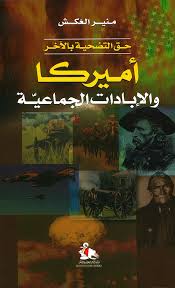
The book "The Right to Sacrifice the Other: America and Genocides" by the researcher Munir Akash comes among the Arabic works that have sought to re-read American history from a perspective radically different from the traditional narrative, which presents the United States as a model of democracy, freedom and human rights. The book was published by Dar al-Rayyes in Beirut in 2002, runs to some 200 pages, and consists of an introduction, seven chapters and two appendices.
Main Themes of the Book
- The structural constants of American eschatology: Akash identifies five central constants that explain the continuity of genocidal projects, among them "the Israelite meaning of America" and the doctrine of divine election and racial superiority, which justify endless expansion and the right to "sacrifice the other".
- Genocide as a structural method: Akash argues that the founding of the United States was built on policies of removing the Indigenous population and replacing their cultures, highlighting historical examples within the continent and beyond that link these policies to religious and economic discourses.
- Method and historical documents: The book relies on official documents, testimonies and Congressional sources to build its arguments, which gives it deep historical credibility and reveals the mechanisms through which the great power formulates its policies.
The Idea from Which Akash Starts
In the author's view, the modern United States cannot be understood without returning to the way European settlers dealt with the continent's Indigenous peoples.
As Akash sees it, the United States did not begin its history at the moment of the declaration of independence, but from a long colonial process linked to the seizure of land, the dismantling of Indigenous societies, wars, displacement, famine, epidemics, and policies that contributed to the collapse of enormous numbers of Indigenous people.
Some sources describe the book as offering a detailed treatment of the massacres suffered by the Indigenous peoples, while Akash focuses on the idea that the violence was not a series of separate incidents but part of a historical course tied to the formation of the American state and society.
How did the destruction of entire human groups become part of a process of state-building, and how was the history of that state later told as a story of freedom and democracy?
Here Akash seeks to move the reader from reading the history of the United States as a political history to reading it as a history of struggle over land, population, resources and power.
Land was not an empty space waiting for someone to settle it, as some older settler narratives may suggest, but was inhabited by communities, tribes and nations with their own political, social, economic and cultural systems.
From this standpoint, European settlement becomes a more complex process than the mere movement of new inhabitants into a new continent; it is the replacement of one society by another.
"The Right to Sacrifice the Other": The Central Idea
The author raises several pivotal questions to convey his idea: How can one society view another human group as less valuable? How does the land on which the other lives become "available land"? And how does the elimination, expulsion or confinement of Indigenous populations to specific areas become something that can be justified politically and morally?
These questions led Akash to what he regards as the essence of the colonial experience: the denial of the other's humanity often precedes the seizure of his land.
When the other becomes, in political and cultural consciousness, an "obstacle" to expansion, eliminating him becomes easier to justify.
Cultural and Demographic Genocide: Broadening the Concept
In Akash's book, the concept of "genocide" is not confined to direct physical destruction but extends to other forms, such as cultural and demographic genocide. This broadening reflects a deeper understanding of how the mechanisms of colonial domination operate, which do not stop at destroying bodies but also seek to erase Indigenous identities and cultures.
Akash's study shows how American policies, throughout history, targeted non-European cultures with the aim of suppressing them and replacing them with the culture of the settlers. This includes not only the removal of languages, traditions and beliefs, but sometimes even the manipulation of the demographic makeup of the targeted communities through policies of forced sterilisation or gender-based discrimination. These dimensions are often overlooked in traditional historical narratives, but Akash brings them back to the fore as essential elements in understanding the American project.
Critique of the Relationship Between American and Israeli Colonialism
Among the most important dimensions the book raises is the link it draws between American colonial policies and contemporary Israeli policies.
The analysis in the book is not merely a historical comparison; it is an attempt to understand the deep intellectual roots that connect these two projects, and how concepts such as the "promised land" and a "divine role" have been used to justify practices of violence and extermination.
The Five Constants of American Eschatology
Akash offers a distinctive analytical framework built on five main "constants", which he argues explain the continuity of genocidal projects in American thought and conduct. He holds that these constants are not passing ideas but structural pillars of the American system:
- The Israelite meaning of America: This constant points to America's adoption of a narrative similar to that of the "chosen people" and its "redemptive" role in the world, which gives its actions a religious legitimacy.
- The doctrine of divine election and racial/cultural superiority: The belief that Americans are divinely chosen and that their culture and race are superior justifies intervention in and control over other peoples.
- The redemptive mission of the world: The United States is seen as bearing a universal message to achieve "democracy" and "freedom", even if this requires the use of force or the destruction of entire cultures.
- Endless expansion: The continuing desire for geographic and economic expansion, which did not stop at the continent's borders but extended to global spheres of influence.
- The right to sacrifice the other: This constant is the culmination of the preceding ones, justifying the sacrifice of other peoples and their resources in pursuit of the goals of the "chosen people" and its "redemptive mission".
Documents and Evidence
Akash does not confine himself to theoretical propositions but supports them with a rigorous research methodology that relies on reliable primary sources. Through his use of historical documents, government correspondence, Congressional reports and individual testimonies, Akash builds a tightly argued account that exposes the hidden dimensions of American policies. These materials allow him to document how these intellectual constants were translated into policies, legislation and social programmes with a destructive impact on the targeted peoples.
His reliance on these official sources gives his arguments considerable persuasive force, since they cannot easily be dismissed as personal opinion; they constitute an analysis of a historical reality supported by evidence, which makes the book a powerful tool for critiquing the traditional American narrative.
The Book's Significance in the Arabic Intellectual Landscape
America and Genocides is a notable addition to the Arabic library, offering a critical view of the United States that differs from the prevailing narratives. The book raises fundamental questions about the limits of documentation and of historical and political approaches to understanding the history of the United States, and encourages readers to examine official American discourse. The book has attracted considerable attention in Arab academic and cultural circles and has been regarded as an important contribution to the critique of colonialism and of great powers from a critical historical perspective.
Akash's style, which is polemical and direct, employs sharp language when discussing settlement and forced assimilation policies, while using historical references and documents to support his arguments. His aim is not to condemn one party alone but to offer a historical-analytical account that places the history of the United States within a critical framework that questions the assumptions of freedom and democracy as absolute values.


