

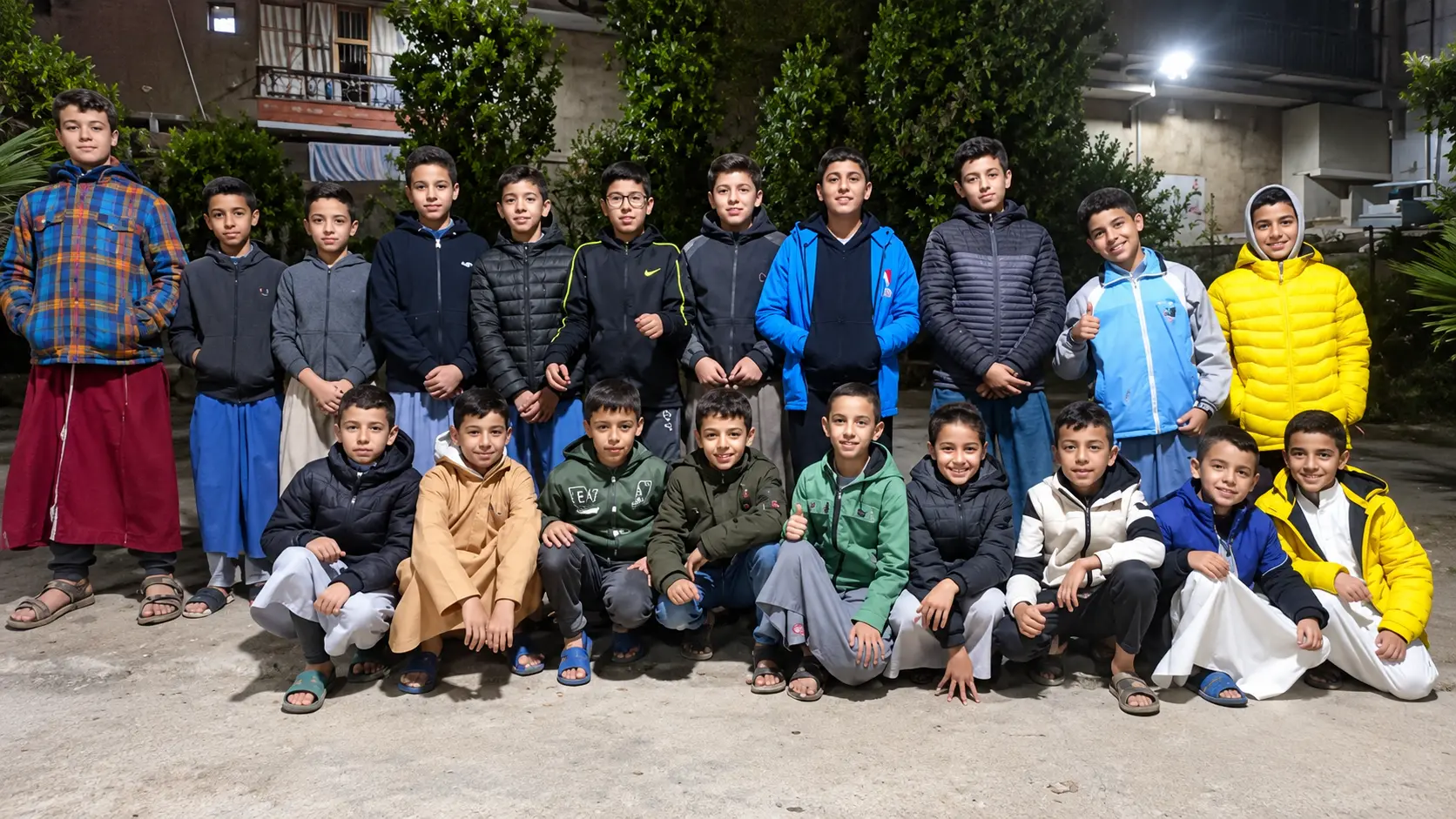
Algeria has witnessed a wave of wide controversy following remarks by Hadda Hazam, director of the newspaper "Al-Fajr", regarding the "Fajr Men" initiative, which encourages children to perform the dawn prayer in mosques. The remarks prompted the Council of Imams to call for a judicial investigation, amid escalating reactions between supporters of the initiative and critics of the position taken against it.
The debate did not stop at the initiative itself or the way it is organised, but extended to the role of mosques in raising children and the standing of the religious institution in society, in a confrontation that brought back to the forefront a deeper dispute over the presence of Islam in Algerian public life.
The issue carries additional sensitivity in a country where the consequences of the clash with everything Islamic during the 1990s remain present in its political and social memory. The "Fajr Men" episode revives old questions about the identity of the state and the place of the mosque in an equation whose files have not been fully closed.
"Fajr Men": An Educational Initiative Becomes a Matter of Public Opinion
The "Fajr Men" initiative began with the participation of a limited number of children and boys in performing the dawn prayer in congregation at mosques. It then expanded and attracted larger numbers, amid positive engagement from broad sectors of Algerian society. However, the initiative entered the circle of controversy after a video clip of Hadda Hazam spread on the "TikTok" platform, in which she objected to the initiative and, in her remarks, accused mosques of posing a danger to children.
The issue escalated when the Council of Imams entered the confrontation. Its national office condemned the circulated remarks, considering that they violate the sanctity of mosques and the standing of imams, and distort the religious, educational and social role of the mosque.
The Council called on the Public Prosecutor and the competent judicial authorities to open an investigation into the circumstances and content of the remarks and to take the necessary legal measures. At the same time, it stressed that protecting and caring for children is a religious, societal and institutional responsibility, and that any possible abuses should be addressed within the framework of individual accountability, far from generalised judgements.
Activists called for responding to the criticism by expanding the initiative and generalising it across mosques of the Republic, arguing that its success and spread demonstrate society's need for educational initiatives that reconnect younger generations with mosques.
The Memory of the 1990s: When Islam Became a Target
To understand the sensitivity surrounding this issue, it is necessary to return to the transformations Algeria underwent in the late 1980s and early 1990s.
Since independence was declared in 1962, the National Liberation Front (FLN) dominated political life, under a one-party system and the wide influence of the military institution. With the rise of social protests in October 1988, the country embarked on a new political course that ended with the adoption of the 1989 constitution, which opened the door to multi-party politics.
In this climate, the Islamic Salvation Front (FIS) emerged as the political force most capable of attracting wide sectors of Algerians, benefiting from its social and preaching presence and from the state of anger towards the existing regime.
The Front achieved a major victory in the local elections of 1990, then led in the first round of the legislative elections held in December 1991, winning 188 seats out of the 231 seats decided in that round.
The second round, however, was not held. In January 1992 the army intervened, the electoral process was halted, and President Chadli Bendjedid was forced to resign. The FIS was then banned and a number of its leaders and supporters were arrested.
That turning point marked the beginning of a major political and security crisis, while the military institution and the forces supporting its decision justified the intervention on grounds related to the future of the state and the nature of the system the FIS might establish.
However, what followed the cancellation of the elections was not merely a constitutional dispute. The country entered a cycle of repression, arrests and armed violence, and the conflict extended for many years, claiming the lives of tens of thousands of Algerians.
What Does "Secularism" Mean in the Algerian Experience?
The background of the Algerian conflict cannot be understood without considering the nature of the state formed after independence, in which the FLN monopolised power for decades and adopted a nationalist, socialist political orientation with a secularist character in the management of the state, despite the deep Islamic presence in society and in national identity.
With the rise of the Islamist movement, the disagreement was not confined to an electoral programme or a competition for parliamentary seats. It extended to a fundamental question: who holds the right to determine the identity of the state, its sources of legislation, and its social and political direction?
From this angle, the cancellation of the elections, the banning of the FIS and the arrest of its leaders can be read as a harsh blow to the rising Islamist political project, and as a decision taken by a military institution and a ruling elite that feared the transfer of power to an ideological and political rival.
The Mosque at the Heart of the Battle over Identity
The mosque was not distant from the transformations Algeria underwent. Before and during the 1990s, it served as a space for religious education, social communication and preaching work, and it was also a prominent platform for political and social mobilisation.
The Islamist movement had benefited from mosques in building its social and preaching networks, at a time when broad sectors of citizens were seeking an alternative to the existing political system. Therefore, the struggle over the Islamic Salvation Front was not separate from the struggle over the religious sphere. Hence, the current debate about children going to mosques for the dawn prayer touches a memory older than the initiative itself: a memory that sees the mosque as a central institution in forming Algerian identity.
The matter is no longer confined to a video clip or angry responses on social media platforms. The Council of Imams' call for a judicial investigation moves the dispute to the level of legal accountability and places the competent authorities before the responsibility of examining the remarks, their context and their content, rather than leaving the matter to media exchanges.
At the same time, the wide popular engagement with the "Fajr Men" initiative reveals that a segment of Algerian society views encouraging children to pray as a natural extension of religious upbringing, not as an activity that warrants suspicion.
The calls to generalise the initiative also reflect a desire to turn the debate into a positive social action, rather than leaving it a captive of exchanges between individuals and institutions.
The "Fajr Men" initiative remains a test of Algerian society's capacity to keep the mosque a space of worship, education and solidarity, and to prevent intellectual differences from turning into a new war over the identity of a society already exhausted by old wars.


