

The Houthi movement's military media outlet, backed by Iran, published on Sunday 22 November 2026 a video showing rows of containers and warehouses filled with boxes of weapons and ammunition, and said they were depots the group had seized from camps in al-Mukha on Yemen's west coast. The quantities displayed appear large, but the central question is not only how many weapons appear in the recording, but where and when these scenes were filmed, and how such military stockpiles ended up under Houthi control if their account is true?
The following day, a Yemeni government body issued a response questioning the authenticity of some of the circulating clips. Three matters are thus intertwined in this case and must be separated: the fall of al-Mukha, which did occur in September; the existence of images of military warehouses; and the claim that everything shown in the recording consists of new spoils from that city.
What does the recording show, and what does it not prove?
The video obtained by Wasl shows warehouses and containers surrounded by earth berms, holding large quantities of boxes of weapons, ammunition and military equipment, some of them densely stacked. The scenes reflect the scale of the stockpiles visible, but they are not sufficient to determine their quantities precisely or their serviceability, nor to establish where and when they were filmed or what happened to the weapons after filming.
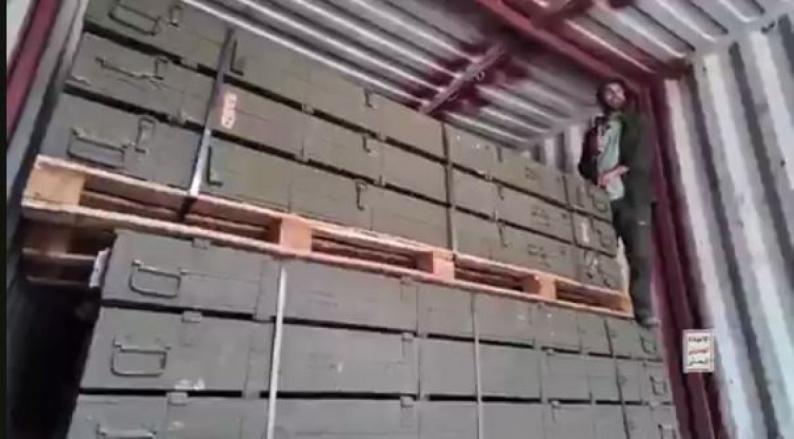
A still from the recording published on 22 November, showing boxes stacked inside a container. Image published by the Wataneya agency; Wasl has not independently verified the exact filming location.
The group claimed the depots belonged to camps where Saudi Arabia had massed weapons over years, and that what was displayed represented a limited part of the spoils.
What is the substance of the government's denial?
On Monday 23 November, the Aden Al-Ghad website reported, citing the Media Verification Center of the Yemeni Ministry of Information, that the Houthis were recirculating footage of arms depots filmed more than two months earlier, and noted that depots appearing in some of the clips had been targeted while being moved.
The center further said that one of the circulating clips, published on 20 November, dates to an area on the border between Uzbekistan and Kazakhstan and has no connection to al-Mukha. However, the published report did not provide a detailed visual comparison that would allow verification that the attached video published on 22 November is the same clip the center referred to regarding that border. The denial therefore cannot be generalised to the recording as a whole.
The origin of the footage, its actual filming date, and the identification of locations thus remain open points of verification.
How did al-Mukha fall?
The Houthis took control of the city of al-Mukha on 10 September 2026, following a rapid offensive on the west coast fronts, coinciding with successive withdrawals by Yemeni government forces and their allies, which ended with the fall of a city that had been an important military and logistical centre for forces opposed to the Houthis and that holds a strategic position near the Bab al-Mandab strait.
The Associated Press documented the fall of the city, while Reuters, citing Yemeni, Iranian and regional sources, reported that the Houthi advance received support from Iran's Revolutionary Guard, including weapons and military advice, while Tehran denies directing the Houthis' military operations directly.

A set of stills of the weapons scenes attributed to al-Mukha, published by the "Southern Yemen" platform on 22 November. The image is a composite of circulating footage and is not an independent investigation of its location or date.
Why were large arms depots left behind after the withdrawal?
To understand how stockpiles of this size came into Houthi hands, it is necessary to return to the way the west coast front collapsed in September. Field information indicates that what happened was not an orderly withdrawal under a complete plan to evacuate personnel and equipment, but a series of military breakthroughs followed by rapid withdrawals, amid confusion in command and breakdowns in communications. On 9 September, the Houthis were able to break through defences along the mountain routes leading to al-Mukha, seize a vital road and a nearby military base, cutting supply lines and threatening the defending forces with isolation.
An account published by the Associated Press, based on testimony from fighters of the National Resistance and government officials, reveals a highly significant detail: on the evening of 9 September, orders were issued for the forward units to withdraw towards al-Mukha, but the arrival of thousands of withdrawing fighters in the city led some forces already there to believe a large Houthi attack was imminent, and they began leaving as well. The retreat thus turned from the front lines into a wider withdrawal, and the forces lost the ability to hold their defences or organise an orderly exit, before the Houthis entered the city the following morning.
This is where the fate of the arms depots can be explained: evacuating warehouses holding large quantities of ammunition and heavy equipment is not like evacuating personnel and combat vehicles; it requires time, transport, secured routes and command that sets clear priorities for what must be moved or left. When defensive lines collapse quickly, supply routes are cut, and forces turn to rescuing their personnel and regrouping their units, moving an entire stockpile becomes extremely difficult, especially if no advance evacuation plan exists. Units assigned to guard the depots may find themselves facing conflicting orders, or without contact with their command, and leave their positions, abandoning equipment they cannot transport.
Compounding this is a deeper flaw documented by the Sanaa Center for Strategic Studies: the National Resistance forces and the Taiz axis continued to operate within separate chains of command, there was no effective coordination between them, and a joint command was not established until the scale of the breakthrough became clear. The centre also pointed to shortcomings in Saudi air cover during the decisive phase. Taken together, these factors mean the withdrawal was not merely a limited field decision but the result of a crisis in the command and control system, which compounded the effects of the Houthi offensive.
If it is confirmed that the depots visible in the video were among the sites Government forces withdrew from, the explanation most consistent with the sequence of events is that the speed of the collapse outpaced the forces' ability to evacuate and protect their stockpiles. This does not absolve the commanders of responsibility; rather, it shifts the question to a more serious level: why were no advance plans put in place to protect and evacuate these depots when the front was breached? And how could the loss of some positions and communication lines lead to the loss of a strategic city and whatever large military stockpiles its camps may have held?
The problem here is not only the weapons that may have been left behind by the withdrawing forces, but a military system that had the equipment and external support, yet failed to keep its command cohesive and its withdrawal organised, which prevented the loss of positions from turning into a probable loss of the weapons themselves.
What does the incident mean militarily, politically and strategically?
If it is confirmed that the Houthis seized large stockpiles of weapons and ammunition during their control of al-Mukha, the incident goes beyond a military trophy to a shift in the balance of power, in which one side's losses become direct gains for its opponent. Weapons on which funds were spent to purchase and equip forces to confront the Houthis become available to the group itself, potentially enabling it to replace expended ammunition, rearm its units, and sustain its military operations without bearing the full cost of supply. The scale of this gain depends on the types of weapons and their serviceability, but seizing a large stockpile of usable material means the loss of the camp does not end with the forces leaving it; it may become an additional source of strength for the side that took control of it.
The more dangerous implication is that the war may have entered a new phase rather than approaching its end. The loss of positions and stockpiles weakens the defensive capabilities of the Yemeni government forces backed by Saudi Arabia and worsens the imbalance between the parties to the conflict. If the Houthis are able to exploit what they seized militarily, their capacity to sustain attacks and prolong the confrontation may grow, while their opponents are forced to rebuild their units and replace lost weapons and ammunition. A single loss may thus become a prolonged military and financial burden rather than a passing setback on the ground.
The seriousness of this development is compounded by al-Mukha's location on the west coast near the Bab al-Mandab strait. The Houthi takeover of the city in September was not merely a geographic expansion; it gave them a presence close to one of the world's most important international shipping lanes and increased their capacity to pressure Saudi Arabia and threaten navigation in the Red Sea. If this territorial advance is combined with additional stocks of equipment, it strengthens their ability to hold their positions and sustain ground operations, although the weapons visible in the video are not by themselves sufficient to prove new naval or missile capabilities. The impact of the battle thus extends from the Yemeni front to calculations of regional security and international trade, particularly amid the broader confrontation between the United States and Iran.
Media-wise, the timing of the video's release, more than two months after al-Mukha's fall, carries a message beyond a display of weapons. Images showing boxes of ammunition and multiple depots are used to present the Houthis as the advancing party capable of turning their opponents' defeats into sources of strength, while placing the military leaderships that lost the city under pointed questions about planning, protection of equipment and management of the withdrawal. The psychological and political impact of these scenes may exceed their actual military value, especially if the relevant authorities fail to provide a documented explanation of what happened to their stockpiles.
In conclusion, if the account of seizing this arsenal is accurate, it represents a compound loss: the loss of territory and weapons together, a weakening of confidence in the leadership, and an enhanced ability for the Houthis to continue fighting and to raise the cost of recovering the lost areas. The accumulation of field gains may also give the group additional leverage in any future negotiations and make a political settlement more complicated, while Yemeni civilians face the prospect of a longer and more draining war. The scene, then, is not limited to boxes of weapons that fell into the enemy's hands; it reveals how the collapse of a single front can change the calculations of the entire war.
Questions still unresolved
Fundamental questions remain about the actual nature of the depots visible in the video, their locations, the quantity of weapons the Houthis have genuinely seized, and the military bodies responsible for protecting them. Most importantly: why were these stockpiles not moved or destroyed before the withdrawal, and who bears responsibility for their falling into the enemy's hands?
These questions call for an independent and transparent investigation that clarifies the circumstances of what happened and identifies responsibilities.
The arsenal: a military embarrassment and a message that the war is not over
Regardless of the debate over the authenticity and source of the footage, the mere announcement by the Houthis that they seized stockpiles of this magnitude represents a political and military embarrassment for the Yemeni government forces backed by Saudi Arabia and its regional allies. This embarrassment would become more serious if the account is confirmed: the matter would not simply be the loss of military positions, but the transfer of large quantities of weapons and ammunition prepared to confront the Houthis into the hands of the group itself.
This is a twofold loss: weakening the capabilities of the side that withdrew, and strengthening its opponent's stock without the latter bearing the full cost of acquiring it. If this arsenal is serviceable, it could help the Houthis replace expended ammunition, prolong their military operations, strengthen their capacity to continue fighting on internal fronts, and possibly widen the scope of regional threats.
More dangerously, if confirmed, this would reveal a deep flaw in the management of the war, in protecting its stockpiles and in coordination among military formations, and would raise uncomfortable questions about the value of years of spending, arming and external support. It would also give the Houthis a propaganda gain that reinforces the image of their superiority among their supporters and places psychological pressure on their opponents.
Ultimately, if the scale of this loss is confirmed, it does not indicate that the conflict is nearing its end, but rather that one of its parties retains the capacity to sustain it, with the likelihood of a longer war and rising human and economic costs, while Yemeni civilians remain the greatest victims of renewed fighting and stalled prospects for a political settlement.


