


In a development that sources from the Islamic Endowments Department (Waqf) in Jerusalem described as an unprecedented breach of the historical status quo at the Al-Aqsa Mosque, Israeli police allowed Jewish settlers, during their storming of the mosque on Sunday, to bring Jewish prayer books into the compound and to hold collective prayers in its courtyards.
At first glance, the matter may seem a detail concerning religious rites, but in Jerusalem it carries highly sensitive political and religious significance.
The issue is not only about who prays and where, but about the broader question: who holds the right to determine the rules of entry and worship inside the Al-Aqsa Mosque?
What is the "status quo"?
For decades, what is known as the status quo has governed the arrangements regulating access to the Al-Aqsa Mosque, its administration, and the practice of worship there.
Under these arrangements, the entire Al-Aqsa compound, which covers approximately 144 dunams, or 14.4 hectares, is considered a sacred Islamic site, and the Islamic Endowments in Jerusalem are responsible for its administration and for organising worship and maintenance.
Jews, meanwhile, were permitted to visit at specified times, but without performing prayers inside the compound.
This is where the significance of the latest development lies. According to the Palestinian Waqf source who spoke to Middle East Eye, there is a major difference between a person entering the site as a visitor and entering it to perform prayers according to their own religious rules.
When the Israeli police officially permit the bringing in of prayer books and the holding of collective prayers, the matter, according to this source, goes beyond individual practice to the imposition of a new religious practice at the site.
From individual acts to organised practice
Jewish prayer inside Al-Aqsa has not been entirely absent in recent years.
Reports have described individual cases in which Israelis performed prayers inside the compound, usually informally or without an announced official approval.
However, the new development, according to the report, is the shift from scattered individual cases to an organised collective practice permitted by the police.
Reports have also referred to the permitting of prayer texts to be brought in, and to practices such as praying, chanting and dancing in the mosque's courtyards.
This is what makes the matter more serious than a single new incursion.
The problem here is not only the number of intruders, but the change in the rules governing their presence inside Al-Aqsa.
Why does this matter?
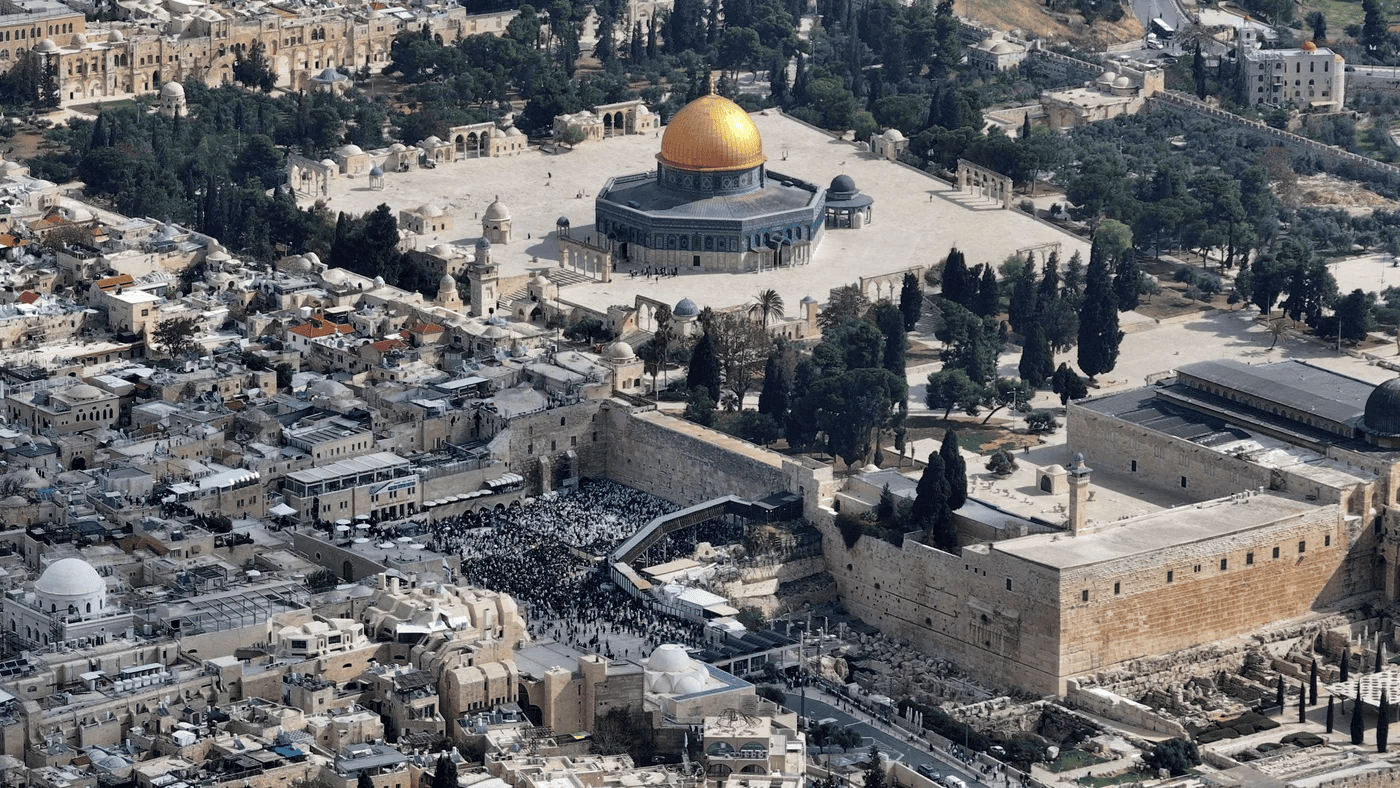
The Al-Aqsa Mosque is not merely a religious site. It is one of the most sensitive places in the Palestinian-Israeli conflict, and any change to its arrangements can quickly turn into a broad political and security crisis.
For this reason, permitting Jewish prayer at the site can be read as a shift from tolerating individual violations to giving official status to a practice that had been rejected under the arrangements of the status quo.
Here the Palestinian and Islamic concerns emerge: that this step may be part of a gradual process to change the character of the place.
Instead of Al-Aqsa remaining an Islamic site that allows Jews to visit without praying, the situation may, according to critics, develop into a reality in which regular Jewish rituals are imposed alongside Islamic worship.
The escalation did not begin today
The latest development comes within an escalating trajectory that has continued for years.
Since Jews occupied East Jerusalem in 1967, the Al-Aqsa question has remained one of the most sensitive files in the conflict.
However, Israeli officials from the nationalist and religious right have in recent years pushed towards changing the rules governing the site.
Among the most prominent is Itamar Ben-Gvir, Israel's National Security Minister, who has previously spoken of imposing what he calls "Israeli sovereignty" over Al-Aqsa.
During a large storming of the mosque in July, more than 3,500 Israelis took part, and Ben-Gvir was among them.
During the incursion, he said that Jews pray at the site and feel that they are "the owners of the place."
These statements make the latest developments clearer. According to the Islamic Endowments and Palestinian sources, the matter does not appear to be merely individual excesses by settlers, but part of a struggle over the nature of the site and the rules governing its administration.
On the other side... restrictions on Muslims
The other side of the picture is the restrictions imposed on Palestinian Muslims' access to Al-Aqsa.
Restrictions on Muslim entry, alongside constraints on the work of the Endowments, are increasing in parallel with the expansion of Jewish presence in the compound. This creates a highly sensitive equation: more space for Jewish practice, alongside greater restrictions on Islamic worship.
Hence the concerns that the change concerns not only allowing Jews to pray, but gradually reshaping the reality inside Al-Aqsa.
What does this mean for the future?
The real importance of the news is not in the prayer books that entered the mosque in a single day, but in the question this event raises: will the exception become the rule?
If collective Jewish prayer inside Al-Aqsa becomes a regularly permitted practice, this would in effect change one of the most important elements of the status quo that has governed the site for decades.
This could open the door to further demands, such as expanding prayer times, increasing the number of Jewish worshippers, or imposing new arrangements dividing times or spaces of worship.
For this reason, the Islamic Endowments view the development as part of a gradual dismantling of the status quo, rather than an isolated incident.
Al-Aqsa: a struggle over place and symbolism
Ultimately, what is happening at Al-Aqsa cannot be understood apart from the broader conflict over Jerusalem.
For Muslims, the mosque represents a deep religious and historical symbol, while for Jewish nationalist and religious currents it represents a central pillar of their vision for Jerusalem's future.
Accordingly, any change to the rules of prayer inside it goes beyond the boundaries of ritual. It touches the identity of the place, its administration, sovereignty over it, and the future of the conflict over Jerusalem.
Perhaps the most dangerous aspect of the latest development is that change does not necessarily come through a large and sudden announcement, but through small steps: an incursion, then individual prayer, then collective prayer, then the bringing in of prayer books, then official permission. As these steps accumulate, a new reality may take shape on the ground before anyone formally declares the end of the "status quo." This is precisely why what is happening matters.
The question is no longer only: who enters the Al-Aqsa Mosque? It has become: who determines the rules of worship there? And who has the right to change them?
In Jerusalem, changing these rules may be more dangerous than any political statement, because what begins as a small measure inside the mosque can turn into a major change in one of the most sensitive issues in the region.


