


In contemporary Islamic consciousness, the name al-Andalus has nearly become a synonym for loss, as Córdoba and Granada are invoked as the lost paradise, and tales are told of palaces, gardens, rivers and burned books, until weeping over al-Andalus has become part of the collective memory of the Muslim nation.
Yet a question arises: how did Muslims weep for so long over an al-Andalus that lasted for centuries, while they nearly forgot an India they ruled for almost a thousand years?
The history of Islam in India is not a margin of Islamic history. It is a chapter that rivals roughly a quarter of that history in scale and impact. In the Indian subcontinent, Muslims left not only cities and palaces, but a complete civilisation: states, schools, universities, languages, architectural styles, trade networks, systems of governance, and a human memory that remains alive in more than 200 million Muslims living there today.
If al-Andalus gave the world the Great Mosque of Córdoba and the Alhambra, India gave something broader: from the Taj Mahal to the Red Fort, from the Jama Masjid to the Qutb Minar, and from cities that were centres of the global economy to a new language called Urdu, born from the interaction of Islam with India.
When Islam reached India before Europe knew al-Andalus
The story began early, before al-Andalus itself was opened. In the first century of the Hijri calendar, corresponding to the seventh century CE, Arab ships were docking on the coasts of Malabar carrying goods, language and the new faith. Those who arrived were not armies but merchants, yet trade has often been the prelude to an entire civilisation.
Then came the decisive moment with the campaign of Muhammad bin Qasim al-Thaqafi in 711 CE (92 AH), by order of the Umayyad caliph al-Walid bin Abd al-Malik, when Islamic armies entered Sindh and Karachi and opened the gate of the Indian subcontinent to an Islamic presence that would last for many centuries.
This campaign may appear in history books as a limited military event, but in reality it was the beginning of a vast transformation. From that time on, Islam was no longer a guest in India; it became one of its major components.
From the Ghaznavids to the Delhi Sultanate: founding the state
In the fourth and fifth centuries AH, corresponding to the tenth and eleventh centuries CE, Mahmud of Ghazni emerged, leading successive campaigns into India and establishing Islamic influence across wide areas of the north.
The real transformation came in 1206 CE (603 AH), when Qutb al-Din Aibak founded the Delhi Sultanate. From that moment, Delhi became the capital of one of the greatest Islamic powers in Asia.
The sultanate was ruled by successive dynasties, including the Mamluks, the Khaljis, the Tughlaqs and others, and its borders expanded until northern India became a vast Islamic political space. This was not merely military rule: a central administration emerged, cities flourished, knowledge spread, and a class of scholars, judges and men of letters took shape.
The figure rarely mentioned
When the history of al-Andalus is recalled, roughly 8 centuries of Islamic rule are evoked. As for India, the periods of continuous and successive Islamic influence extend from the early eighth century CE until the effective fall of the Mughal state in the nineteenth century, a span of nearly 1,000 years.
This figure alone is enough to reorder memory. India was not a distant province; it was one of the largest arenas of Islamic civilisation, home to millions of Muslims, and an economic and cultural centre rivalling the greatest centres of the world at the time. At the height of the Mughal era, India contributed roughly a quarter of global economic output, according to commonly cited historical economic estimates, a scale that reveals that speaking of India is not speaking of ruins, but of a complete global power.
Why, then, has al-Andalus remained so present, while the memory of India has receded?
Perhaps because the fall of al-Andalus was dramatic and concentrated: a last city falls, a king weeps, a people is expelled. India's story, by contrast, is longer and more complex: centuries of rule, then British colonialism, then partition, then national conflicts, then the survival of tens of millions of Muslims within the modern Indian state.
Yet the complexity of the story does not justify forgetting it, especially since almost every corner of India bears traces showing that Muslims were not passing through. Blood was shed, schools were founded, roads were built, cities were erected, languages were born, arts flourished, justice was sought by rulers, and scholars illuminated minds.
How did Islamic India produce one of the greatest civilisational renaissances in Asia?
Many empires knew conquest, but few managed to turn conquered land into a lasting civilisation. India was among the most prominent examples in which the Islamic presence went beyond the realms of the state, learning, the economy and the arts.
Between the establishment of the Delhi Sultanate and the rise of the Mughal Empire, Islam was no longer merely a political authority; it became an essential element in shaping India's own identity.
In 1526 CE (932 AH), Sultan Zahir al-Din Muhammad Babur won the First Battle of Panipat, founding the Mughal Empire, one of the greatest Islamic empires in history. The Mughal state was not merely an extension of the Delhi Sultanate; it was the beginning of a new phase in which Islamic civilisation in India reached the peak of its political, military and economic power.
For more than three centuries, the Mughals ruled most of the Indian subcontinent, and emperors succeeded one another on the throne, each leaving his own mark, from Humayun to Jalal al-Din Akbar, then Jahangir, Shah Jahan and Aurangzeb Alamgir. During their reigns, India became one of the richest and most influential regions on earth.
Historical economic studies indicate that Mughal India was, during the seventeenth and eighteenth centuries CE, among the largest economies in the world, its contribution estimated at roughly a quarter of global economic output.
This was not due to gold alone, but to an integrated economic system. Agriculture witnessed a huge boom thanks to the development of irrigation systems, and handicrafts, especially textiles, silk and cotton, became sought after in Europe and Asia. Islamic ports on the Indian Ocean became major stations in world trade, linking the Middle East, Central Asia and East Africa with Southeast Asia.
Ships carried spices, textiles, metals and precious stones, while caravans crossed the prosperous Islamic cities of Agra, Delhi and Lahore, forming an economic network that made India a beating heart of international trade.
They did not only build palaces; they built entire cities
One of the most common errors is reducing Islamic civilisation in India to a single building, the Taj Mahal. In truth, the Taj Mahal is merely the tip of an enormous civilisational iceberg. Muslims re-planned entire cities according to an urban vision advanced for its time, in which the great mosques sit at the centre of the city, linked to markets, caravanserais, gardens, water networks, palaces and administrative centres.
The city of Shahjahanabad, which later became Old Delhi, was a complete model of Islamic urban planning, and Emperor Shah Jahan made it one of the most beautiful capitals of the world in the seventeenth century. Gardens were not merely places for leisure; they were designed according to Islamic philosophy inspired by descriptions of paradise, so water became a key element of the architecture, with symmetrical geometric walkways and lush gardens, many of which still exist today.
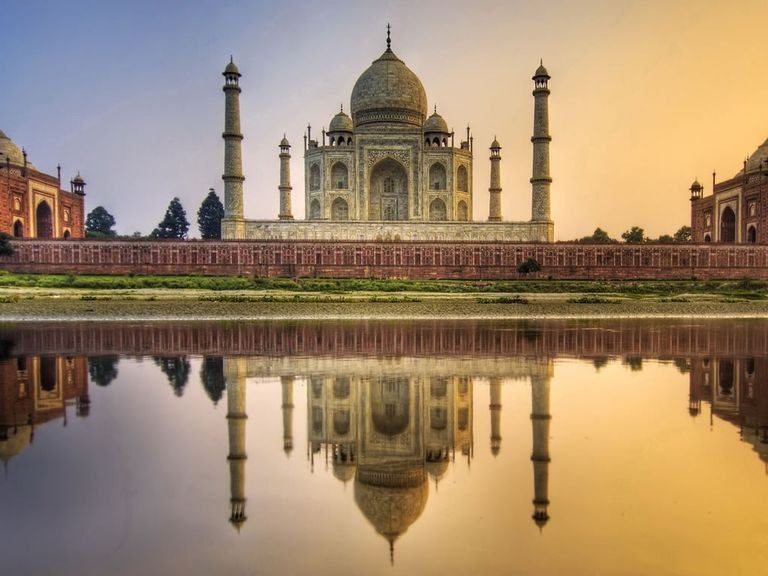
The world promotes the Taj Mahal as the greatest love story in history, but this narrative reduces the truth. This structure, which Emperor Shah Jahan commissioned in memory of his wife Mumtaz Mahal, was not merely a mausoleum; it was a declaration that Islamic architecture in India had reached the highest degrees of creativity.
Its construction took more than twenty years, and thousands of engineers, craftsmen, calligraphers and sculptors from across the Islamic world took part in building it. Its design combined the Persian school, Turkish taste, Islamic decoration and Indian craftsmanship, producing a work that is still classed among the wonders of the modern world and attracts millions of visitors every year.
Thus the Taj Mahal is not merely a tourist landmark, but a stone document bearing witness to the civilisational power that Muslims attained in India.
The Red Fort: where an entire empire was administered
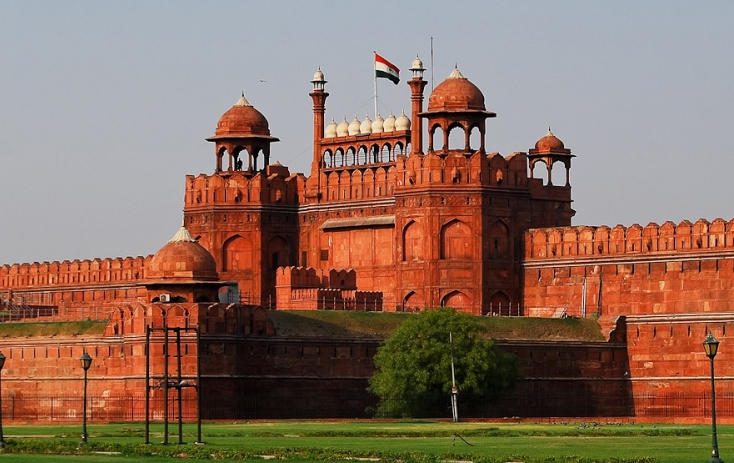
Hundreds of kilometres away, the Red Fort in Delhi stands as a witness to the grandeur of the Mughal state. This fortress was not merely a military stronghold; it was the political and administrative capital of the empire, and from within its palaces decisions governing millions of people were issued. Its ornate halls, marble arcades and inner gardens reflect the philosophy of Islamic rule that combined strength with beauty, and authority with art.
To this day, India's prime minister delivers the Independence Day address from the walls of the Red Fort, an implicit acknowledgement that this Islamic monument has become an unavoidable part of the history of the modern Indian state.
The Jama Masjid: the beating heart of Delhi
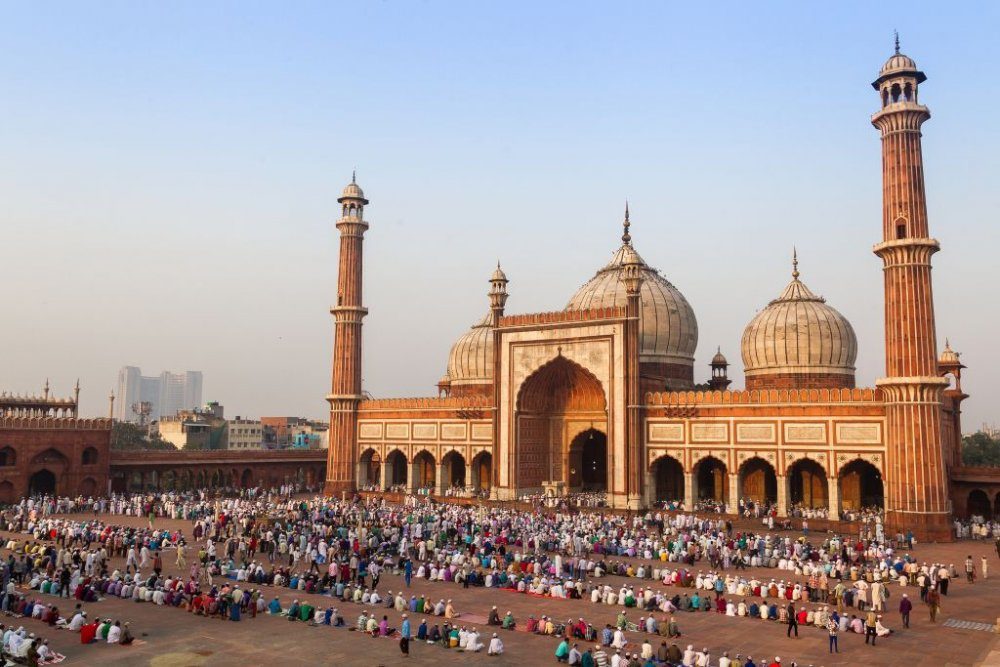
When Shah Jahan wished to build a mosque worthy of the imperial capital, he erected the Jama Masjid in Delhi, which remains today the largest and best-known mosque in India, with its white marble domes, soaring minarets and vast courtyard that can accommodate tens of thousands of worshippers. The mosque was not merely a place of worship; it was an open university, a court, a centre for legal opinions, a platform for learning, and a meeting place for merchants, scholars and travellers.
In its courtyards generations of scholars took shape, who spread across Asia carrying the sciences of jurisprudence, hadith, language, mathematics and astronomy.
The Qutb Minar: the stone that tells the beginning of the story
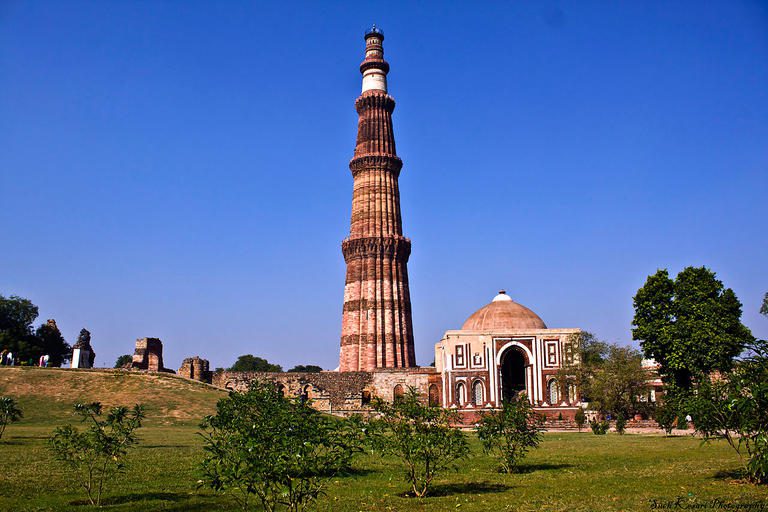
Before all these masterpieces, the Qutb Minar had announced the birth of a new era. After the establishment of the Delhi Sultanate, Sultan Qutb al-Din Aibak began building this minaret in 1199 CE (595 AH), before his successors completed it.
Rising more than 72 metres, it remained for centuries the tallest minaret in the Islamic world, and it is still today one of the most prominent symbols of early Islamic architecture in India.
Its archaeological complex, which includes the Quwwat al-Islam Mosque and other remains, represents the first witness to the transfer of Islamic art from Central Asia to the Indian subcontinent, and then its fusion with the local environment to produce a new architectural style that later became one of the greatest artistic schools in the world.
But civilisation is not measured by stones alone, nor by the grandeur of palaces, but by what it leaves in minds, languages and sciences.
When historians speak of the fall of states, they often tie the end of a civilisation to the end of political rule. India, however, presents a different model: although the Islamic state declined, its influence remained present in almost every detail of life.
The cities that Muslims built still pulse with life, the language born in their palaces and markets is still spoken by millions, and the mosques they erected still reach towards the sky, while more than 200 million Muslims live on the very land that was once a beating heart of Islamic civilisation.
Among the greatest achievements of Muslims in India is that they did not impose their culture on society; rather, over long centuries a civilisational interaction arose that produced a new culture. The most prominent witness to this is the Urdu language.
This language did not exist before Islamic rule, but was born from the blending of Persian, which was the language of administration and literature, with Arabic, Turkish and local Indian languages, until it became a language in its own right.
Today Urdu is one of the most important languages of South Asia, and its vocabulary carries thousands of Arabic and Persian words, forming a cultural bridge between the Islamic world and the Indian subcontinent.
This was not limited to language. Poets, writers, historians and jurists emerged who combined Islamic and Indian cultures, producing a literary heritage that is still taught today.
The schools that illuminated minds
In Islamic Indian civilisation the mosque was not merely a place of prayer. Around the great mosques arose schools, hadith houses, circles of jurisprudence, assemblies of learning and translation centres, and cities such as Delhi, Agra and Lahore became scholarly centres to which students came from across Asia.
In these schools the sciences of the Qur'an, hadith and jurisprudence were taught, alongside medicine, astronomy, mathematics, engineering and philosophy. India also witnessed a wide movement of translation among Arabic, Persian and Sanskrit, which allowed knowledge to pass between civilisations and enriched the entire human heritage.
India: where Islam remained despite changing states
States succeeded one another, empires fell, and then British domination came after long battles, before the last official chapter of the Mughal Empire closed following the uprising of 1857 CE (1274 AH), when Britain ended the rule of the last Mughal emperor, Bahadur Shah Zafar.
But Islam did not end with the fall of the state. It remained in cities, villages and markets, and in millions of people who preserved their faith and heritage despite major political transformations.
Then came 1947 CE (1366 AH) with the partition of the subcontinent into India and Pakistan, beginning a new phase in which millions of Muslims became a minority within the modern Indian state. Despite this historic transformation, Muslims remained one of the principal components of India.
More than 200 million Muslims: a presence that cannot be bypassed
Population estimates for 2025 CE (1446-1447 AH) indicate that the number of Muslims in India ranges between 200 and 215 million, roughly 14 to 15% of the total population. Although they are a minority in proportion, India is considered the third-largest country in the world in terms of Muslim population, after Indonesia and Pakistan.
This alone reveals the scale of the Islamic legacy there. If Islamic India were merely a passing page in history, this vast human and cultural extension would not have survived for centuries after the end of Muslim rule.
Yet this heritage today faces growing challenges. In recent years, debate has intensified over a number of historic mosques, and claims have emerged demanding that the identity of some Islamic sites be changed or that they be demolished on the grounds that they were built over ancient Hindu temples.
Hate speech and religious polarisation have also raised wide concern among local and international human rights organisations, which have repeatedly called for the protection of minority rights and the preservation of India's historic heritage.
Nonetheless, the great Islamic landmarks, such as the Taj Mahal, the Red Fort, the Jama Masjid and the Qutb Minar, still lead India's cultural and tourist scene, and millions of Indians of all faiths visit them as part of the country's civilisational identity, not merely as remnants of a bygone political era.
There, Muslims did not leave a single mosque, but thousands of mosques; they did not build a single palace, but entire cities; they did not found a single school, but a scholarly and cultural system that spanned centuries; and they did not leave a small minority, but an Islamic community that today counts among the largest Muslim communities in the world.
The purpose of highlighting this historical legacy is not to rank al-Andalus against India, nor to diminish the tragedy of the fall of Granada, but to correct the angle from which history is viewed.
For nations that forget half of their history cannot understand their present. For nearly 1,000 years India was one of the greatest arenas of Islamic civilisation, a unique laboratory of interaction between Islam and the cultures of Asia, and a cradle of architectural, scientific and linguistic achievements that still bear witness today.


