

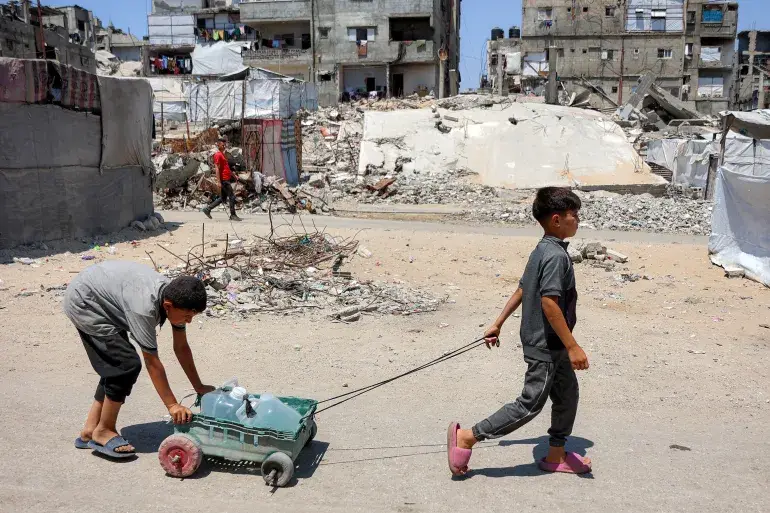
Hamas has announced the dissolution of the government that administered the Gaza Strip for almost two decades, and the handover of administrative responsibilities to the National Committee for the Administration of Gaza (NCAG). The movement described the step as supporting the implementation of the ceasefire agreement and paving the way for a transitional civilian administration, amid continued Israeli military operations and a stalled political settlement process.
The announcement came as the war in the Gaza Strip continues, having begun on 7 Rabi al-Akhir 1445 AH, corresponding to 7 October 2023 CE, despite the conclusion of a US-sponsored ceasefire agreement in October 2025. Hamas accuses Israel of failing to abide by the terms of the agreement, while Israeli forces continue their military operations in various areas of the Strip.
Dissolution of the government and transfer of powers
At a press conference held at the Al-Aqsa Martyrs Hospital in the city of Deir al-Balah, the Director-General of the Government Media Office, Ismail al-Thawabta, announced the resignation of the head of the Government Administrative Committee, Mohammed al-Farra, and confirmed the transfer of administration of the Strip to the National Committee for the Administration of Gaza.
He explained that technical and administrative employees would continue their work to ensure the continuity of essential services, stressing that personnel in government institutions are ready to work under the supervision of the new administration.
For its part, Hamas considered the step to represent progress in implementing the ceasefire agreement, and affirmed its readiness to facilitate the management of civil affairs in the Strip.
What is the National Committee for the Administration of Gaza?
The National Committee for the Administration of Gaza was established in January 2026 under a resolution issued by the UN Security Council within the twenty-point US plan to end the war in Gaza.
The committee is composed of Palestinian figures with technical and administrative backgrounds, and has taken the Egyptian capital, Cairo, as its temporary headquarters, as the Israeli occupation authorities have not yet allowed its members to enter the Gaza Strip.
The committee is tasked with administering civil files, including the health, education, water and public services sectors, in addition to overseeing internal security through a unified police force. Administration of the Strip is to pass later to the Palestinian Authority at a subsequent stage, according to the vision set out in the international plan.
The committee's chair, Ali Abdul Hamid Shaath, affirmed the committee's readiness to assume its duties as soon as the necessary conditions are in place, stressing the need for a unified authority, a clear legal framework and a security apparatus under a single administration.
Does this mean disarming Hamas?
Although the United States and the Israeli occupation insist on the disarmament of Hamas before moving to the next phase of what is termed the peace process, the movement's announcement did not include any explicit commitment to giving up its weapons.
Hamas limited itself to indicating its readiness to hand over security responsibilities within the arrangements of the transitional phase, while affirming that Israel has not implemented its basic obligations, foremost among them withdrawal from the Gaza Strip and the adequate entry of humanitarian aid.
For its part, Israel rejected treating the step as a genuine transformation. Israeli Foreign Minister Gideon Saar described the announcement as a "maneuver", considering that the movement seeks to retain its military strength while a civilian administration takes charge of public services.
He affirmed that Israel still adheres to a plan calling for the disarmament of Hamas and all Palestinian factions and the transformation of the Gaza Strip into a demilitarised zone.
Why did Hamas announce this step now?
Analysts believe the timing of the announcement is linked to Hamas's attempt to demonstrate its readiness to relinquish administration of the Strip, amid repeated Israeli accusations that it obstructs settlement efforts and clings to power.
It is also believed that the movement seeks to send a message to the US administration that it is committed to the proposed peace plan, and that the main obstacle to its implementation is the continuation of Israeli military operations and non-implementation of commitments related to the ceasefire.
Observers point out that the step may also aim to thwart any future arrangements that could lead to the administration of only limited parts of the Gaza Strip, with continued Israeli control over large areas of it.
A stalled "peace" process
Despite the announcement of the dissolution of the government, the second phase of the ceasefire agreement still faces major obstacles, most notably disagreement over the future of Hamas's weapons, the mechanism for administering the Strip, reconstruction, and the withdrawal of Israeli forces.
Hamas insists that implementation of the first phase of the agreement, including the entry of aid, the return of displaced persons and Israeli withdrawal, must precede any new political or security arrangements, while Israel continues to link any progress in the political process to the disarmament of the movement.
Thus, the dissolution of the government represents a notable political shift in the administration of the Gaza Strip, but its success remains contingent on reaching international and regional consensus on the future of the Strip, amid the continuation of the war and the stalling of settlement negotiations.


