

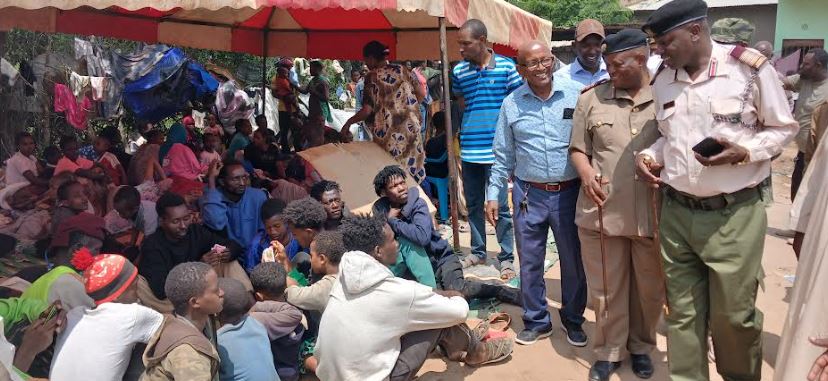
Kenyan authorities have released a rapid assessment of humanitarian needs in the border area of Moyale with Ethiopia, covering 758 displaced households, following clashes that drove tens of thousands to cross the border in search of safety, amid growing pressure on temporary shelters, host communities and essential services.
The assessment was published on Tuesday, 3 November 2026, through the data portal of the United Nations High Commissioner for Refugees, with the aim of supporting emergency response planning, setting priorities for the distribution of resources and coordinating the efforts of local authorities, humanitarian organisations and donors.
The document explained that assessment teams interviewed 439 displaced households in six temporary shelter sites, in addition to 319 displaced households living with host communities.
The sample did not include local households that had not been displaced and had not hosted displaced people, which means the assessment focuses on the situation of households affected by the crisis and does not represent a survey of all residents of the area.
Ethiopian clashes push civilians across the border
The crisis traces back to renewed fighting in the Moyale area, located on the border between Kenya and Ethiopia, during the second half of October 2026, amid a conflict between groups linked to the Ethiopian regions of Oromia and Somali.
According to reports by the Reuters news agency, clashes erupted that left at least nine people dead and others injured, after the confrontations spread into populated areas on the Ethiopian side of the border town.
The violence caused families to flee across the border into Kenya, where some went to temporary shelter centres, while other families took refuge with relatives and acquaintances in local communities.
Moyale lies on an important land route linking Kenya and Ethiopia, which makes any security disruption in the area affect the lives of residents as well as trade and transport between the two countries.
Estimates reaching 50,000 people
On 28 October, the UN refugee agency warned of growing humanitarian needs on the Kenyan-Ethiopian border, noting that displacement movements had continued since 22 October.
The agency cited local authorities as estimating that up to 50,000 people had crossed into Kenya, while stressing that the figure is not yet final, due to ongoing registration and verification processes and the possibility of further movements across the border.
On 27 October, the Kenya National Commission on Human Rights had referred to about 40,000 people who had fled the disturbances in Ethiopia, including more than 15,000 in temporary shelter sites and over 20,000 with relatives and acquaintances.
The discrepancy between the estimates reflects the fluid nature of the crisis and the difficulty of counting all new arrivals, especially those staying outside official reception centres.
Shelter, food and water under pressure
The large-scale displacement has increased pressure on the services available in Moyale and neighbouring areas, as arriving families need safe places to stay, food, clean water and health services.
The Kenya National Commission on Human Rights warned that the arrival of large numbers over a short period doubles the burden on host communities, which already suffer from limited availability of some basic resources.
It also noted that rain in the area heightens concerns about families living in temporary conditions being exposed to cold and disease, as well as the challenges related to sanitation and public hygiene.
At the same time, authorities and humanitarian organisations face the task of providing services both to families housed in shelter centres and to displaced people who have spread across host neighbourhoods and villages.
Six shelter sites and families dispersed among residents
The government study is of particular importance because it did not limit itself to displaced people inside temporary shelter sites.
It covered 439 households across six sites, alongside 319 households living with host communities, which allows the concerned bodies to consider the needs of two groups whose living conditions and ways of accessing aid differ.
Focusing on shelter centres alone could overlook displaced families living in private homes, whereas an integrated response also requires attention to the pressures facing Kenyan host families.
Collecting data on both groups helps build a broader picture of how displaced people are distributed and identifies the locations that need additional support.
However, the information available from the document summary does not yet include detailed findings on the rates of shortages of food, shelter, water or health services, and therefore the scale of gaps in each sector cannot be determined precisely.
Concerns that the effects of the violence may extend into Kenya
The repercussions of the clashes have not been limited to the arrival of displaced people, as they have also affected commercial activity and transport movement at the border.
According to the Kenya News Agency, truck traffic through the border crossing has been disrupted, some shops have closed their doors, and there are fears of cross-border gunfire and continued security tension.
Local leaders also warned that the influx of displaced people could worsen pressure on resources in Marsabit County, which already faces challenges linked to water scarcity and food security.
These concerns underline the importance of preventing the spread of clashes into the Kenyan side and ensuring the protection of civilians fleeing violence without exposing host communities to further risks.
A border crisis that requires a response beyond temporary shelter
The new government assessment comes at a stage when Kenyan authorities and their partners need accurate field information to guide the humanitarian response, especially with continued uncertainty over the numbers of displaced people and how long they will remain.
The priority of protection, water, food and health care stands out, alongside support for local communities that have received large numbers of those fleeing.
The continued tension on the Ethiopian side may also obstruct the safe return of families, and some temporary shelter sites may require more sustainable arrangements.
The Moyale crisis shows how local clashes in a border area can, within days, turn into a cross-border humanitarian challenge that leaves thousands of families facing urgent needs and places pressure on towns that were not party to the fighting.
Pending the stabilisation of the security situation, the ability of humanitarian bodies to reach displaced people, provide essential services and support host communities will remain among the most important factors determining the extent of the suffering caused by this crisis.


