


Iran-backed Shiite armed militias in Iraq have announced their refusal to give up their weapons and threatened to target any foreign military presence that remains in the country, as the mission of the US-led international coalition against the Islamic State ("ISIS") in Iraq comes to an end on 30 September 2026.
The end of the mission places the issue of weapons outside state control at the forefront of the Iraqi scene, after armed militias had justified keeping their weapons, among other reasons, by the presence of foreign forces.
The United States confirmed the end of the mission of the "Combined Joint Task Force – Operation Inherent Resolve" in Iraq after nearly 12 years since it was launched to confront the Islamic State group ("ISIS"). Baghdad announced that the new phase will be based on Iraqi forces taking over security responsibility, with forms of bilateral cooperation continuing with countries that had participated in the coalition, including training, intelligence sharing and building defence capabilities.
"Ashab al-Kahf" refuses to hand over weapons
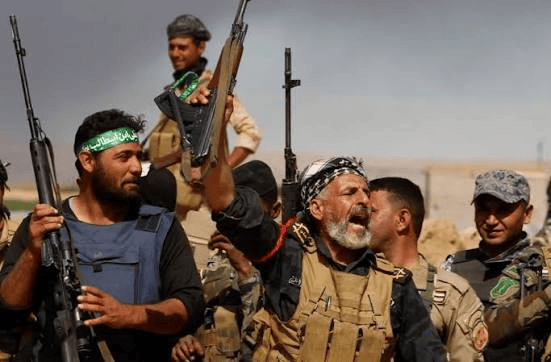
Among the most prominent positions issued by the Shiite militias was a statement from the Iran-backed group "Ashab al-Kahf," which celebrated the end of the coalition's military presence and described it as a victory for what it calls the "resistance."
The group rejected calls to hand over its weapons and described talk of this as a "dream" that cannot be achieved.
It also threatened that, starting from Wednesday night, any foreign presence, whether on the ground or in Iraqi airspace, would face a "military response" from it.
The group affirmed its continued affiliation with what it calls the "Axis of Resistance," and threatened to respond against any country that participates in an attack on Iran.
Refusal to disarm is not limited to "Ashab al-Kahf." Prominent militias linked to Tehran, led by Kata'ib Hezbollah and Harakat Hezbollah al-Nujaba, also refuse to give up their weapons outside the framework of arrangements they accept, and had previously linked this to the withdrawal of foreign forces from Iraq.
Government: no weapons outside the law
For its part, Iraqi Prime Minister Ali al-Zaidi stressed that the end of the coalition's mission must be accompanied by strengthening the state's sovereignty over its security decisions.
Al-Zaidi said in a speech marking the end of the mission: "No weapon outside the umbrella of the law, and no force outside the institutions of the state," affirming that the war on what he calls terrorism will continue and that Iraqi forces will assume full responsibility for the country's security.
Over the past months, the government had begun moves to bring the militias' weapons under state authority, amid internal and external pressure to limit the ability of armed militias to take military decisions independently of official institutions.
Some militias, including Asa'ib Ahl al-Haq and Kata'ib Imam Ali, say they have placed their weapons under state authority, while other militias have announced their refusal to give up weapons.
Dispute over the deadline for disarming the militias
Iraqi and international reports had previously referred to 30 September as a targeted date for bringing the armed militias' weapons under state authority, in parallel with the end of the coalition's mission.
However, the implementation of this process did not take place by the stated date.
Recent reports said the government is aiming to complete the process of controlling militia weapons by 30 June 2027, amid resistance from the most hardline groups.
Nevertheless, Iraqi statements differ on whether a binding final deadline exists at all: in September, an adviser to the prime minister said the committee tasked with handling the weapons file has no fixed final deadline for completing its mission. Accordingly, 30 June 2027 is currently presented as a target for the process, not a legal final deadline agreed upon unambiguously.
The coalition's exit does not mean an end to military cooperation
The end of the international coalition's mission does not mean that security relations between Iraq, the United States and the coalition's participating countries are severed.
The relationship has shifted to bilateral arrangements covering training, intelligence cooperation and building security and defence capabilities, at a time when ISIS still maintains cells in areas of Iraq and Syria.
This detail gains significance in light of "Ashab al-Kahf's" threat to target "any foreign presence," as it is not yet clear how the militias will deal with forms of security cooperation that fall outside the ended coalition mission.
A new phase in the struggle over weapons and influence
The departure of coalition forces removes one of the main arguments the Iran-backed militias used to justify keeping weapons outside the direct control of the state, but it does not mean the file has been resolved.
The Iraqi government says the next phase must be based on confining weapons to the hands of official institutions, while the armed militias insist on retaining their military capabilities and announce their continued affiliation with the axis led by Iran in the region.
The debate in Iraq thus shifts from the question of the presence of foreign forces to a more direct question: can the state impose effective control over weapons and military decision-making within its territory after the end of the coalition's mission?


