


The US aircraft carrier USS Abraham Lincoln has become a striking example of the price the US armed forces pay for prolonged deployment and numerous military commitments around the world, after having been one of the most prominent instruments of American power in the war on Iran.
After months at sea, reports emerged of severe exhaustion among the carrier's crew, supply disruptions, declining morale and concerns related to mental health. At a time when the length of the ship's deployment raised questions inside the United States that go beyond the conditions of a few thousand sailors, to a larger issue: is Washington depleting the readiness of its military faster than it can replenish it?
In a statement issued on 14 August, the US Navy acknowledged that the Abraham Lincoln had spent 266 days deployed, 200 of them in a combat zone, conducted more than 10,000 sorties and dropped more than 1.5 million pounds of munitions. It also acknowledged adjusting meal plans when fresh supplies could not arrive, and addressing cases related to mental health, stating explicitly that the sailors and Marines aboard had been "pushed to their limits."
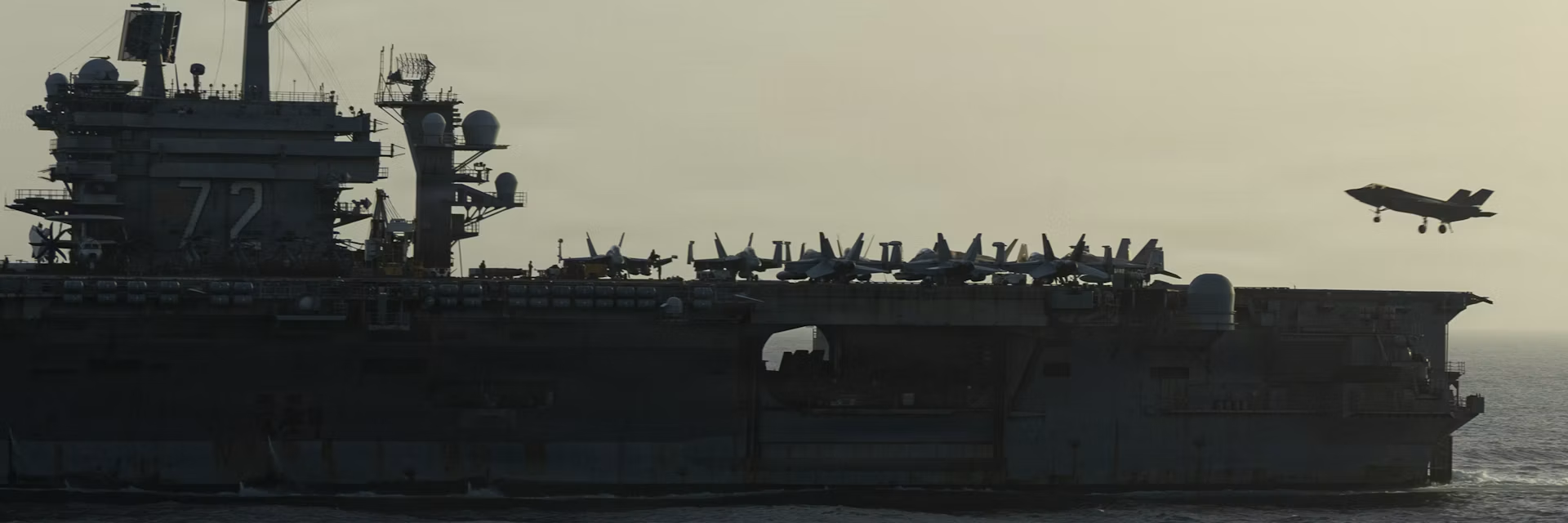
Months at sea and mounting pressure
The problem was not merely the length of the deployment, but its continuation alongside a high tempo of combat and very limited rest periods.
Families and individuals associated with the carrier spoke of declining morale and psychological strain, while Military Times reported that at least two crew members attempted to jump from the ship during the long deployment. The military leadership, for its part, said the number of mental health cases recorded aboard the carrier was low compared with other carriers, while US officials rejected describing the situation as a collapse in the crew's ability to work.
The issue prompted action in Congress, where lawmakers demanded that the Department of Defense and the Navy provide answers about the planning of the extended deployment, its impact on exhaustion, morale, mental health and crew readiness, and whether the crisis reveals a broader flaw in the management of US naval operations.
But the crisis acquires its real significance when viewed as a military and strategic problem, not only a humanitarian one.
Military readiness is not an unlimited resource. Every additional day a ship spends on operations means additional operating hours for its engines, systems and aircraft, greater consumption of munitions and spare parts, and a possible postponement of scheduled maintenance, training and rest for the crew.
Readiness: a reserve that can be drained
Modern militaries rely on operational cycles that balance deployment and combat on one hand with maintenance, training and rest on the other. When the first part is extended, the cost does not necessarily appear immediately on the battlefield; it shifts to the next phase.
A ship that remains at sea longer than planned may later need a longer maintenance period, and a crew working under continuous pressure needs more time to restore its readiness, while redeploying other units to cover shortfalls shifts the pressure from one military theatre to another.
This is not a new problem for the US Navy. The US Government Accountability Office (GAO) concluded years ago that the rising tempo of operations had lengthened deployments, reduced training and postponed maintenance, with negative effects on the readiness of ships and their crews.
In one of the most telling indicators, the office found that 37% of the combat readiness certifications for crews of US cruisers and destroyers based in Japan had expired by June 2017, after the intensity of missions pushed ships to operate without adequate training periods.
That same year, the US destroyers USS Fitzgerald and USS John S. McCain collided with commercial ships, killing 17 sailors. The two incidents came amid wide debate at the time about exhaustion, training and readiness in the US fleet.
Closing one gap by opening another
To end the extended deployment of the Abraham Lincoln, the Navy sent the aircraft carrier USS George Washington to the Middle East to replace it.
At first glance, this appears to be a normal rotation of forces: one carrier leaves and another arrives.
But the George Washington is not a reserve ship waiting without a mission. It is the US carrier permanently stationed in Japan and one of Washington's most important military assets in the western Pacific.
By moving it to the Middle East, the western Pacific has been temporarily left without a US aircraft carrier, in a region that Washington itself considers one of the most important arenas of strategic competition with China. The Navy has thus eased the pressure on the Abraham Lincoln, but it has done so by withdrawing a significant military capability from another theatre.
Here lies the fundamental paradox: extending the deployment of one aircraft carrier does not create new military capability. It allows the same capability to be used for a longer period now, at the cost of drawing down part of it in the future, whether through maintenance, training, rest or deployment to other regions.
In other words, from this perspective, Washington is not increasing its military reserves; it is borrowing from them.
A problem older than the Iran war
The strain on the tempo of US operations does not begin with the current war.
The GAO had previously warned that US forces had for years suffered from rising demand on military units, repeated and prolonged deployments, and difficulties in maintenance, training and personnel.
In an earlier report, the office noted that heightened demand on naval forces had increased the deployment length of many ships from seven months to nine months, a level it described as less sustainable.
Subsequent reports also revealed that the Navy failed to complete many ship maintenance operations on schedule, resulting in the loss of thousands of days during which the ships could have been used for training or operations. Between 2014 and 2019 alone, ships recorded more than 33,000 additional days in maintenance compared with the planned schedules.
These figures mean that the problem concerns not only the number of aircraft carriers or ships the United States possesses, but also the way this force is used and the number of commitments it is asked to carry out at the same time.
Is the US military weak, or is Washington fighting more wars than it should?
In the end, the crisis of the Abraham Lincoln raises a question that goes beyond the carrier itself.
The United States still has the largest defence budget in the world, along with an extensive network of bases, alliances and vast naval and air capabilities. For that reason, discussing the pressure on its forces does not mean that the US military has become incapable or weak.
But military power, however large, has a ceiling.
When Washington asks the same force to maintain a broad presence in Asia, deter China, support its operations in Europe, secure shipping lanes, and protect its bases and allies in the Middle East, while at the same time waging an open war with Iran, the question becomes: do the available military resources match the scale of the commitments chosen by the political leadership?
The American researcher Monica Duffy Toft, in an analysis published by The Conversation, summed up this dilemma by saying that the problem is not necessarily that US forces are "overstretched" relative to the threats facing the United States, but that they are stretched relative to the wars and commitments its presidents choose to enter.
From this angle, the Abraham Lincoln becomes more than a carrier worn down by months at sea.
It is a miniature model of the dilemma of American power itself: a huge military capability that can withstand enormous pressure for a long period, but whose continued use from one crisis to another and from one war to another means an accumulating deferred bill in maintenance, munitions, personnel and strategic deployment.
The US Navy managed to keep the Abraham Lincoln in combat for additional months, then sent the George Washington from the Pacific to take its place. But this step also reveals the limits of the solution: Washington can move its strength from one sea to another, yet it cannot make a single carrier present in two places at the same time.
For this reason, the question raised by the crisis of the Abraham Lincoln may not be: can the United States continue these wars?
Rather: what will it have to deplete or give up elsewhere in order to keep waging them?


