

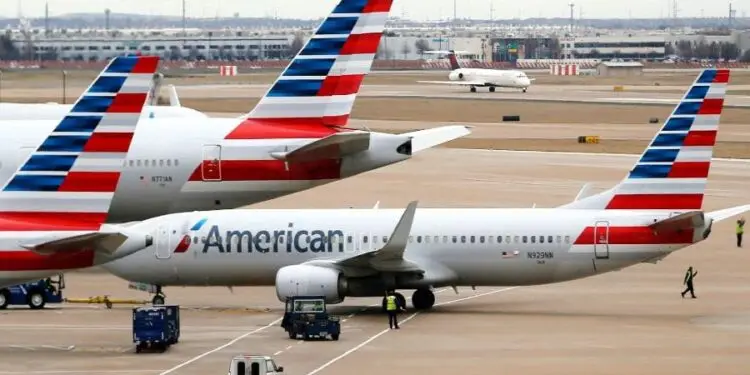
US airports on Friday evening, 13 November 2026, saw what was the largest crisis of its kind, as departure boards at a number of the biggest airports turned into long lists of delays and cancellations, while thousands of travellers remained stranded in waiting areas, aircraft stood motionless on runways, and others were forced to divert their routes or return to their departure airports.
Behind this disruption was an exceptional decision issued by the US Federal Aviation Administration to suspend take-offs from airports across the country, after a widespread malfunction affected the communications of air traffic control centres. The decision was not caused by a storm, a natural disaster or a declared security threat, but by a technical problem in a network that is supposed to form the backbone of aircraft movement within US airspace.
Within a few hours, the number of delayed flights exceeded 10,000, and cancellations approached 5,000, according to data from the FlightAware platform at 7:20 pm Eastern Time. Although the take-off suspension was lifted after more than four hours, the crisis persisted on the ground, as operating schedules and the distribution of aircraft and crews had been thrown into disarray, and the effects of the disruption extended to airports outside the United States.
The problem, then, was not only the number of flights that stopped, but also the question that imposed itself forcefully: how can a communications failure push the largest aviation system in the world into halting take-offs nationwide? And what does the incident reveal about the infrastructure that manages aircraft movement, and the system's ability to cope with simultaneous failures?
Four hours that halted the country's skies
The crisis began on Friday afternoon, when the US Federal Aviation Administration issued an order suspending take-offs from airports, citing exceptional circumstances and safety considerations.
The decision came after a disruption in communications with air traffic control centres, the centres responsible for directing aircraft as they move between regions and airports, and for coordinating between the different control units to ensure safe separation between aircraft.
According to figures reported by US media, the number of delayed flights exceeded 10,000, while the number of cancelled flights approached 5,000 on the day of the crisis. Data from the company Cirium also showed that around 827 flights were diverted to other airports or returned to their departure airports, including 670 that returned to the departure point and 157 that headed to alternative airports.
When the suspension was announced, thousands of aircraft were already in the air. Estimates indicated that more than 3,000 aircraft were flying in US airspace, while some 3,100 aircraft were headed to US airports according to data from Flightradar24.
The order did not involve bringing down aircraft already airborne en masse; instead, they were allowed to continue their flights and land, while the take-off of new aircraft was halted to avoid adding pressure to the communications and monitoring system that had been affected by the malfunction.
After more than four hours, authorities announced the resumption of take-offs at 8:15 pm Eastern Time. However, reopening the airspace did not mean that air traffic had returned to normal, as the crisis had caused widespread disruption to the operating network, which required time to be reorganised.
What broke down within the aviation system?
The gravity of the incident lies in the fact that the malfunction did not affect a peripheral service or a limited administrative system, but struck the communications on which air traffic control centres depend to track and direct aircraft.
The US air traffic control network comprises 22 regional centres, in addition to 527 airport control towers and 146 facilities for monitoring aircraft approaching and departing airports, and more than 14,000 air traffic controllers work within this system. The regional centres manage the movement of aircraft travelling between states and regions, and coordinate the handover of responsibility for an aircraft from one controller to another, ensuring continuous contact with the aircraft and monitoring of its position and route.
CNN reported, citing a source in the aviation sector, that radars and communication frequencies were cut off at the same time, while a recording of an air traffic controller handling aircraft approaching Chicago showed him saying: "We lost all the frequencies."
Steve Arroyo, a former pilot with United Airlines and aviation expert, said that the inability to communicate with aircraft means they must be kept on the ground rather than sent into the air, as they could face risks due to the absence of the necessary contact with control.
Thus, the decision to suspend take-offs was not a punitive measure or an operational exaggeration, but a precautionary step to prevent risks from multiplying while the malfunction continued.
The stated cause: ageing equipment overwhelmed by data
In explaining the crisis, US Transportation Secretary Sean Duffy attributed the malfunction to problems in old communications equipment, explaining that network switches and routing devices came under heavy strain as a result of the surge in data flow, which led to disruption of the information on which the monitoring centres rely.
US administration officials pointed out that introducing new equipment and technologies into the aviation system had not prevented the failure of some older components; rather, the older systems came under a load they were unable to handle stably.
According to Duffy's statements, some components of the network still rely on analogue communications technology and old equipment, and inconsistencies appeared in the data coming from routing devices, which prompted authorities to suspend take-offs as a precaution.
However, the precise technical cause that increased the load on the equipment had not been conclusively determined in the first hours following the incident.
Authorities also denied the existence of initial indications of a cyberattack. Homeland Security Secretary Markwayne Mullin said that investigations had revealed no evidence pointing to a deliberate intrusion, while stressing that authorities had not ruled out all possibilities before completing the examination.
Officials likewise denied any link between the crisis and the global Microsoft services outage that had occurred the previous day, while the company stated that it had no indications of a connection between the two incidents.
As for the new artificial intelligence system that the Federal Aviation Administration had been working to roll out to help predict aviation problems and provide recommendations to controllers, Duffy denied that it was linked to the malfunction, confirming that the system that failed relies on old equipment separate from the new technology.
A legacy infrastructure running American aviation
The incident reveals a clear paradox in the US aviation sector: a system that manages millions of flights a year and handles millions of passengers, yet still faces challenges linked to the obsolescence of essential parts of its technological infrastructure.
According to a report by Reuters, the US air traffic control network suffers from equipment and communications problems, alongside a shortage of air traffic controllers and a multiplicity of old systems that do not always operate in an integrated manner.
In a report issued in 2024, the US Government Accountability Office noted that the Federal Aviation Administration had classified 51 of the 138 systems reviewed as unsustainable, and another 54 systems as at risk of becoming unsustainable; accordingly, systems facing sustainability problems or future risks exceeded three quarters of the systems covered by the review.
The problem is not limited to the age of the equipment, but extends to the way the communications network is managed and the multiplicity of its components. Officials at the Federal Aviation Administration indicated that more than 300 facilities belonging to the agency in some cases operate as separate technical systems, relying on old computer and communications equipment that do not communicate smoothly with one another.
According to Reuters, some manifestations of equipment obsolescence reached the point of searching for spare parts through online auction sites or manufacturing some of them using 3D printing.
These details take on added significance when compared with the size of the airspace the United States manages, which exceeds 29 million square miles, and an average of 44,360 flights per day that the Federal Aviation Administration handles, according to figures cited in an Al Jazeera report.
The problem, therefore, is not a single old device in a closed room, but an interconnected structure on which the movement of aircraft between cities and states depends, affecting airports, airlines and logistics services inside and outside the country.
Billions of dollars in modernisation: why did it not prevent the breakdown?
The 13 November crisis was not the first signal that the US aviation system needs wide-scale modernisation. In recent years, authorities and Congress have approved plans and investments to upgrade communications systems, radars and control centres.
In July 2025, Congress approved allocating $12.5 billion to modernise old infrastructure, including communications and radar systems, and approved additional sums to replace and consolidate some control centres. In the same week as the crisis, the US administration requested additional funding of $30.1 billion to develop airports and air traffic control systems, including $10.1 billion for upgrading aviation surveillance.
The administration announced that 68% of the Federal Aviation Administration's old copper communications network had been replaced with high-speed fibre optics.
However, the shift from copper wires to fibre optics does not necessarily mean the network has been fully modernised. The devices that manage communications, operating software, data distribution mechanisms and systems linking the centres all require comprehensive development.
The crisis shows that upgrading a single element does not guarantee the stability of the system if other components continue to operate with old technology, or if there is insufficient capacity to absorb surges in data and exceptional pressure situations.
Reuters also cited the Government Accountability Office warning about weak planning for the modernisation programme, noting that the administration lacked reliable and integrated cost and schedule estimates, and that the office found 11,389 separate project schedules not coordinated under a single master plan, which raises the risks of delays, repeated work and budget overruns.
The Federal Aviation Administration aims to complete the first phase of modernisation by December 2028, but continued reliance on old components until then raises questions about the system's ability to avoid similar failures during the transition years.
From American airports to international flights
The effects of the crisis did not stop at US borders. The international aviation network is interconnected, and any widespread halt at airports in a country the size of the United States inevitably affects flights arriving in and departing from it, and the schedules of airlines that rely on its airports as major hubs.
Pearson Airport in Toronto, Canada, announced that no scheduled flights from the United States were arriving during the suspension period, while Mexico City airport confirmed that flights linked to it had been affected.
A flight from London Heathrow to New York was also cancelled, and US authorities handled international flights arriving in the country separately, depending on the nature of each case and the operational circumstances surrounding it.
Travellers arriving from other countries found themselves facing unclear travel plans, after some were forced to remain on board aircraft or wait for rebooking, while others struggled to reach their final destinations.
At Los Angeles airport, travellers spoke of having to wait for hours, while some sought rental cars or alternative means of transport, but the growing demand for vehicles led to shortages at some locations.
The impact also extended to the air cargo sector, which forms a fundamental part of trade and supply chains. According to data from the Airlines for America association, US airlines carry around 61,000 tonnes of goods and parcels daily to and from more than 220 countries.
Consequently, the disruption of flights affects not only the passenger waiting to reach their destination, but may also delay commercial shipments, goods and parcels that depend on adherence to transport and delivery schedules.
An economic bill that exceeds the price of tickets
US authorities have not yet announced a final estimate of the financial losses resulting from the crisis, but the size of the aviation sector reveals the extent of the economic interests disrupted.
Aviation contributes around 4% of US gross domestic product and provides about 9.4 million jobs. Potential losses are spread across airlines, which had to reorganise schedules, change flight routes and provide services to affected passengers; airports that faced congestion at gates and waiting areas; and cargo companies whose shipments were delayed.
Companies also bear additional operating costs linked to aircraft being at unplanned airports, the redistribution of flight crews, accommodation for some staff and passengers, as well as extra fuel consumption in cases of diversion and holding.
As for passengers, their losses sometimes exceed the value of the ticket, extending to hotel bookings, missed work commitments and events, alternative transport costs, and family and business commitments that are difficult to compensate.
The timing is especially sensitive because the crisis occurred roughly two weeks before the Thanksgiving holiday, one of the busiest travel seasons in the United States. Airlines for America had forecast that the number of air travellers during the holiday would reach around 2.7 million passengers per day.
Why did the disruption continue after take-offs resumed?
Lifting the take-off suspension does not mean that aircraft automatically return to their original positions, or that crews remain available to operate flights according to the scheduled timetables.
Each aircraft is linked to a chain of consecutive flights, each flight crew works within specific time limits, and each airport gate is tied to an arrival and departure schedule. When take-offs halt for hours, this chain is disrupted, and the impact of the crisis begins to spread from one flight to the next.
An aircraft may be forced to land at an alternative airport, remain on the runway waiting for a vacant gate, or see its next flight delayed due to the absence of the crew or aircraft assigned to it.
At Chicago O'Hare airport, the captain of a United Airlines flight tried to return to the gate after about an hour of waiting on the runway, but faced difficulty due to congestion and aircraft piling up at gate stands.
Jet Blue announced that it expected disruption to continue on Saturday, including further cancellations, while officials warned that restoring normal schedules could take several days.
This highlights one of the most important characteristics of operational crises in aviation: a technical fault may be resolved within hours, but its operational effects persist for much longer, because the aviation network does not run as separate flights, but as an interlinked chain of aircraft, crews, airports and timetables.
Could the scene be repeated?
The most prominent warning came from Transportation Secretary Sean Duffy himself, who gave no assurance that the crisis would not recur. Instead, he acknowledged that authorities had not expected this type of disruption to occur, indicating that restarting the system did not mean the end of future risks.
On the other hand, officials stated that the authorities were able to manage the situation, that no human losses linked to the incident were recorded, and that no evidence proving the system had been subjected to a cyberattack had emerged in the first hours.
But the absence of human casualties does not eliminate questions about the system's ability to withstand a similar outage, especially since the decision to halt departures nationwide was not a routine measure, and since the last large-scale incident, in January 2023, was linked to a failure of the system that disseminates important notices to pilots, and at the time caused a halt to domestic flights for less than two hours and disrupted thousands of flights.
The difference between the two incidents is fundamental. In 2023, the system that sends alerts to pilots failed; in November 2026, the fault affected the communications of the air traffic control centres themselves, a link that is more sensitive in managing aircraft movements.
Senator Tammy Duckworth, the senior Democratic member of the Senate Aviation Subcommittee, called for a comprehensive and full investigation into the incident.
Answering questions about the likelihood of recurrence requires clear technical findings that identify the cause of the increased pressure on network equipment, the efficiency of backup systems, and their ability to operate when main communications fail, as well as the readiness of regional centres to handle a simultaneous outage.


