


Ajuma Begum stayed awake until 3am waiting for her son to return from the market before accepting that he would not come home. The next day, he called to tell her that he was on the Bangladeshi coast, waiting to begin a sea voyage to Malaysia that she had desperately tried to prevent him from undertaking.
That was the start of weeks of anxiety for the 58-year-old woman, whose fears deepened after a boat carrying Rohingya refugees capsized near Malaysia in early November, leaving dozens dead. She felt she could breathe again when her son finally reached his destination.
Begum's 16-year-old son, Abu Musa, is one of thousands of members of the persecuted Myanmar ethnic minority who have boarded boats over the past two months, according to the Arakan Project, a regional human rights organisation that tracks Rohingya boat journeys.
The Guardian spoke with refugees who reached Malaysia and with families of those who departed. Among them were young people who fled deteriorating conditions in refugee camps, and women who were sent to marry Rohingya men or to join husbands already in Malaysia.
More than 1.1 million Rohingya refugees live in camps in Bangladesh near the border with Myanmar; three-quarters of them arrived in 1438 AH (2017 CE) following the "genocide" massacres committed by the Myanmar military against the Rohingya people.
The camps in Bangladesh face harsh conditions. The government has imposed strict restrictions on refugees' ability to work or move freely, and educational opportunities are limited in the overcrowded camps, which since 1445 AH (2024 CE) have received some 200,000 additional refugees from Rakhine State in Myanmar.
The newcomers have fled the conflict between the Myanmar military and the Arakan Army, an insurgent group accused of forcibly recruiting Rohingya and targeting civilians in Rakhine State, the northern region of Myanmar that was home to most of the Rohingya. According to the Arakan Project, which has monitored the persecution of the Rohingya in Myanmar since 1999, 22 boats have been documented leaving the Bay of Bengal for Southeast Asia since September, carrying some 4,000 people.
Many Rohingya are lured by promises of a better life away from Bangladesh by people smugglers, but migrants may be kidnapped and held for ransom at various points along the way.
Chris Lewa, coordinator of the Arakan Project, says: "If they are late in paying the ransom, they are beaten, often in front of a camera, so that the family in Bangladesh can watch it." She adds: "It is difficult to know the exact number of people who have left. Refugees are held in secret locations – in warehouses, forests or along the coast – and then transferred on small boats to a larger ship at sea where hundreds are held."
Abu Musa left Bangladesh because he felt that restrictions on refugees in Bangladesh regarding work or attending school had deprived them of a future. He says: "My mother did not want me to leave the camp and she was watching me all the time. Then one day I left our shelter, and I told her I was going to the market, but I went straight to Teknaf [on the coast] with my friends."
Musa and his friends took 26 days to reach Malaysia, via a route that included two weeks at sea and detention in smuggling camps in Myanmar and Thailand along the way. In the final stage, they spent around six days without food. His mother says: "When I ask about his journey, he just cries and says nothing."
Chris Lewa believes that migration levels between the Bay of Bengal and Southeast Asia may be comparable to their peak in 1436 AH (2015 CE), when some 170,000 people were trafficked over three years, according to Human Rights Watch.
The discovery of mass graves in Thailand in 1436 AH (May 2015 CE) led to an intensive crackdown on smuggling networks, but the trade now appears to be growing again. Lewa believes that reduced aid in Bangladesh and violence in Myanmar are fuelling the despair that drives large numbers of Rohingya to people smugglers.
A Rohingya broker, who has worked with smugglers since 1439 AH (2018 CE), says the number of those wishing to leave is so large that she no longer needs to look for them, as they now come to her themselves.
Myanmar's criminals pay the broker 20,000 Bangladeshi taka (equivalent to £122) for each person she recruits. Those individuals themselves must then pay about 500,000 taka, and the smugglers can then extort them for additional sums by demanding ransom.
She says: "There is no limit to the number of people who can be sent. The smugglers can take people from many places; some boats can carry 400 people."
Like Abu Musa, 13-year-old Farhan disappeared from his family's shelter in late October. His father, Abdul Haque, 35, says: "We searched everywhere – at the shelters of our relatives, our friends, his school, in every place he used to go – but we could not find him anywhere."
The family was in a state of deep grief. Since leaving Myanmar in 1438 AH (2017 CE), Abdul Haque had spent all his money on private lessons for his son, given by other refugees in place of formal education.
Two days after the search began, they received a call from a smuggler in Teknaf who said the boy was "on the way" to Malaysia and asked for 350,000 taka for his "safe arrival."
Farhan left on a boat on 29 October, and there has been no news of him since. His father fears he may have been on a boat that sank near the border between Malaysia and Thailand on 9 November, which was carrying around 70 Rohingya.
His mother, Rashida, 30, says: "We cannot sleep or eat. All we do is pray to hear any news about our son."
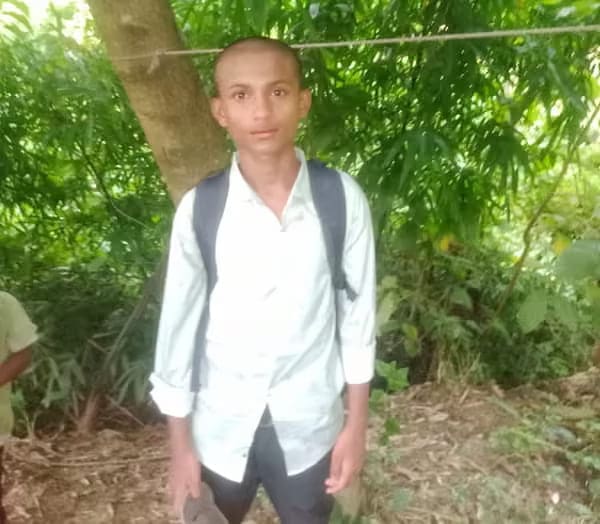
A photo of Farhan.
According to Chris Lewa, 36 bodies were recovered by the Thai and Malaysian authorities, 26 people were rescued, and eight remain missing. The boat's passengers had been on a larger vessel carrying around 300 people, but they transferred to smaller boats to reach the Malaysian coast.
Last month, Malaysia's Human Rights Commission said it was "astonished and shocked" by the country's decision to charge 11 survivors of the incident for entering without valid documents.
The family of 24-year-old Rubina Begum was devastated when they learned that she and her five-year-old son had died in the tragedy. Begum was afraid, but her husband, who had already reached Malaysia, persuaded her to leave. The family says the last contact with them was when she departed on 26 October, but they repeatedly called the smugglers, who insisted she would reach Malaysia safely, until they finally admitted she had drowned when the boat capsized. The smuggler no longer answers their calls.
Rubina Begum's father, Abul Basar, says his wife was already ill, but she fell into a coma-like state from the shock of the news.
He says: "I have lost my daughter, which means I have lost my world. The world has become a dark place for me. She was very afraid of water and should not have gone there, but she was forced to."
He holds the international community's lack of action, which has failed to allow refugees to return safely to Myanmar, responsible for the deaths of the Rohingya at sea.
The Guardian, UK.


