


Southern Syria saw a notable escalation in the movements of Israeli occupation forces during the first half of August, with dozens of ground incursions recorded in the governorates of Quneitra and Daraa, alongside reports of extensive damage to agricultural land resulting from the occupation's spraying of chemical herbicides over areas of Syrian territory.
According to field reports, the weekend saw a new series of incursions and raids carried out by Israeli occupation forces in villages and towns in southwestern Syria, continuing a pattern of military operations that has risen markedly in recent weeks.
Raids in Quneitra and Shooting in Daraa
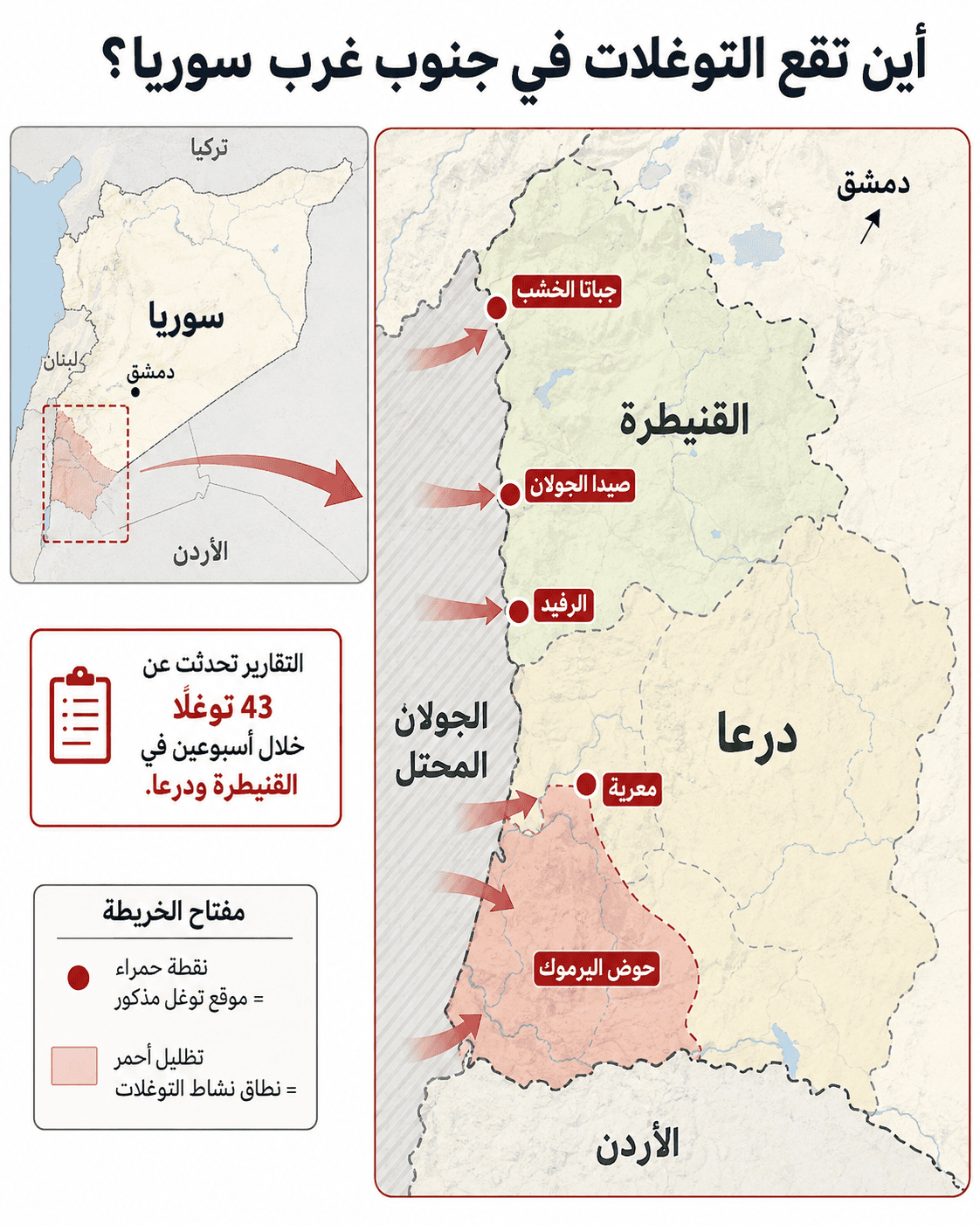
In Quneitra governorate, occupation forces entered the town of Jubata al-Khashab with six military vehicles, raided and searched a house, then withdrew from the area.
Later on Saturday, 15 August 2026, corresponding to 2 Rabi' al-Awwal 1448 AH, occupation forces advanced into the town of al-Rifid in the countryside of Quneitra and searched a number of homes, with no arrests recorded according to the reports received.
On Friday, occupation forces had carried out another operation in the village of Ma'ariya in the western countryside of Daraa, where local reports said Israeli forces opened fire during their incursion into the area.
The following day, Sunday, 16 August 2026, corresponding to 3 Rabi' al-Awwal 1448 AH, a force belonging to the Israeli occupation entered an area near the village of Saida al-Golan in Quneitra and set up a military checkpoint to search residents and passersby.
A number of residents were subjected to field searches and interrogation, with no reports of arrests.
43 Incursions in Two Weeks
Figures cited by the Syrian Observatory for Human Rights indicate a sharp rise in the pace of incursions, with 43 separate ground incursions recorded within just two weeks carried out by Israeli occupation forces inside the governorates of Quneitra and Daraa.
A large part of these movements was concentrated in areas surrounding the Yarmouk River basin, as well as in towns and villages close to lines of contact in southwestern Syria.
These operations include setting up temporary military checkpoints, searching residents and homes, and entering villages with military vehicles, which in some cases withdraw after several hours.
This comes amid the Israeli occupation's expansion of its military activity within Syrian territory in recent period, which has fuelled residents' fears that these operations will become a recurring and lasting presence in areas that depend heavily on agriculture and livestock breeding.
Herbicides Threaten Farmland
The concerns of residents of Quneitra and Daraa are not limited to military incursions. Reports have revealed extensive damage to orchards, pastures and agricultural land resulting from the spraying by Israeli occupation forces of chemical herbicides over Syrian territory.
According to local reports, large areas of Quneitra's land were scorched and damaged after the spraying operations, directly affecting farmers who depend on this land as a primary source of income and livelihood.
The issue carries particular weight given the nature of the economy in southern Syria's regions, which depends largely on agriculture, pastures and livestock breeding, making the damage to soil and crops a direct threat to residents' livelihood security.
Chemical Spraying over Syria and Lebanon
The spraying operations did not begin this month. The issue was raised from the start of the year, with reports of the Israeli occupation using herbicides in large quantities in areas of southern Syria and Lebanese territory.
Samples collected earlier in the year showed the presence of chemical substances linked to the spraying operations, amid concerns about their effects on farmland, crops and the environment.
In June, Lebanon informed the United Nations that the Israeli occupation is using herbicides in a manner that could, according to the Lebanese position, amount to their use as a weapon of war and in violation of international law.
Reports noted that the concentration of chemical substances found in some areas was far higher than the usual levels that might result from farmers' use of herbicides to control weeds.
Simultaneous Military and Economic Pressure
The combination of repeated military incursions and damage to agricultural land is a growing source of concern for residents of southern Syria, especially in villages in Quneitra and the western countryside of Daraa.
Beyond the restrictions on residents' movement caused by raids and checkpoints, the damage to farmland threatens the livelihoods of thousands of people and adds to the economic pressures on areas already suffering from difficult living conditions.
The recording of 43 incursions within two weeks indicates that the Israeli occupation's military movements are no longer isolated incidents but have become near-daily activity in parts of southern Syria, while the herbicide spraying adds a further dimension to the escalation that extends beyond the direct military aspect to reach farmland and residents' sources of livelihood.
As these operations continue, concerns are growing about the entrenchment of a new reality in Quneitra and Daraa, based on repeated incursions, temporary field control and pressure on residents, alongside damage to the land that forms the economic mainstay of many villages in the area.


