

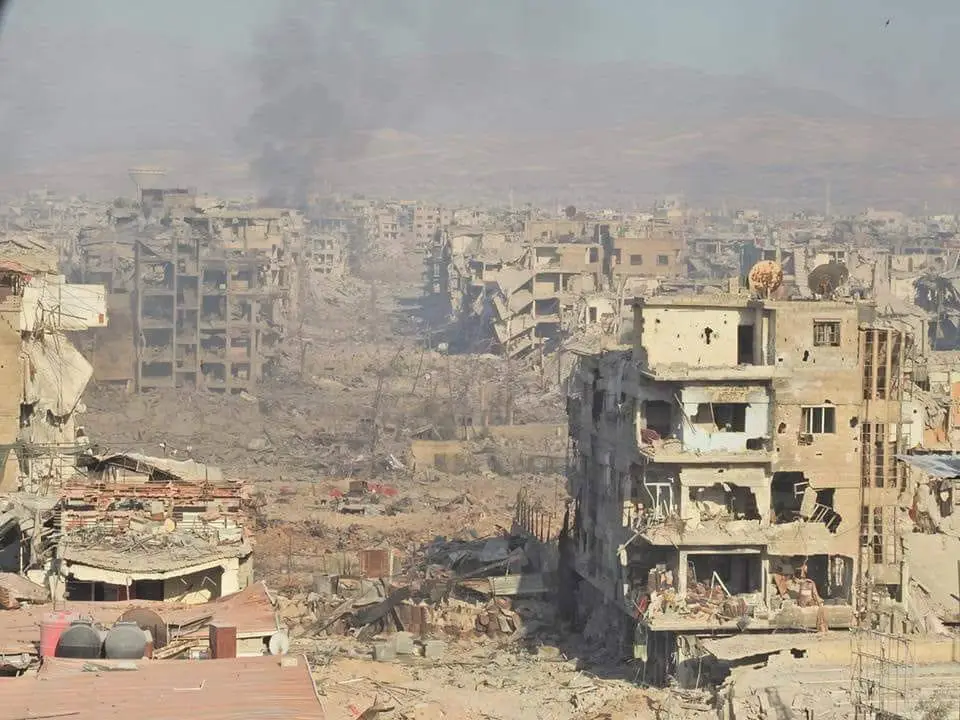
Behind every figure in the statistics of war is a human being who had a name, a home, a family, and a life they did not expect would end, or be changed forever, because another person was targeted nearby.
A recent investigative report supported by the Arij network, based on data from the organisation Airwars, has reopened the file on civilian casualties from US airstrikes and strikes by the coalition led by the United States in Yemen, Syria, Iraq and Somalia.
But the most harrowing figure concerns children.
Of the known civilian victims whose categories could be identified, the investigation documented 1,286 children, or about 42%. In other words, children made up nearly one in every two known civilian victims in the data the investigation examined.
These are not "collateral damage" when viewed from the perspective of the family struck by the strike.
A child who is killed does not become less valuable because the missile was aimed at a fighter. A mother who loses her children is not a secondary detail in a military statement. A civilian who is left permanently disabled does not have their story end when the raid ends.
This is where the question raised by the investigation arises: how many civilian lives may be put at risk in order to hit a single military target?
When the home becomes the place where its occupant is targeted
The investigation found that night-time strikes and strikes in the early morning hours were associated with a high rate of civilian losses. A former official in civilian protection at the Pentagon explained that these hours may make it easier to locate the targeted person in his home, but they also mean that his children and family members are likely to be around him.
In other words, the military advantage itself — knowing that the wanted person is inside his house — can turn into a danger to the family living with him.
The problem becomes more serious when the targeting process fails to detect civilians surrounding the target, or when assessments are built on patterns of behaviour and movement.
The large number of children and civilians, according to experts cited by the investigation, raises serious questions about proportionality, distinction, and the precautions required to protect civilians.
Fatima: the survivor who was left alone
Perhaps the story of Fatima in Yemen sums up what thousands of figures fail to say.
In December 2009, a US strike targeted the area of Al-Ma'jala in Yemen's Abyan Governorate, in search of elements suspected of belonging to al-Qaeda.
A Yemeni parliamentary fact-finding committee recorded the killing of 41 civilians and 14 al-Qaeda members.
Among the dead were 14 members of a single family.
Fatima was 13 years old. Missiles and cluster bombs struck the three tents in which her family was living, and she was the only survivor of her family.
She spent three months in a hospital in Jordan in a coma and in shock, then returned to Yemen.
But she did not return to her life. There was no home to which her family could welcome her; she returned alone, carrying the traces of the strike and the memories of a family that disappeared in seconds.
At this point, the question becomes larger than the numbers of aircraft, missiles and targets.
Who is held accountable for the killing of Fatima's family?
The civilian is not a margin of war
The investigation says that the ratio of civilians killed to targeted fighters rose, in the operations it studied during the first months of Donald Trump's second term, to 2.3 civilians killed for every fighter killed, the highest ratio among the presidential periods covered by the data through the end of May 2025. The investigation affirms that changes in the rules of engagement between US administrations were among the factors it examined to understand the variation in the scale of civilian harm.
But behind the debate over "acceptable loss rates" lies a fact that must not be lost: the civilian is not a figure appended to a military target.
When children constitute 42% of the known civilian victims across a large set of documented operations, the question of how targeting decisions are made is not merely an emotional one, but a matter of accountability and the protection of civilians.
Perhaps the problem lies in the language of war itself. The words "target," "precision strike," "collateral damage," and "civilian casualties."
But behind these words stand 1,286 children, fathers and mothers, homes whose people are gone, and survivors like Fatima who will carry a decision made thousands of kilometres away for the rest of their lives.
For this reason, the documentation of victims should not end at counting them.
Every person killed has a story, every child has a name, and every family has the right to know what happened to them, why it happened, who made the decision, who will be held accountable for their deaths, how victims will be compensated, and how a repetition of what happened can be prevented!
War does not make the life of a civilian cheap, nor does it make the distance between the one who presses the button and the one who falls beneath it any less a matter of responsibility.
These figures in the investigation remain an approximate ratio, and the true toll is certainly higher, because the command that decides on bombing does not care about the killing of civilians so long as they are Muslims.


