


In one of the most severe natural disasters the region has seen in recent years, sudden floods and mudslides have swept through areas along the border between Nepal and Tibet, leaving hundreds dead and missing, and wiping out villages and commercial areas entirely, while rescue teams continue to search through the rubble and mud for survivors.
According to the latest toll announced by Nepal Police on Thursday, 27 August 2026, corresponding to 14 Rabi al-Awwal 1448 AH, at least 270 people have been killed in the areas affected by the floods, while the search for the missing continues, including more than 600 tourists.
On the Chinese side of the border, official media announced that three people were killed and 265 others went missing in a landslide near a border post in Tibet, raising the confirmed total on both sides to at least 273 dead. India also announced that it had been unable to contact 288 of its citizens following the disaster.
The final picture of the losses remains incomplete, given that search and rescue operations are ongoing and access to several areas inundated by water and mud is difficult.
A Massive Landslide Swallows Buildings and Vehicles
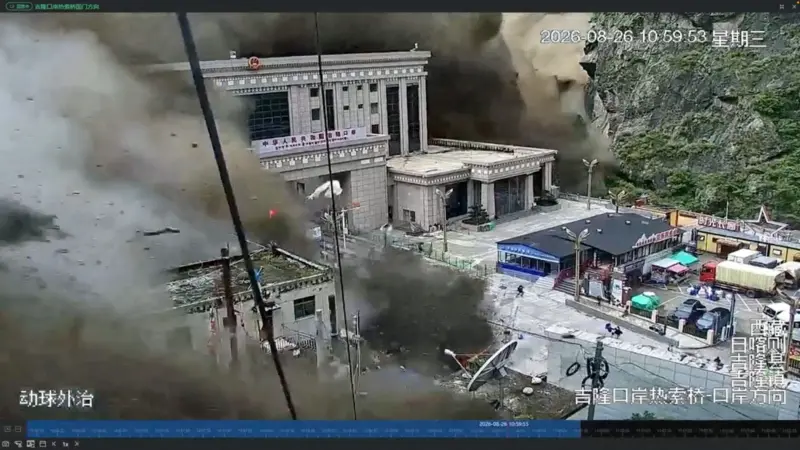
Footage captured by surveillance cameras on the Chinese side reveals the immense force of the landslide.
The images show dozens of people fleeing a huge mass of water, debris and mud, as the landslide swept into a multi-storey building before engulfing it entirely, and hurled trucks and buses away from their positions.
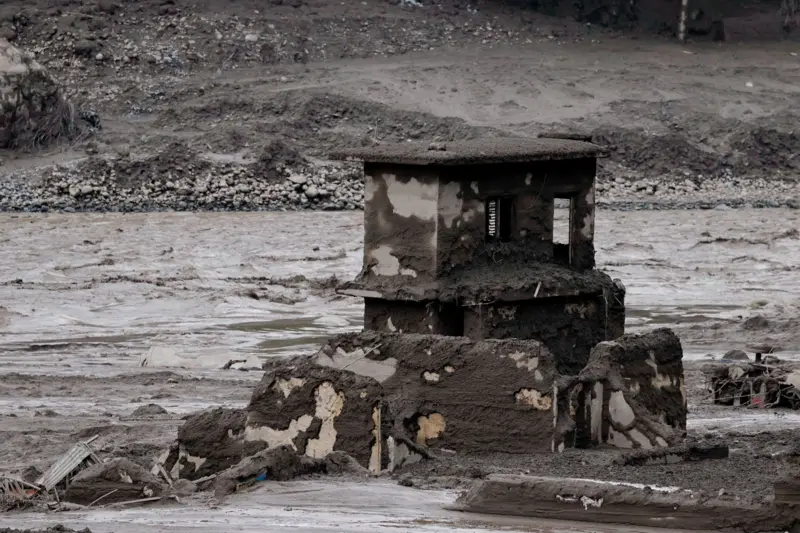
In the most affected areas of Nepal, images distributed by the police showed raging floods sweeping through riverbeds and uprooting homes, while only parts of the upper floors of some buildings remained visible after layers of mud had buried them.
David Fisher, representative of the International Federation of Red Cross and Red Crescent Societies in Nepal, said that villages and commercial areas had been "wiped off the map," noting the Federation's readiness to send aid and emergency supplies to the disaster-stricken areas.
Nuwakot: Accounts from the Heart of the Disaster
Nuwakot in Nepal was among the most affected areas. A survivor named Kalpana Malla recounted how she watched members of her family being swept away before her eyes.
She said her father, mother, sister and her sister's children were carried off by the water and were unable to escape, while she and her son survived after reaching the roof of a house.
Her account reflects the sudden nature of the flood, as many residents did not have enough time to evacuate their homes or reach higher ground.
Her son, Sugam Malla, said he was able to pull his mother to safety, while the fate of his sister remains unknown after contact with her was lost and her phone was switched off.
In another account, Gouma Pandit said the water swept away her livestock and farmland, along with large quantities of corn, rice and mustard seed crops, thereby losing her source of livelihood within hours.
More Than 600 Tourists Among the Missing
The losses were not limited to residents of the border areas. Nepal's Tourism Board announced that hundreds of people could not be reached, including citizens of India, Australia, Britain, Malaysia, the Netherlands, Portugal, South Africa, South Korea and the United States.
The Board recorded 142 Indian citizens among the missing, while India's Ministry of External Affairs separately announced that contact had been lost with 288 of its citizens.
The presence of tourists adds to the complexity of the search operations, given the difficulty of determining their whereabouts after roads were cut off, communications were damaged and some areas were surrounded by water and debris.
Meanwhile, the Nepalese army continued to carry out aerial sorties to search for survivors and transport those who could be evacuated from isolated areas.
Why Did the Floods Happen?
The final causes of the disaster have not yet been determined, but Nepalese officials and experts have put forward several possibilities, including a landslide or rockfall that blocked a river in a mountainous area, before the water burst downstream towards the low-lying areas with great force.
Nepal's Foreign Minister Shishir Khanal said an earthquake may have caused soil to slide and close off the riverbed, before the water accumulated and then rushed suddenly into the areas below.
By contrast, Nepal's National Disaster Risk Reduction and Management Authority considered that a glacial rockfall on the border between Nepal and China was behind the floods.
However, researcher Sarthak Shrestha of the International Centre for Integrated Mountain Development said preliminary assessments had shown no abnormal indicators on the Chinese side, suggesting that a glacial rockfall within Nepal had blocked the Lindi river and triggered the chain of floods.
Risk of a Second Flood
The most dangerous aspect is that the disaster may not yet be over. Experts have warned of a continuing blockage in the course of one of the rivers upstream, which increases the likelihood of a new lake forming, from which large quantities of water could be released suddenly.
Chiangong Chang, head of the climate and environmental risk department at the International Centre for Integrated Mountain Development, said authorities are warning of the possibility of a second flood for as long as the river remains blocked.
This means that rescue teams and residents in nearby areas face not only the effects of the first disaster, but also the possibility of a new wave of floods and landslides.
For this reason, authorities are working to evacuate residents living in the areas most at risk and move them to safer locations.
Tibet: Large-Scale Rescue Operations
On the Chinese side, Tibetan authorities mobilised around 800 emergency personnel, along with 150 vehicles, trained police dogs and speedboats to take part in search and rescue operations.
This response followed a landslide that struck the Gyirong port area on the border, causing significant loss of life and extensive damage.
Chinese President Xi Jinping called for every possible effort to be made to search for and rescue the missing, as the clearing of debris and searches in the affected areas continue.
However, the rugged mountainous terrain and damage to roads and infrastructure make access to some sites extremely difficult.
Electricity and Infrastructure Under Strain
The consequences of the disaster have not been limited to lives and homes. Nepal's Electricity Authority announced that about 430 megawatts of power generation capacity had been damaged, causing disruptions to electricity supplies.
These losses add to the damage to roads, houses and agricultural areas, and the disruption of transport and communications in the areas overwhelmed by water and debris.
Under such conditions, rescue operations themselves become more complicated, because teams need to reach residents in areas where roads are not functioning normally, while power and communications outages limit residents' ability to request help.
India and Britain Offer Assistance
As the number of missing grew, neighbouring countries announced their readiness to help. Indian Prime Minister Narendra Modi said his government was prepared to provide all possible forms of humanitarian aid to Nepal, while British Prime Minister Andy Burnham affirmed that his government would do everything it could to support British citizens in the affected areas.
At the same time, Nepalese authorities are intensifying evacuation efforts, while rescue teams work to reach isolated areas and search for survivors amid the mud and rubble.
A Disaster Exposing the Fragility of Mountain Regions
Dealing with natural disasters in mountainous regions is increasingly difficult due to the nature of the terrain, which makes landslides, river blockages and sudden floods more dangerous.
In this particular disaster, the combination of rugged terrain with landslides and sudden floods reduced the time available to residents to respond, and turned many sites within minutes from inhabited areas into expanses covered in mud and water.
Scientists are also monitoring the growing impact of climate change on the intensity and frequency of extreme weather phenomena in the Himalayan region, although determining the direct role of climate change in this disaster requires more detailed studies.
A Race Against Time Before the Next Wave
As the death toll rises and the search for the missing continues, Nepal is entering a race against time.
Rescue teams face a dual task: searching for survivors under the rubble, while at the same time preventing a second disaster due to the possible collapse of the natural dam that formed in the riverbed.
The number of missing remains open to rise, especially as contact continues to be lost with hundreds of people, including tourists, foreigners and residents of the most affected villages.
In areas such as Nuwakot, the losses do not stop at lives; farmland, livestock, homes and sources of income disappeared within hours, meaning the effects of the disaster will last long after the waters recede.


