

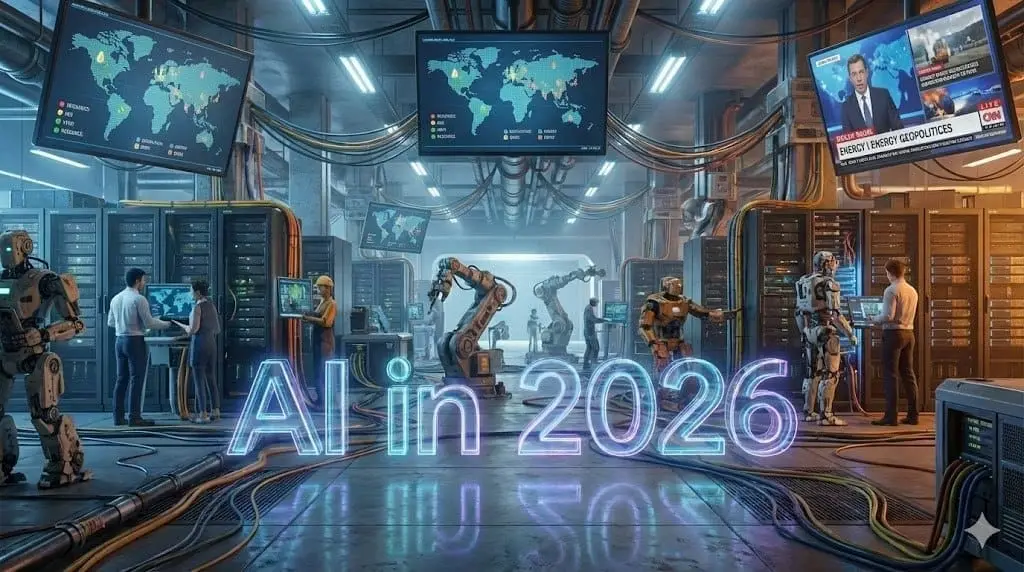
Introduction: The Year of Hitting the Wall
If the past years were the years of "maximum speed," then 2026 is the year in which the artificial intelligence train will collide with the wall of physical and geopolitical reality. In this year, the question will no longer be "What can artificial intelligence do?" but "Do we have the resources, energy and sufficient global peace to run it?" We are entering a new phase marked by scarcity, conflict, and the search for unconventional technical exits to break the limits of silicon.
First: The Resource Crisis.. When the Digital "Ghoul" Goes Hungry
The first features of 2026 are the transition from "abundance of computing" to an "energy crisis."
- The Resource Ceiling and Energy Demand
Algorithmic models in 2026 have come to require energy exceeding the capacity of existing electricity grids in many countries. Data centres are no longer mere buildings; they now require dedicated power generation facilities (miniature nuclear or renewable).
Expectation: In 2026 we will see a forced slowdown in training the largest models, not because of weakness in the technology, but because of the impossibility of supplying the necessary energy without causing civilian power outages.
- The Depletion of Human Data (The Data Wall)
By mid-2026, companies will have consumed nearly all of the high-quality human-written text available on the internet.
The solution and the danger: The solution is reliance on "synthetic data," in which one artificial intelligence trains another. But this carries the risk of "model collapse," in which quality gradually deteriorates and models become "hallucinatory" and closed in on themselves, much like the degeneration of genes resulting from inbreeding.
Second: The Dawn of the Quantum.. Is It the Saviour?
As conventional chips (GPUs) reach their physical limits, 2026 begins with a real flirtation with quantum computing.
- The Quantum-Classical Hybrid
We will not see quantum computers on our desks in 2026, but we will see, for the first time, "hybrid" data centres. Conventional processors will be used for ordinary tasks, while intractable problems (such as simulating the folding of complex proteins, new cybersecurity encryption, or optimising global supply chains) will be outsourced to quantum processing units (QPUs) via the cloud. This development is the only lifeline for continuing the trend of technological acceleration, but it remains very costly and not fully stable.
Third: Artificial Intelligence in a Burning World (Geopolitics and War)
Technology cannot be separated from politics in 2026. The world is going through disputes and wars, and artificial intelligence has become the "new gunpowder."
- The Chip Wars Intensify
Global supply chains for advanced chips will be the first target in any dispute. Any tension in Taiwan or East Asia would mean a "stroke" for the global artificial intelligence sector. In 2026, states will treat chip stockpiles as a strategic commodity on a par with wheat and oil reserves. - The Automated Battlefield
In armed conflicts, in 2026 we will see a frightening development: swarms of autonomous drones that communicate among themselves and make manoeuvring and attack decisions without direct human intervention, based instead on situational-assessment algorithms. This confronts the world with ethical dilemmas that are no longer theoretical but have become battlefield reality.
Fourth: Fatal Weaknesses.. Why Is Artificial Intelligence Still "Stupid"?
Despite all this development, 2026 reveals the "fragility" of intelligent systems that were overlooked during the surge of enthusiasm.
- The "Long Tail" Problem
Artificial intelligence excels at the 90% of cases that are repetitive, but it fails catastrophically in the rare or unexpected 10% (edge cases). In 2026, major incidents (in autonomous driving or medical diagnosis) will occur due to rare situations on which the model was not trained, proving that these systems lack the innate "common sense" possessed by a five-year-old child. - Vulnerability to Attack (Adversarial Attacks)
Researchers in 2026 will discover new ways to deceive algorithms with minor changes that the human eye does not notice (such as placing a small sticker on a stop sign so that a car takes it for a speed-limit sign). These security vulnerabilities will make governments and companies very hesitant before handing over the keys to critical infrastructure to artificial intelligence.
Conclusion
2026 is not the year of celebration; it is the year of "sifting." It is the year that will separate "media noise" from "real value." The companies and states that survive this year will be those able to secure their energy sources, protect their supply chains from conflict, and develop artificial intelligence models that are "efficient," not merely "massive."
We stand on the threshold of an age in which silicon blends with the atom (the quantum), and in which algorithms intertwine with the lines of fire in conflict zones. What is coming is not merely programming; it is a struggle for survival.


