


While a Palestinian in occupied Jerusalem was forced to demolish his home with his own hands so as not to bear the cost of its demolition by Israeli bulldozers, new Palestinian statistics recorded 11,620 demolition and destruction operations that affected Palestinian homes and property in the West Bank, including Jerusalem, over the past three years. The data show a significant escalation in demolition operations, amid strict Israeli restrictions on Palestinian construction and settlement expansion that increase pressure on residents, their land and their livelihoods.
In the Ashqariyya neighbourhood of the town of Beit Hanina, north of occupied Jerusalem, Palestinian citizen Fadl al-Rajabi, on Saturday 10 October/October 2026, was forced to demolish his home himself, in implementation of a decision issued by the Israeli authorities on the grounds of building without a permit.
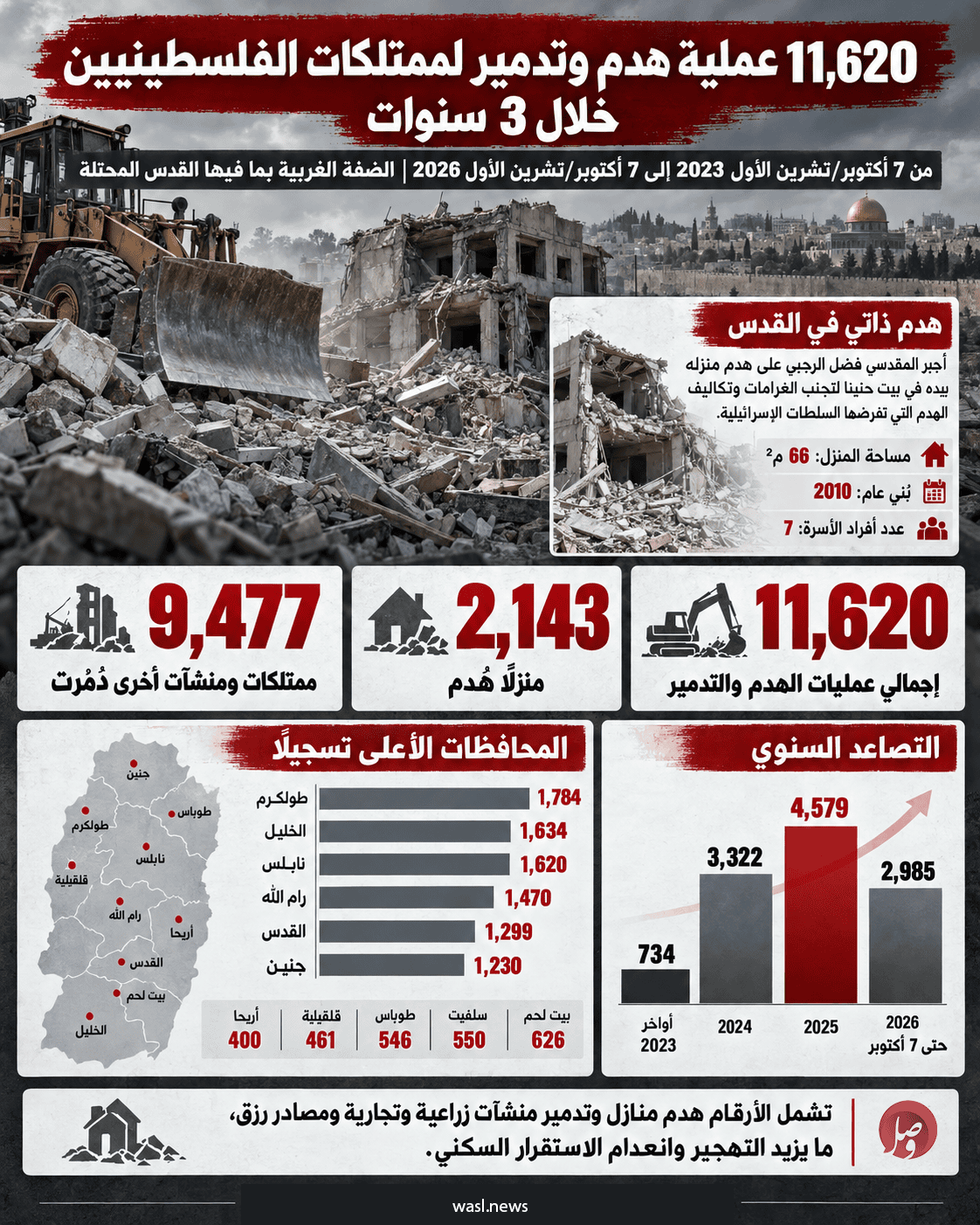
The home, which covers an area of 66 square metres, was built in 2010 and houses seven members of the al-Rajabi family, before it was reduced to rubble roughly sixteen years after its construction.
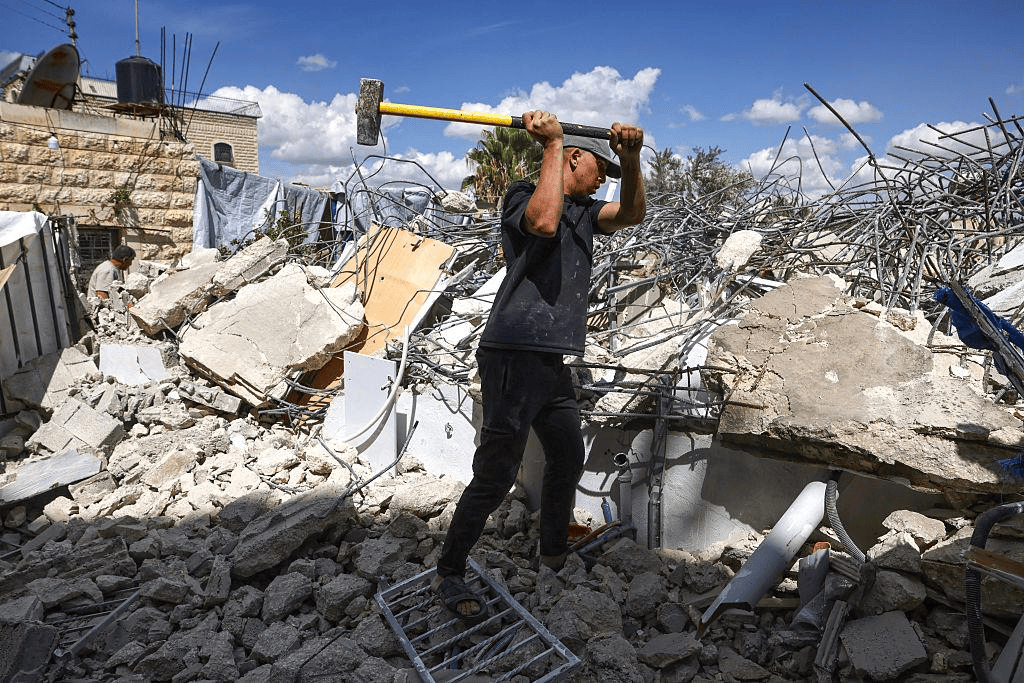
According to local Palestinian sources, al-Rajabi carried out the demolition himself to avoid the fines and high costs that the Israeli authorities impose on homeowners when municipal crews carry out the demolition.
This practice places Palestinian families before two harsh options: either destroy their homes with their own hands, or bear the expenses of their demolition by Israeli bulldozers, in addition to losing the home itself.
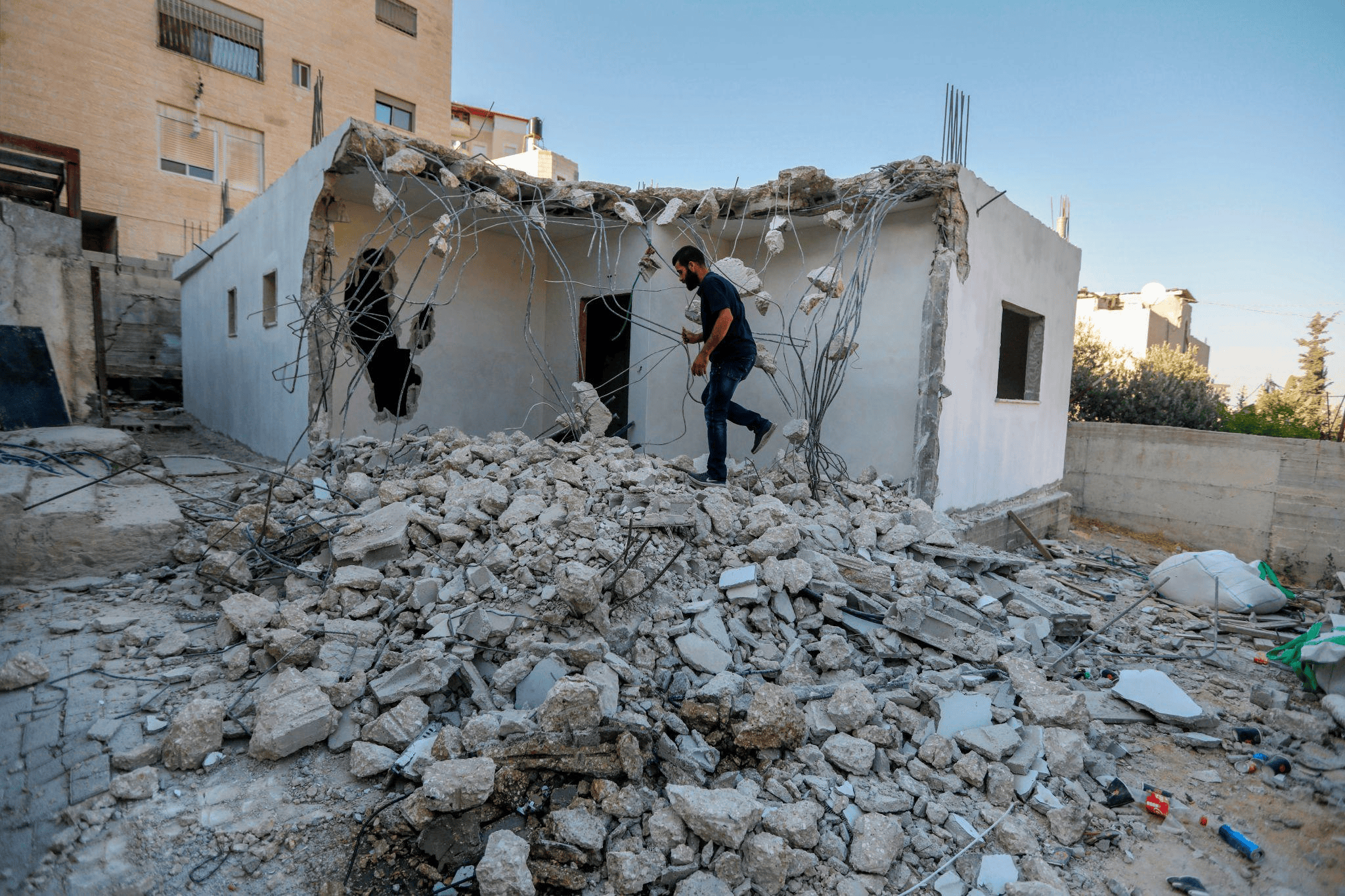
Al-Rajabi's case was not the only one in the area. On Sunday 11 October, Israeli bulldozers demolished three other homes belonging to the Shawamreh family in the same Ashqariyya neighbourhood, on the grounds of building without a permit.
The Wadi Hilweh Information Center reported that municipal crews of the Israeli authorities entered the neighbourhood accompanied by bulldozers, amid a security deployment and the closure of several streets and entrances to the area, before carrying out the demolitions.
11,620 demolition and destruction operations over three years
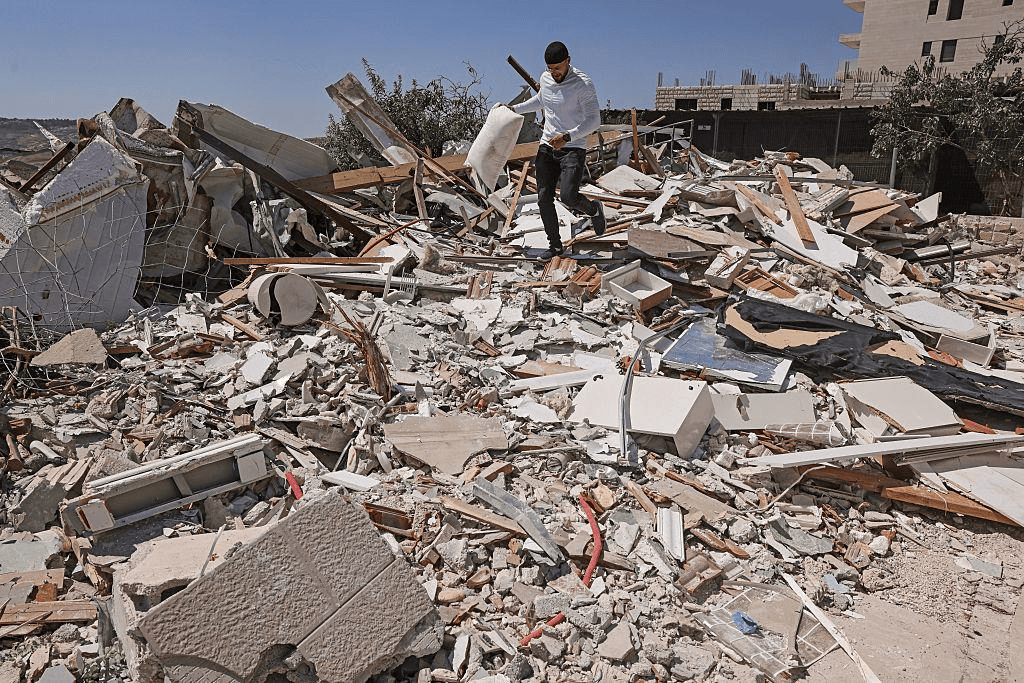
These developments coincide with data issued by the Palestinian information center "Mu'taa", which documented 11,620 demolition and destruction operations targeting Palestinian homes and property in the West Bank, including occupied Jerusalem, during the period from 7 October 2023 to 7 October 2026.
According to the center, the documented cases were distributed among 2,143 home demolition operations and 9,477 operations destroying other Palestinian property.
The damage covered by these statistics includes, in addition to homes, facilities and property linked to the livelihoods of Palestinians, including agricultural and commercial facilities.
It is important to distinguish between the number of recorded demolition and destruction operations and the number of homes demolished. The total of 11,620 does not mean that the same number of residential units were demolished; it includes different categories of property.
According to the data, the governorate of Tulkarm recorded the highest toll, with 1,784 operations, followed by Hebron with 1,634, then Nablus with 1,620.
Ramallah came next with 1,470, then occupied Jerusalem with 1,299, and Jenin with 1,230.
In the remaining governorates, the center documented 626 operations in Bethlehem, 550 in Salfit, 546 in Tubas, 461 in Qalqilya and 400 in Jericho.
This geographic distribution shows that demolition and destruction operations were not limited to areas near settlements or threatened Jerusalem neighbourhoods, but extended to the various governorates of the West Bank, reflecting the breadth of their impact on residents and property.
Escalation of demolitions year after year
Mu'taa's data show a notable rise in the pace of demolition and destruction operations during the period covered by the monitoring.
A total of 734 operations were recorded from 7 October until the end of 2023.
The toll rose to 3,322 operations during 2024, before reaching 4,579 operations in 2025, which witnessed the highest full-year toll within the period covered by the report.
From the beginning of 2026 until 7 October, the center recorded a further 2,985 operations.
These figures indicate that demolition and destruction operations have become more widespread compared with the beginning of the period covered by the report, although the difference in the length of the time periods calls for caution when directly comparing the tolls of the final months of 2023 with the subsequent full years.
The repercussions are not limited to the loss of housing. The destruction of agricultural and commercial facilities and service establishments leads to the loss of income sources, weakens families' ability to remain in their areas, and raises the costs of rebuilding or relocating elsewhere.
Why do Palestinians demolish their homes with their own hands?
"Self-demolition" operations are among the most prominent practices faced by Palestinians in occupied East Jerusalem.
The Israeli authorities issue demolition orders for homes and facilities built without Israeli building permits, but human rights and UN organisations affirm that the planning and building system makes obtaining these permits extremely difficult for Palestinians.
In a report published by Human Rights Watch in June 2026, the organisation explained that Palestinians in East Jerusalem and Area C of the West Bank face severe restrictions on construction, and that obtaining Israeli permits is almost impossible in many cases.
The organisation cited testimonies from Palestinian families who sought to obtain permits, and enlisted lawyers and engineers, but were unable to meet the requirements imposed by the Israeli authorities.
On the other hand, Palestinians continue to face the need for new housing as their families grow, which pushes some of them to build without obtaining the required permits, and they subsequently become exposed to fines, legal proceedings and demolition orders.
When the implementation of a decision becomes imminent, a family may be compelled to demolish the home itself to avoid bearing additional costs imposed by the municipality.
Self-demolition differs from direct demolition by bulldozers in the manner of implementation, but it leads to the same outcome: the loss of the home and the displacement of its residents or their forced search for an alternative place to live.
The United Nations documents the spread of self-demolition in Jerusalem
Data from the United Nations Office for the Coordination of Humanitarian Affairs (OCHA) confirm that self-demolition represents a significant share of demolition operations in East Jerusalem.
According to a UN report issued in May 2026, the Israeli authorities demolished, or owners were compelled to demolish, 98 Palestinian structures in East Jerusalem from the beginning of the year until 27 April, leading to the displacement of more than 230 people, including around 100 children.
Among these structures, 55 were residential homes, while 53 demolition operations were carried out by the owners themselves.
The office noted that Israeli planning authorities impose severe restrictions on Palestinian construction in East Jerusalem and Area C, and that the number of people displaced by demolitions linked to the lack of permits had risen notably.
In another report issued in August 2026, the office explained that some 170 Palestinian structures had been demolished in East Jerusalem since the beginning of the year for lack of Israeli building permits, in addition to around 700 structures in Area C.
These findings reinforce concerns about the continued loss by Palestinians of their homes and essential facilities, given their limited legal and financial options for avoiding demolition.
Demolition and displacement amid settlement expansion
Demolition operations are not separate from the reality of Israeli control over occupied Palestinian territory, particularly in East Jerusalem and Area C, which are under full Israeli control.
While the establishment and expansion of settlements continue, Palestinian communities face restrictions on planning, construction and land use, limiting their capacity for natural growth and for meeting the needs of residents.
In Jerusalem specifically, demolition operations intersect with issues of eviction, the seizure of properties and the activity of settler associations, especially in neighbourhoods such as Silwan.
In its report issued in June 2026, Human Rights Watch warned of the escalation of demolitions and evictions in East Jerusalem and their impact on the Palestinian presence in the city.
The United Nations also affirms that the destruction of property in occupied territories is subject to strict limits under international humanitarian law, which prohibits the occupying power from destroying private property except where absolutely necessitated by military operations.
The United Nations and the international community, according to the adopted resolutions and legal positions, consider Israeli settlements in occupied Palestinian territory to be in violation of international law.
In this context, the effects of demolition are not limited to the loss of buildings, but also include weakening the residential and economic stability of Palestinian families and increasing the likelihood of their displacement from the areas where they live.
From the loss of a home to a threat to community stability
The case of Fadl al-Rajabi represents a model of the direct repercussions of these policies on Palestinian families.
A home that had stood since 2010, in which a family of seven lived, ended up being demolished by its owner, after the alternative became bearing the costs of its demolition by the Israeli authorities.
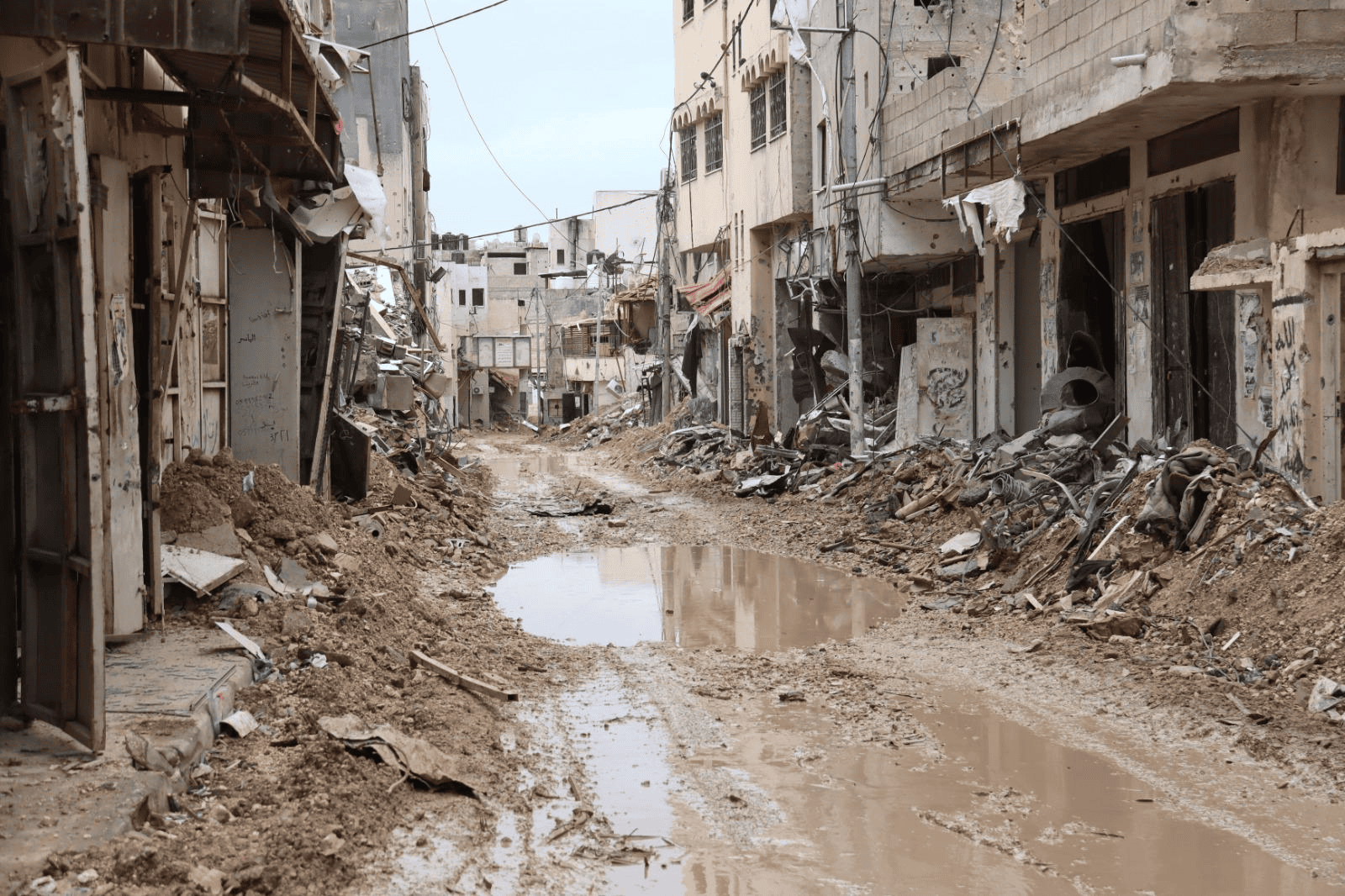
At the same time, the statistics documented by Mu'taa reveal that the loss of homes and property extends on a wide scale across the West Bank, with thousands of operations recorded over the past three years.
These events become more serious when they include facilities on which residents depend for their livelihoods, as families lose not only their shelter but may also lose the means of supporting themselves and their capacity to rebuild their lives.
Thus, the demolition of a home in Beit Hanina is not merely an administrative procedure related to a building permit, but part of a broader reality in which thousands of Palestinian properties are subject to demolition and destruction, and in which families face mounting pressure to remain on their land and in their homes.
As demolition operations continue in Jerusalem and across the various governorates of the West Bank, the toll of 11,620 operations over three years raises questions about the future of Palestinian residential and economic stability, amid the continued Israeli restrictions on construction and settlement expansion in the occupied territories.
Sources and references
- Palestine Chronicle, report "Palestinian forced to demolish Jerusalem home as property demolition and destruction tops 11,600", 11 October 2026.
- Palestinian information center "Mu'taa", statistics on demolition and destruction of property in the West Bank, from 7 October 2023 to 7 October 2026.
- Wattan News Agency, "Occupation bulldozers demolish 3 homes in Beit Hanina, Jerusalem", 11 October 2026.
- Human Rights Watch, "East Jerusalem: Israel Escalating Home Demolitions and Evictions", 17 June 2026.
- United Nations Office for the Coordination of Humanitarian Affairs (OCHA), humanitarian situation reports on the occupied Palestinian territory, 1 May and 7 August 2026.


